| Record Information |
|---|
| Version | 2.0 |
|---|
| Created at | 2022-04-28 13:05:18 UTC |
|---|
| Updated at | 2022-04-28 13:05:18 UTC |
|---|
| NP-MRD ID | NP0068080 |
|---|
| Secondary Accession Numbers | None |
|---|
| Natural Product Identification |
|---|
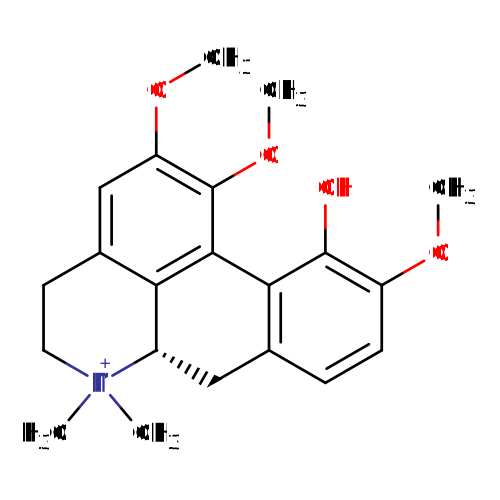
| Common Name | (+)-Menisperine |
|---|
| Description | Menisperine belongs to the class of organic compounds known as aporphines. These are quinoline alkaloids containing the dibenzo[de,g]quinoline ring system or a dehydrogenated derivative thereof. (+)-Menisperine is found in Corydalis decumbens , Dicranostigma franchetianum, Fagara coca, Magnolia grandiflora, Menispermum dauricum , Nandina domestica , Penianthus zenkeri, Penianthus zenkeri Engl & Diels, Phellodendron amurense , Rhigiocarya racemifera Miers, Stephania cepharantha , Tinospora capillipes Gagnep., Xylopia parviflora , Zanthoxylum nitidum and Zanthoxylum piperitum . (+)-Menisperine was first documented in 2017 (PMID: 28975733). Based on a literature review a small amount of articles have been published on Menisperine (PMID: 33992976) (PMID: 31202880) (PMID: 30738242) (PMID: 29124775). |
|---|
| Structure | COC1=CC=C2C[C@H]3C4=C(C(OC)=C(OC)C=C4CC[N+]3(C)C)C2=C1O InChI=1S/C21H25NO4/c1-22(2)9-8-13-11-16(25-4)21(26-5)19-17(13)14(22)10-12-6-7-15(24-3)20(23)18(12)19/h6-7,11,14H,8-10H2,1-5H3/p+1/t14-/m0/s1 |
|---|
| Synonyms | | Value | Source |
|---|
| Isocorydine methochloride | MeSH | | Menisperine chloride, (S)-isomer | MeSH | | Menisperine iodide, (S)-isomer | MeSH |
|
|---|
| Chemical Formula | C21H26NO4 |
|---|
| Average Mass | 356.4410 Da |
|---|
| Monoisotopic Mass | 356.18563 Da |
|---|
| IUPAC Name | (9S)-3-hydroxy-4,15,16-trimethoxy-10,10-dimethyl-10-azatetracyclo[7.7.1.0^{2,7}.0^{13,17}]heptadeca-1(17),2,4,6,13,15-hexaen-10-ium |
|---|
| Traditional Name | (9S)-3-hydroxy-4,15,16-trimethoxy-10,10-dimethyl-10-azatetracyclo[7.7.1.0^{2,7}.0^{13,17}]heptadeca-1(17),2,4,6,13,15-hexaen-10-ium |
|---|
| CAS Registry Number | Not Available |
|---|
| SMILES | COC1=CC=C2C[C@H]3C4=C(C(OC)=C(OC)C=C4CC[N+]3(C)C)C2=C1O |
|---|
| InChI Identifier | InChI=1S/C21H25NO4/c1-22(2)9-8-13-11-16(25-4)21(26-5)19-17(13)14(22)10-12-6-7-15(24-3)20(23)18(12)19/h6-7,11,14H,8-10H2,1-5H3/p+1/t14-/m0/s1 |
|---|
| InChI Key | XQINTCORIZHGFD-AWEZNQCLSA-O |
|---|
| Experimental Spectra |
|---|
|
| Not Available | | Predicted Spectra |
|---|
|
| | Spectrum Type | Description | Depositor ID | Depositor Organization | Depositor | Deposition Date | View |
|---|
| 1D NMR | 13C NMR Spectrum (1D, 25 MHz, D2O, predicted) | Wishart Lab | Wishart Lab | David Wishart | 2021-06-20 | View Spectrum | | 1D NMR | 1H NMR Spectrum (1D, 100 MHz, D2O, predicted) | Wishart Lab | Wishart Lab | David Wishart | 2021-06-20 | View Spectrum | | 1D NMR | 13C NMR Spectrum (1D, 252 MHz, D2O, predicted) | Wishart Lab | Wishart Lab | David Wishart | 2021-06-20 | View Spectrum | | 1D NMR | 1H NMR Spectrum (1D, 1000 MHz, D2O, predicted) | Wishart Lab | Wishart Lab | David Wishart | 2021-06-20 | View Spectrum | | 1D NMR | 13C NMR Spectrum (1D, 50 MHz, D2O, predicted) | Wishart Lab | Wishart Lab | David Wishart | 2021-06-20 | View Spectrum | | 1D NMR | 1H NMR Spectrum (1D, 200 MHz, D2O, predicted) | Wishart Lab | Wishart Lab | David Wishart | 2021-06-20 | View Spectrum | | 1D NMR | 13C NMR Spectrum (1D, 75 MHz, D2O, predicted) | Wishart Lab | Wishart Lab | David Wishart | 2021-06-20 | View Spectrum | | 1D NMR | 1H NMR Spectrum (1D, 300 MHz, D2O, predicted) | Wishart Lab | Wishart Lab | David Wishart | 2021-06-20 | View Spectrum | | 1D NMR | 13C NMR Spectrum (1D, 101 MHz, D2O, predicted) | Wishart Lab | Wishart Lab | David Wishart | 2021-06-20 | View Spectrum | | 1D NMR | 1H NMR Spectrum (1D, 400 MHz, D2O, predicted) | Wishart Lab | Wishart Lab | David Wishart | 2021-06-20 | View Spectrum | | 1D NMR | 13C NMR Spectrum (1D, 126 MHz, D2O, predicted) | Wishart Lab | Wishart Lab | David Wishart | 2021-06-20 | View Spectrum | | 1D NMR | 1H NMR Spectrum (1D, 500 MHz, D2O, predicted) | Wishart Lab | Wishart Lab | David Wishart | 2021-06-20 | View Spectrum | | 1D NMR | 13C NMR Spectrum (1D, 151 MHz, D2O, predicted) | Wishart Lab | Wishart Lab | David Wishart | 2021-06-20 | View Spectrum | | 1D NMR | 1H NMR Spectrum (1D, 600 MHz, D2O, predicted) | Wishart Lab | Wishart Lab | David Wishart | 2021-06-20 | View Spectrum | | 1D NMR | 13C NMR Spectrum (1D, 176 MHz, D2O, predicted) | Wishart Lab | Wishart Lab | David Wishart | 2021-06-20 | View Spectrum | | 1D NMR | 1H NMR Spectrum (1D, 700 MHz, D2O, predicted) | Wishart Lab | Wishart Lab | David Wishart | 2021-06-20 | View Spectrum | | 1D NMR | 13C NMR Spectrum (1D, 201 MHz, D2O, predicted) | Wishart Lab | Wishart Lab | David Wishart | 2021-06-20 | View Spectrum | | 1D NMR | 1H NMR Spectrum (1D, 800 MHz, D2O, predicted) | Wishart Lab | Wishart Lab | David Wishart | 2021-06-20 | View Spectrum | | 1D NMR | 13C NMR Spectrum (1D, 226 MHz, D2O, predicted) | Wishart Lab | Wishart Lab | David Wishart | 2021-06-20 | View Spectrum | | 1D NMR | 1H NMR Spectrum (1D, 900 MHz, D2O, predicted) | Wishart Lab | Wishart Lab | David Wishart | 2021-06-20 | View Spectrum |
| | Chemical Shift Submissions |
|---|
|
| Not Available | | Species |
|---|
| Species of Origin | |
|---|
| Chemical Taxonomy |
|---|
| Description | Belongs to the class of organic compounds known as aporphines. These are quinoline alkaloids containing the dibenzo[de,g]quinoline ring system or a dehydrogenated derivative thereof. |
|---|
| Kingdom | Organic compounds |
|---|
| Super Class | Alkaloids and derivatives |
|---|
| Class | Aporphines |
|---|
| Sub Class | Not Available |
|---|
| Direct Parent | Aporphines |
|---|
| Alternative Parents | |
|---|
| Substituents | - Aporphine
- Benzoquinoline
- Phenanthrene
- 1-naphthol
- Naphthalene
- Quinoline
- Tetrahydroisoquinoline
- Anisole
- Alkyl aryl ether
- 1-hydroxy-4-unsubstituted benzenoid
- Aralkylamine
- Benzenoid
- Quaternary ammonium salt
- Tetraalkylammonium salt
- Azacycle
- Ether
- Organoheterocyclic compound
- Organic nitrogen compound
- Hydrocarbon derivative
- Organooxygen compound
- Organonitrogen compound
- Organopnictogen compound
- Organic oxygen compound
- Amine
- Organic salt
- Organic cation
- Aromatic heteropolycyclic compound
|
|---|
| Molecular Framework | Aromatic heteropolycyclic compounds |
|---|
| External Descriptors | Not Available |
|---|
| Physical Properties |
|---|
| State | Not Available |
|---|
| Experimental Properties | | Property | Value | Reference |
|---|
| Melting Point | Not Available | Not Available | | Boiling Point | Not Available | Not Available | | Water Solubility | Not Available | Not Available | | LogP | Not Available | Not Available |
|
|---|
| Predicted Properties | |
|---|
| General References | - He L, Jiang H, Lan T, Qiu Y, Yang K, Chen K, Yao X, Yao Z, Lu W: Chemical profile and potential mechanisms of Huo-Tan-Chu-Shi decoction in the treatment of coronary heart disease by UHPLC-Q/TOF-MS in combination with network pharmacology analysis and experimental verification. J Chromatogr B Analyt Technol Biomed Life Sci. 2021 Jun 15;1175:122729. doi: 10.1016/j.jchromb.2021.122729. Epub 2021 Apr 20. [PubMed:33992976 ]
- Jiang ZM, Wang LJ, Pang HQ, Guo Y, Xiao PT, Chu C, Guo L, Liu EH: Rapid profiling of alkaloid analogues in Sinomenii Caulis by an integrated characterization strategy and quantitative analysis. J Pharm Biomed Anal. 2019 Sep 10;174:376-385. doi: 10.1016/j.jpba.2019.06.011. Epub 2019 Jun 7. [PubMed:31202880 ]
- Wang LJ, Jiang ZM, Xiao PT, Sun JB, Bi ZM, Liu EH: Identification of anti-inflammatory components in Sinomenii Caulis based on spectrum-effect relationship and chemometric methods. J Pharm Biomed Anal. 2019 Apr 15;167:38-48. doi: 10.1016/j.jpba.2019.01.047. Epub 2019 Jan 30. [PubMed:30738242 ]
- Dabrowski D, Lech K, Jarosz M: Capillary-HPLC with tandem mass spectrometry in analysis of alkaloid dyestuffs - a new approach. Electrophoresis. 2018 May;39(9-10):1276-1283. doi: 10.1002/elps.201700349. Epub 2017 Dec 11. [PubMed:29124775 ]
- Liu Y, Zhou W, Mao Z, Liao X, Chen Z: Analysis of six active components in Radix tinosporae by nonaqueous capillary electrophoresis with mass spectrometry. J Sep Sci. 2017 Dec;40(23):4628-4635. doi: 10.1002/jssc.201700815. Epub 2017 Oct 30. [PubMed:28975733 ]
|
|---|