| Record Information |
|---|
| Version | 2.0 |
|---|
| Created at | 2022-04-28 12:45:52 UTC |
|---|
| Updated at | 2022-04-28 12:45:52 UTC |
|---|
| NP-MRD ID | NP0067922 |
|---|
| Secondary Accession Numbers | None |
|---|
| Natural Product Identification |
|---|
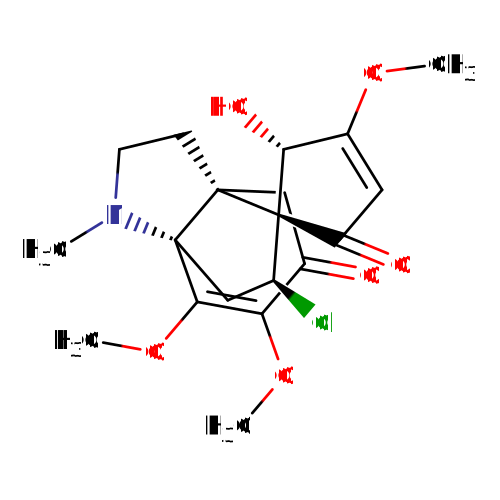
| Common Name | Acutumine |
|---|
| Description | Acutumine, also known as dauricumine, belongs to the class of organic compounds known as acutumine and related alkaloids. These are alkaloids with a structure based on the tricyclic acutumine skeleton, which contains an indoline moiety and two cyclopentene rings. Acutumine is found in Apis cerana, Hypserpa nitida, Menispermum dauricum, Menispermum dauricum DC. and Sinomenium acutum Rehder & Wilson . Acutumine was first documented in 2019 (PMID: 31022719). Based on a literature review a small amount of articles have been published on Acutumine (PMID: 33523640) (PMID: 32843671) (PMID: 35112449) (PMID: 32313070). |
|---|
| Structure | COC1=CC(=O)[C@]2([C@@H](Cl)C[C@]34N(C)CC[C@]23CC(=O)C(OC)=C4OC)[C@@H]1O InChI=1S/C19H24ClNO6/c1-21-6-5-17-8-10(22)14(26-3)16(27-4)18(17,21)9-12(20)19(17)13(23)7-11(25-2)15(19)24/h7,12,15,24H,5-6,8-9H2,1-4H3/t12-,15+,17+,18+,19+/m0/s1 |
|---|
| Synonyms | | Value | Source |
|---|
| Dauricumine | MeSH |
|
|---|
| Chemical Formula | C19H24ClNO6 |
|---|
| Average Mass | 397.8500 Da |
|---|
| Monoisotopic Mass | 397.12922 Da |
|---|
| IUPAC Name | (1R,1'S,5S,6'S,8'S)-8'-chloro-5-hydroxy-2',3',4-trimethoxy-10'-methyl-10'-azaspiro[cyclopentane-1,7'-tricyclo[4.3.3.0^{1,6}]dodecane]-2',3-diene-2,4'-dione |
|---|
| Traditional Name | (1R,1'S,5S,6'S,8'S)-8'-chloro-5-hydroxy-2',3',4-trimethoxy-10'-methyl-10'-azaspiro[cyclopentane-1,7'-tricyclo[4.3.3.0^{1,6}]dodecane]-2',3-diene-2,4'-dione |
|---|
| CAS Registry Number | Not Available |
|---|
| SMILES | COC1=CC(=O)[C@]2([C@@H](Cl)C[C@]34N(C)CC[C@]23CC(=O)C(OC)=C4OC)[C@@H]1O |
|---|
| InChI Identifier | InChI=1S/C19H24ClNO6/c1-21-6-5-17-8-10(22)14(26-3)16(27-4)18(17,21)9-12(20)19(17)13(23)7-11(25-2)15(19)24/h7,12,15,24H,5-6,8-9H2,1-4H3/t12-,15+,17+,18+,19+/m0/s1 |
|---|
| InChI Key | FSXRARBVZZKCGJ-FMAJMWNWSA-N |
|---|
| Experimental Spectra |
|---|
|
| Not Available | | Predicted Spectra |
|---|
|
| | Spectrum Type | Description | Depositor ID | Depositor Organization | Depositor | Deposition Date | View |
|---|
| 1D NMR | 13C NMR Spectrum (1D, 25 MHz, D2O, predicted) | Wishart Lab | Wishart Lab | David Wishart | 2021-06-20 | View Spectrum | | 1D NMR | 1H NMR Spectrum (1D, 100 MHz, D2O, predicted) | Wishart Lab | Wishart Lab | David Wishart | 2021-06-20 | View Spectrum | | 1D NMR | 13C NMR Spectrum (1D, 252 MHz, D2O, predicted) | Wishart Lab | Wishart Lab | David Wishart | 2021-06-20 | View Spectrum | | 1D NMR | 1H NMR Spectrum (1D, 1000 MHz, D2O, predicted) | Wishart Lab | Wishart Lab | David Wishart | 2021-06-20 | View Spectrum | | 1D NMR | 13C NMR Spectrum (1D, 50 MHz, D2O, predicted) | Wishart Lab | Wishart Lab | David Wishart | 2021-06-20 | View Spectrum | | 1D NMR | 1H NMR Spectrum (1D, 200 MHz, D2O, predicted) | Wishart Lab | Wishart Lab | David Wishart | 2021-06-20 | View Spectrum | | 1D NMR | 13C NMR Spectrum (1D, 75 MHz, D2O, predicted) | Wishart Lab | Wishart Lab | David Wishart | 2021-06-20 | View Spectrum | | 1D NMR | 1H NMR Spectrum (1D, 300 MHz, D2O, predicted) | Wishart Lab | Wishart Lab | David Wishart | 2021-06-20 | View Spectrum | | 1D NMR | 13C NMR Spectrum (1D, 101 MHz, D2O, predicted) | Wishart Lab | Wishart Lab | David Wishart | 2021-06-20 | View Spectrum | | 1D NMR | 1H NMR Spectrum (1D, 400 MHz, D2O, predicted) | Wishart Lab | Wishart Lab | David Wishart | 2021-06-20 | View Spectrum | | 1D NMR | 13C NMR Spectrum (1D, 126 MHz, D2O, predicted) | Wishart Lab | Wishart Lab | David Wishart | 2021-06-20 | View Spectrum | | 1D NMR | 1H NMR Spectrum (1D, 500 MHz, D2O, predicted) | Wishart Lab | Wishart Lab | David Wishart | 2021-06-20 | View Spectrum | | 1D NMR | 13C NMR Spectrum (1D, 151 MHz, D2O, predicted) | Wishart Lab | Wishart Lab | David Wishart | 2021-06-20 | View Spectrum | | 1D NMR | 1H NMR Spectrum (1D, 600 MHz, D2O, predicted) | Wishart Lab | Wishart Lab | David Wishart | 2021-06-20 | View Spectrum | | 1D NMR | 13C NMR Spectrum (1D, 176 MHz, D2O, predicted) | Wishart Lab | Wishart Lab | David Wishart | 2021-06-20 | View Spectrum | | 1D NMR | 1H NMR Spectrum (1D, 700 MHz, D2O, predicted) | Wishart Lab | Wishart Lab | David Wishart | 2021-06-20 | View Spectrum | | 1D NMR | 13C NMR Spectrum (1D, 201 MHz, D2O, predicted) | Wishart Lab | Wishart Lab | David Wishart | 2021-06-20 | View Spectrum | | 1D NMR | 1H NMR Spectrum (1D, 800 MHz, D2O, predicted) | Wishart Lab | Wishart Lab | David Wishart | 2021-06-20 | View Spectrum | | 1D NMR | 13C NMR Spectrum (1D, 226 MHz, D2O, predicted) | Wishart Lab | Wishart Lab | David Wishart | 2021-06-20 | View Spectrum | | 1D NMR | 1H NMR Spectrum (1D, 900 MHz, D2O, predicted) | Wishart Lab | Wishart Lab | David Wishart | 2021-06-20 | View Spectrum |
| | Chemical Shift Submissions |
|---|
|
| Not Available | | Species |
|---|
| Species of Origin | |
|---|
| Chemical Taxonomy |
|---|
| Description | Belongs to the class of organic compounds known as acutumine and related alkaloids. These are alkaloids with a structure based on the tricyclic acutumine skeleton, which contains an indoline moiety and two cyclopentene rings. |
|---|
| Kingdom | Organic compounds |
|---|
| Super Class | Alkaloids and derivatives |
|---|
| Class | Acutumine and related alkaloids |
|---|
| Sub Class | Not Available |
|---|
| Direct Parent | Acutumine and related alkaloids |
|---|
| Alternative Parents | |
|---|
| Substituents | - Acutumine skeketon
- Indole or derivatives
- Cyclohexenone
- N-alkylpyrrolidine
- Pyrrolidine
- Vinylogous ester
- Ketone
- Secondary alcohol
- Tertiary amine
- Tertiary aliphatic amine
- Cyclic ketone
- Azacycle
- Organoheterocyclic compound
- Alkyl chloride
- Alcohol
- Organopnictogen compound
- Organooxygen compound
- Organonitrogen compound
- Organochloride
- Organohalogen compound
- Organic nitrogen compound
- Organic oxygen compound
- Carbonyl group
- Amine
- Organic oxide
- Alkyl halide
- Hydrocarbon derivative
- Aliphatic heteropolycyclic compound
|
|---|
| Molecular Framework | Aliphatic heteropolycyclic compounds |
|---|
| External Descriptors | |
|---|
| Physical Properties |
|---|
| State | Not Available |
|---|
| Experimental Properties | | Property | Value | Reference |
|---|
| Melting Point | Not Available | Not Available | | Boiling Point | Not Available | Not Available | | Water Solubility | Not Available | Not Available | | LogP | Not Available | Not Available |
|
|---|
| Predicted Properties | |
|---|
| General References | - Hsu IT, Tomanik M, Herzon SB: Metric-Based Analysis of Convergence in Complex Molecule Synthesis. Acc Chem Res. 2021 Feb 16;54(4):903-916. doi: 10.1021/acs.accounts.0c00817. Epub 2021 Feb 1. [PubMed:33523640 ]
- Hu P, Chi HM, DeBacker KC, Gong X, Keim JH, Hsu IT, Snyder SA: Quaternary-centre-guided synthesis of complex polycyclic terpenes. Nature. 2019 May;569(7758):703-707. doi: 10.1038/s41586-019-1179-2. Epub 2019 Apr 25. [PubMed:31022719 ]
- Huang YF, He F, Wang CJ, Xie Y, Zhang YY, Sang Z, Qiu P, Luo P, Xiao SY, Li J, Wu FC, Liu L, Zhou H: Discovery of chemical markers for improving the quality and safety control of Sinomenium acutum stem by the simultaneous determination of multiple alkaloids using UHPLC-QQQ-MS/MS. Sci Rep. 2020 Aug 25;10(1):14182. doi: 10.1038/s41598-020-71133-4. [PubMed:32843671 ]
- Grunenfelder DC, Navarro R, Wang H, Fastuca NJ, Butler JR, Reisman SE: Enantioselective Synthesis of (-)-10-Hydroxyacutuminine. Angew Chem Int Ed Engl. 2022 Apr 11;61(16):e202117480. doi: 10.1002/anie.202117480. Epub 2022 Feb 23. [PubMed:35112449 ]
- Kim CY, Mitchell AJ, Glinkerman CM, Li FS, Pluskal T, Weng JK: The chloroalkaloid (-)-acutumine is biosynthesized via a Fe(II)- and 2-oxoglutarate-dependent halogenase in Menispermaceae plants. Nat Commun. 2020 Apr 20;11(1):1867. doi: 10.1038/s41467-020-15777-w. [PubMed:32313070 ]
|
|---|