| Record Information |
|---|
| Version | 2.0 |
|---|
| Created at | 2022-04-28 12:17:33 UTC |
|---|
| Updated at | 2024-09-12 20:39:11 UTC |
|---|
| NP-MRD ID | NP0067434 |
|---|
| Secondary Accession Numbers | None |
|---|
| Natural Product Identification |
|---|
| Common Name | 3-Isopaynantheine |
|---|
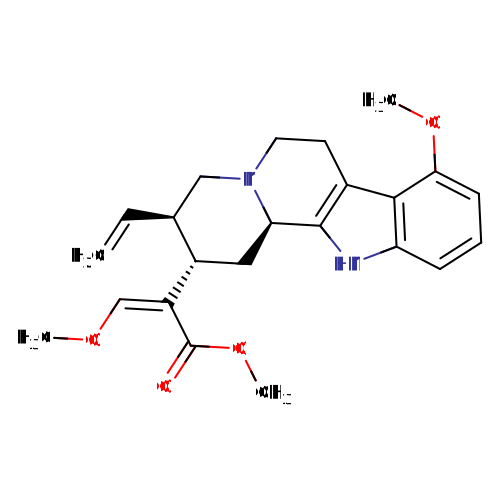
| Description | 3-Isopaynantheine belongs to the class of organic compounds known as corynanthean-type alkaloids. These are alkaloids with a structure based on the corynanthean nucleus, which is a tetracycle characterized by an indole fused to a quinolizidine. Additionally, the quinolizidine ring system is substituted to a 2-methylpropyl group and one ethyl group. 3-Isopaynantheine is found in Mitragyna hirsuta, Mitragyna speciosa and Mitragyna speciosa Korth.. 3-Isopaynantheine was first documented in 2013 (PMID: 24169379). Based on a literature review very few articles have been published on 3-Isopaynantheine (PMID: 24659356). |
|---|
| Structure | [H]C([H])=C([H])[C@@]1([H])C([H])([H])N2C([H])([H])C([H])([H])C3=C(N([H])C4=C([H])C([H])=C([H])C(OC([H])([H])[H])=C34)[C@@]2([H])C([H])([H])[C@]1([H])C(=C([H])OC([H])([H])[H])C(=O)OC([H])([H])[H] InChI=1/C23H28N2O4/c1-5-14-12-25-10-9-15-21-18(7-6-8-20(21)28-3)24-22(15)19(25)11-16(14)17(13-27-2)23(26)29-4/h5-8,13-14,16,19,24H,1,9-12H2,2-4H3/b17-13-/t14-,16-,19+/s2 |
|---|
| Synonyms | Not Available |
|---|
| Chemical Formula | C23H28N2O4 |
|---|
| Average Mass | 396.4870 Da |
|---|
| Monoisotopic Mass | 396.20491 Da |
|---|
| IUPAC Name | methyl 2-[(2S,3R,12bR)-3-ethenyl-8-methoxy-1H,2H,3H,4H,6H,7H,12H,12bH-indolo[2,3-a]quinolizin-2-yl]-3-methoxyprop-2-enoate |
|---|
| Traditional Name | methyl 2-[(2S,3R,12bR)-3-ethenyl-8-methoxy-1H,2H,3H,4H,6H,7H,12H,12bH-indolo[2,3-a]quinolizin-2-yl]-3-methoxyprop-2-enoate |
|---|
| CAS Registry Number | Not Available |
|---|
| SMILES | [H]C([H])=C([H])[C@@]1([H])C([H])([H])N2C([H])([H])C([H])([H])C3=C(N([H])C4=C([H])C([H])=C([H])C(OC([H])([H])[H])=C34)[C@@]2([H])C([H])([H])[C@]1([H])C(=C([H])OC([H])([H])[H])C(=O)OC([H])([H])[H] |
|---|
| InChI Identifier | InChI=1/C23H28N2O4/c1-5-14-12-25-10-9-15-21-18(7-6-8-20(21)28-3)24-22(15)19(25)11-16(14)17(13-27-2)23(26)29-4/h5-8,13-14,16,19,24H,1,9-12H2,2-4H3/b17-13-/t14-,16-,19+/s2 |
|---|
| InChI Key | JGZKIGWXPPFMRG-JBUZHXCTNA-N |
|---|
| Experimental Spectra |
|---|
|
| Not Available | | Predicted Spectra |
|---|
|
| Not Available | | Chemical Shift Submissions |
|---|
|
| Not Available | | Species |
|---|
| Species of Origin | |
|---|
| Chemical Taxonomy |
|---|
| Description | This compound belongs to the class of organic compounds known as corynanthean-type alkaloids. These are alkaloids with a structure based on the corynanthean nucleus, which is a tetracycle characterized by an indole fused to a quinolizidine. Additionally, the quinolizidine ring system is substituted to a 2-methylpropyl group and one ethyl group. |
|---|
| Kingdom | Organic compounds |
|---|
| Super Class | Alkaloids and derivatives |
|---|
| Class | Corynanthean-type alkaloids |
|---|
| Sub Class | Not Available |
|---|
| Direct Parent | Corynanthean-type alkaloids |
|---|
| Alternative Parents | |
|---|
| Substituents | - Corynanthean skeleton
- Pyridoindole
- Beta-carboline
- 3-alkylindole
- Quinolizine
- Indole or derivatives
- Indole
- Anisole
- Aralkylamine
- Alkyl aryl ether
- Benzenoid
- Piperidine
- Heteroaromatic compound
- Vinylogous ester
- Alpha,beta-unsaturated carboxylic ester
- Enoate ester
- Methyl ester
- Pyrrole
- Tertiary aliphatic amine
- Tertiary amine
- Carboxylic acid ester
- Amino acid or derivatives
- Azacycle
- Organoheterocyclic compound
- Monocarboxylic acid or derivatives
- Ether
- Carboxylic acid derivative
- Organic nitrogen compound
- Organic oxygen compound
- Organopnictogen compound
- Organic oxide
- Hydrocarbon derivative
- Organooxygen compound
- Organonitrogen compound
- Carbonyl group
- Amine
- Aromatic heteropolycyclic compound
|
|---|
| Molecular Framework | Aromatic heteropolycyclic compounds |
|---|
| External Descriptors | Not Available |
|---|
| Physical Properties |
|---|
| State | Not Available |
|---|
| Experimental Properties | | Property | Value | Reference |
|---|
| Melting Point | Not Available | Not Available | | Boiling Point | Not Available | Not Available | | Water Solubility | Not Available | Not Available | | LogP | Not Available | Not Available |
|
|---|
| Predicted Properties | |
|---|
| General References | - Cao XF, Wang JS, Wang XB, Luo J, Wang HY, Kong LY: Monoterpene indole alkaloids from the stem bark of Mitragyna diversifolia and their acetylcholine esterase inhibitory effects. Phytochemistry. 2013 Dec;96:389-96. doi: 10.1016/j.phytochem.2013.10.002. Epub 2013 Oct 26. [PubMed:24169379 ]
- Wang M, Carrell EJ, Ali Z, Avula B, Avonto C, Parcher JF, Khan IA: Comparison of three chromatographic techniques for the detection of mitragynine and other indole and oxindole alkaloids in Mitragyna speciosa (kratom) plants. J Sep Sci. 2014 Jun;37(12):1411-8. doi: 10.1002/jssc.201301389. Epub 2014 Apr 25. [PubMed:24659356 ]
|
|---|