| Record Information |
|---|
| Version | 2.0 |
|---|
| Created at | 2022-04-28 09:27:31 UTC |
|---|
| Updated at | 2022-04-28 09:27:32 UTC |
|---|
| NP-MRD ID | NP0065206 |
|---|
| Secondary Accession Numbers | None |
|---|
| Natural Product Identification |
|---|
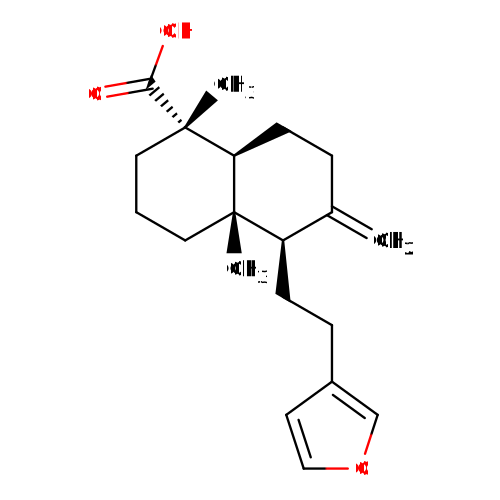
| Common Name | Polyalthic acid |
|---|
| Description | Polyalthic acid, also known as polyalthate, belongs to the class of organic compounds known as colensane and clerodane diterpenoids. These are diterpenoids with a structure based on the clerodane or the colensane skeleton. Clerodanes arise from labdanes by two methyl migrations. Polyalthic acid is found in Asanthus solidaginifolius, Brickellia lemmonii, Copaifera duckei, Copaifera paupera, Acanthostyles buniifolius, Gutierrezia sarothrae, Polyalthia fragrans, Potamogeton lucens and Ricinocarpus stylosus. Polyalthic acid was first documented in 2020 (PMID: 32431465). Based on a literature review a small amount of articles have been published on Polyalthic acid (PMID: 34510530) (PMID: 34069033) (PMID: 32035325) (PMID: 31918399). |
|---|
| Structure | C[C@@]12CCC[C@@](C)([C@H]1CCC(=C)[C@H]2CCC1=COC=C1)C(O)=O InChI=1S/C20H28O3/c1-14-5-8-17-19(2,10-4-11-20(17,3)18(21)22)16(14)7-6-15-9-12-23-13-15/h9,12-13,16-17H,1,4-8,10-11H2,2-3H3,(H,21,22)/t16-,17+,19+,20+/m1/s1 |
|---|
| Synonyms | | Value | Source |
|---|
| Polyalthate | Generator |
|
|---|
| Chemical Formula | C20H28O3 |
|---|
| Average Mass | 316.4410 Da |
|---|
| Monoisotopic Mass | 316.20384 Da |
|---|
| IUPAC Name | (1S,4aS,5R,8aS)-5-[2-(furan-3-yl)ethyl]-1,4a-dimethyl-6-methylidene-decahydronaphthalene-1-carboxylic acid |
|---|
| Traditional Name | (1S,4aS,5R,8aS)-5-[2-(furan-3-yl)ethyl]-1,4a-dimethyl-6-methylidene-hexahydro-2H-naphthalene-1-carboxylic acid |
|---|
| CAS Registry Number | Not Available |
|---|
| SMILES | C[C@@]12CCC[C@@](C)([C@H]1CCC(=C)[C@H]2CCC1=COC=C1)C(O)=O |
|---|
| InChI Identifier | InChI=1S/C20H28O3/c1-14-5-8-17-19(2,10-4-11-20(17,3)18(21)22)16(14)7-6-15-9-12-23-13-15/h9,12-13,16-17H,1,4-8,10-11H2,2-3H3,(H,21,22)/t16-,17+,19+,20+/m1/s1 |
|---|
| InChI Key | ZQHJXKYYELWEOK-UMGGQSCQSA-N |
|---|
| Experimental Spectra |
|---|
|
| Not Available | | Predicted Spectra |
|---|
|
| | Spectrum Type | Description | Depositor ID | Depositor Organization | Depositor | Deposition Date | View |
|---|
| 1D NMR | 13C NMR Spectrum (1D, 25 MHz, D2O, predicted) | Wishart Lab | Wishart Lab | David Wishart | 2021-06-20 | View Spectrum | | 1D NMR | 1H NMR Spectrum (1D, 100 MHz, D2O, predicted) | Wishart Lab | Wishart Lab | David Wishart | 2021-06-20 | View Spectrum | | 1D NMR | 13C NMR Spectrum (1D, 252 MHz, D2O, predicted) | Wishart Lab | Wishart Lab | David Wishart | 2021-06-20 | View Spectrum | | 1D NMR | 1H NMR Spectrum (1D, 1000 MHz, D2O, predicted) | Wishart Lab | Wishart Lab | David Wishart | 2021-06-20 | View Spectrum | | 1D NMR | 13C NMR Spectrum (1D, 50 MHz, D2O, predicted) | Wishart Lab | Wishart Lab | David Wishart | 2021-06-20 | View Spectrum | | 1D NMR | 1H NMR Spectrum (1D, 200 MHz, D2O, predicted) | Wishart Lab | Wishart Lab | David Wishart | 2021-06-20 | View Spectrum | | 1D NMR | 13C NMR Spectrum (1D, 75 MHz, D2O, predicted) | Wishart Lab | Wishart Lab | David Wishart | 2021-06-20 | View Spectrum | | 1D NMR | 1H NMR Spectrum (1D, 300 MHz, D2O, predicted) | Wishart Lab | Wishart Lab | David Wishart | 2021-06-20 | View Spectrum | | 1D NMR | 13C NMR Spectrum (1D, 101 MHz, D2O, predicted) | Wishart Lab | Wishart Lab | David Wishart | 2021-06-20 | View Spectrum | | 1D NMR | 1H NMR Spectrum (1D, 400 MHz, D2O, predicted) | Wishart Lab | Wishart Lab | David Wishart | 2021-06-20 | View Spectrum | | 1D NMR | 13C NMR Spectrum (1D, 126 MHz, D2O, predicted) | Wishart Lab | Wishart Lab | David Wishart | 2021-06-20 | View Spectrum | | 1D NMR | 1H NMR Spectrum (1D, 500 MHz, D2O, predicted) | Wishart Lab | Wishart Lab | David Wishart | 2021-06-20 | View Spectrum | | 1D NMR | 13C NMR Spectrum (1D, 151 MHz, D2O, predicted) | Wishart Lab | Wishart Lab | David Wishart | 2021-06-20 | View Spectrum | | 1D NMR | 1H NMR Spectrum (1D, 600 MHz, D2O, predicted) | Wishart Lab | Wishart Lab | David Wishart | 2021-06-20 | View Spectrum | | 1D NMR | 13C NMR Spectrum (1D, 176 MHz, D2O, predicted) | Wishart Lab | Wishart Lab | David Wishart | 2021-06-20 | View Spectrum | | 1D NMR | 1H NMR Spectrum (1D, 700 MHz, D2O, predicted) | Wishart Lab | Wishart Lab | David Wishart | 2021-06-20 | View Spectrum | | 1D NMR | 13C NMR Spectrum (1D, 201 MHz, D2O, predicted) | Wishart Lab | Wishart Lab | David Wishart | 2021-06-20 | View Spectrum | | 1D NMR | 1H NMR Spectrum (1D, 800 MHz, D2O, predicted) | Wishart Lab | Wishart Lab | David Wishart | 2021-06-20 | View Spectrum | | 1D NMR | 13C NMR Spectrum (1D, 226 MHz, D2O, predicted) | Wishart Lab | Wishart Lab | David Wishart | 2021-06-20 | View Spectrum | | 1D NMR | 1H NMR Spectrum (1D, 900 MHz, D2O, predicted) | Wishart Lab | Wishart Lab | David Wishart | 2021-06-20 | View Spectrum |
| | Chemical Shift Submissions |
|---|
|
| Not Available | | Species |
|---|
| Species of Origin | |
|---|
| Chemical Taxonomy |
|---|
| Description | Belongs to the class of organic compounds known as colensane and clerodane diterpenoids. These are diterpenoids with a structure based on the clerodane or the colensane skeleton. Clerodanes arise from labdanes by two methyl migrations. |
|---|
| Kingdom | Organic compounds |
|---|
| Super Class | Lipids and lipid-like molecules |
|---|
| Class | Prenol lipids |
|---|
| Sub Class | Diterpenoids |
|---|
| Direct Parent | Colensane and clerodane diterpenoids |
|---|
| Alternative Parents | |
|---|
| Substituents | - Clerodane diterpenoid
- Heteroaromatic compound
- Furan
- Oxacycle
- Organoheterocyclic compound
- Monocarboxylic acid or derivatives
- Carboxylic acid
- Carboxylic acid derivative
- Organic oxygen compound
- Organic oxide
- Hydrocarbon derivative
- Organooxygen compound
- Carbonyl group
- Aromatic heteropolycyclic compound
|
|---|
| Molecular Framework | Aromatic heteropolycyclic compounds |
|---|
| External Descriptors | Not Available |
|---|
| Physical Properties |
|---|
| State | Not Available |
|---|
| Experimental Properties | | Property | Value | Reference |
|---|
| Melting Point | Not Available | Not Available | | Boiling Point | Not Available | Not Available | | Water Solubility | Not Available | Not Available | | LogP | Not Available | Not Available |
|
|---|
| Predicted Properties | |
|---|
| General References | - Kovatch PY, Ferreira AE, Ghizonni GML, Ambrosio SR, Crotti AEM, Heleno VCG: Detailed (1) H and (13) C NMR structural assignment of ent-polyalthic acid, a biologically active labdane diterpene. Magn Reson Chem. 2022 Feb;60(2):255-260. doi: 10.1002/mrc.5217. Epub 2021 Sep 20. [PubMed:34510530 ]
- Rodriguez-Silverio J, Sanchez-Mendoza ME, Rocha-Gonzalez HI, Reyes-Garcia JG, Flores-Murrieta FJ, Lopez-Lorenzo Y, Quinonez-Bastidas GN, Arrieta J: Evaluation of the Antinociceptive, Antiallodynic, Antihyperalgesic and Anti-Inflammatory Effect of Polyalthic Acid. Molecules. 2021 May 14;26(10). pii: molecules26102921. doi: 10.3390/molecules26102921. [PubMed:34069033 ]
- Cicek SS, Wenzel-Storjohann A, Girreser U, Tasdemir D: Biological Activities of Two Major Copaiba Diterpenoids and Their Semi-synthetic Derivatives. Rev Bras Farmacogn. 2020;30(1):18-27. doi: 10.1007/s43450-020-00002-y. Epub 2020 Feb 21. [PubMed:32431465 ]
- Tang T, Li CH, Li DS, Jing SX, Hua J, Luo SH, Liu Y, Li SH: Peltate glandular trichomes of Colquhounia vestita harbor diterpenoid acids that contribute to plant adaptation to UV radiation and cold stresses. Phytochemistry. 2020 Apr;172:112285. doi: 10.1016/j.phytochem.2020.112285. Epub 2020 Feb 5. [PubMed:32035325 ]
- Pontes de Sousa I, Ferreira AG, Miller Crotti AE, Alves Dos Santos R, Kiermaier J, Kraus B, Heilmann J, Jacometti Cardoso Furtado NA: New antifungal ent-labdane diterpenes against Candida glabrata produced by microbial transformation of ent-polyalthic acid. Bioorg Chem. 2020 Jan;95:103560. doi: 10.1016/j.bioorg.2019.103560. Epub 2019 Dec 28. [PubMed:31918399 ]
|
|---|