| Record Information |
|---|
| Version | 2.0 |
|---|
| Created at | 2022-04-28 07:27:08 UTC |
|---|
| Updated at | 2022-04-28 07:27:08 UTC |
|---|
| NP-MRD ID | NP0062926 |
|---|
| Secondary Accession Numbers | None |
|---|
| Natural Product Identification |
|---|
| Common Name | (S)-Lactaldehyde |
|---|
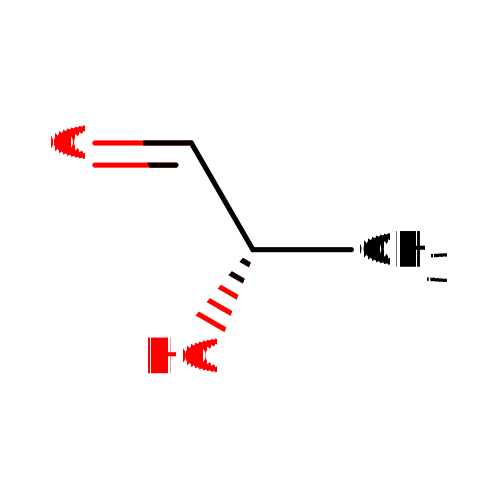
| Description | Lactaldehyde, also known as 2-hydroxypropanal, belongs to the class of organic compounds known as alpha-hydroxyaldehydes. These are organic compounds containing an aldehyde substituted with a hydroxyl group on the adjacent carbon. The molecule is chiral, its stereocenter being located on the second carbon atom. Lactaldehyde exists in several forms: In open-chain form and as cyclic hemiacetal; in solution and in crystal forms; as monomer and as dimer. Lactaldehyde is an extremely weak basic (essentially neutral) compound (based on its pKa). Lactaldehyde exists in all living species, ranging from bacteria to humans. Within humans, lactaldehyde participates in a number of enzymatic reactions. In particular, lactaldehyde can be converted into pyruvaldehyde; which is mediated by the enzyme aldose reductase. In addition, lactaldehyde can be biosynthesized from propylene glycol; which is catalyzed by the enzyme aldose reductase. Methylglyoxal is converted to D-lactaldehyde by glycerol dehydrogenase (gldA). Lactaldehyde is then oxidized to lactic acid by aldehyde dehydrogenase. In humans, lactaldehyde is involved in the metabolic disorder called the leigh syndrome pathway. Lactaldehyde is an intermediate in the methylglyoxal metabolic pathway. Lactaldehyde is a three-carbon atom species with a carbonyl group on the first carbon atom (making it an aldehyde), and a hydroxy group on the second carbon atom, making it a secondary alcohol. (S)-Lactaldehyde is found in Escherichia coli. (S)-Lactaldehyde was first documented in 1958 (PMID: 13502404). In crystal form, three conformers occur as hemiacetal dimers with a 1,4-dioxane ring skeleton:In equilibrium solution, negligibly small amounts of the monomer and at least one five-membered ring dimer exist (PMID: 6706932) (PMID: 6421801) (PMID: 14203169) (PMID: 14323585) (PMID: 6373710) (PMID: 6427403). |
|---|
| Structure | InChI=1S/C3H6O2/c1-3(5)2-4/h2-3,5H,1H3/t3-/m0/s1 |
|---|
| Synonyms | | Value | Source |
|---|
| L-2-Hydroxypropionaldehyde | ChEBI | | L-Lactaldehyde | ChEBI | | (+-)-2-Hydroxypropanal | HMDB | | (2S)-2-Hydroxypropanal | HMDB | | (S)-Lactaldehyde | HMDB | | 2-Hydroxypropanal | HMDB | | 2-Hydroxypropionaldehyde | HMDB | | alpha-Hydroxypropionaldehyde | HMDB | | Hydroxypropionaldehyde | HMDB |
|
|---|
| Chemical Formula | C3H6O2 |
|---|
| Average Mass | 74.0785 Da |
|---|
| Monoisotopic Mass | 74.03678 Da |
|---|
| IUPAC Name | (2S)-2-hydroxypropanal |
|---|
| Traditional Name | L-lactaldehyde |
|---|
| CAS Registry Number | Not Available |
|---|
| SMILES | C[C@H](O)C=O |
|---|
| InChI Identifier | InChI=1S/C3H6O2/c1-3(5)2-4/h2-3,5H,1H3/t3-/m0/s1 |
|---|
| InChI Key | BSABBBMNWQWLLU-VKHMYHEASA-N |
|---|
| Experimental Spectra |
|---|
|
| Not Available | | Predicted Spectra |
|---|
|
| | Spectrum Type | Description | Depositor ID | Depositor Organization | Depositor | Deposition Date | View |
|---|
| 1D NMR | 13C NMR Spectrum (1D, 25 MHz, D2O, predicted) | Wishart Lab | Wishart Lab | David Wishart | 2021-06-20 | View Spectrum | | 1D NMR | 1H NMR Spectrum (1D, 100 MHz, D2O, predicted) | Wishart Lab | Wishart Lab | David Wishart | 2021-06-20 | View Spectrum | | 1D NMR | 13C NMR Spectrum (1D, 252 MHz, D2O, predicted) | Wishart Lab | Wishart Lab | David Wishart | 2021-06-20 | View Spectrum | | 1D NMR | 1H NMR Spectrum (1D, 1000 MHz, D2O, predicted) | Wishart Lab | Wishart Lab | David Wishart | 2021-06-20 | View Spectrum | | 1D NMR | 13C NMR Spectrum (1D, 50 MHz, D2O, predicted) | Wishart Lab | Wishart Lab | David Wishart | 2021-06-20 | View Spectrum | | 1D NMR | 1H NMR Spectrum (1D, 200 MHz, D2O, predicted) | Wishart Lab | Wishart Lab | David Wishart | 2021-06-20 | View Spectrum | | 1D NMR | 13C NMR Spectrum (1D, 75 MHz, D2O, predicted) | Wishart Lab | Wishart Lab | David Wishart | 2021-06-20 | View Spectrum | | 1D NMR | 1H NMR Spectrum (1D, 300 MHz, D2O, predicted) | Wishart Lab | Wishart Lab | David Wishart | 2021-06-20 | View Spectrum | | 1D NMR | 13C NMR Spectrum (1D, 101 MHz, D2O, predicted) | Wishart Lab | Wishart Lab | David Wishart | 2021-06-20 | View Spectrum | | 1D NMR | 1H NMR Spectrum (1D, 400 MHz, D2O, predicted) | Wishart Lab | Wishart Lab | David Wishart | 2021-06-20 | View Spectrum | | 1D NMR | 13C NMR Spectrum (1D, 126 MHz, D2O, predicted) | Wishart Lab | Wishart Lab | David Wishart | 2021-06-20 | View Spectrum | | 1D NMR | 1H NMR Spectrum (1D, 500 MHz, D2O, predicted) | Wishart Lab | Wishart Lab | David Wishart | 2021-06-20 | View Spectrum | | 1D NMR | 13C NMR Spectrum (1D, 151 MHz, D2O, predicted) | Wishart Lab | Wishart Lab | David Wishart | 2021-06-20 | View Spectrum | | 1D NMR | 1H NMR Spectrum (1D, 600 MHz, D2O, predicted) | Wishart Lab | Wishart Lab | David Wishart | 2021-06-20 | View Spectrum | | 1D NMR | 13C NMR Spectrum (1D, 176 MHz, D2O, predicted) | Wishart Lab | Wishart Lab | David Wishart | 2021-06-20 | View Spectrum | | 1D NMR | 1H NMR Spectrum (1D, 700 MHz, D2O, predicted) | Wishart Lab | Wishart Lab | David Wishart | 2021-06-20 | View Spectrum | | 1D NMR | 13C NMR Spectrum (1D, 201 MHz, D2O, predicted) | Wishart Lab | Wishart Lab | David Wishart | 2021-06-20 | View Spectrum | | 1D NMR | 1H NMR Spectrum (1D, 800 MHz, D2O, predicted) | Wishart Lab | Wishart Lab | David Wishart | 2021-06-20 | View Spectrum | | 1D NMR | 13C NMR Spectrum (1D, 226 MHz, D2O, predicted) | Wishart Lab | Wishart Lab | David Wishart | 2021-06-20 | View Spectrum | | 1D NMR | 1H NMR Spectrum (1D, 900 MHz, D2O, predicted) | Wishart Lab | Wishart Lab | David Wishart | 2021-06-20 | View Spectrum |
| | Chemical Shift Submissions |
|---|
|
| Not Available | | Species |
|---|
| Species of Origin | |
|---|
| Chemical Taxonomy |
|---|
| Description | Belongs to the class of organic compounds known as alpha-hydroxyaldehydes. These are organic compounds containing an aldehyde substituted with a hydroxyl group on the adjacent carbon. |
|---|
| Kingdom | Organic compounds |
|---|
| Super Class | Organic oxygen compounds |
|---|
| Class | Organooxygen compounds |
|---|
| Sub Class | Carbonyl compounds |
|---|
| Direct Parent | Alpha-hydroxyaldehydes |
|---|
| Alternative Parents | |
|---|
| Substituents | - Alpha-hydroxyaldehyde
- Secondary alcohol
- Organic oxide
- Hydrocarbon derivative
- Short-chain aldehyde
- Alcohol
- Aliphatic acyclic compound
|
|---|
| Molecular Framework | Aliphatic acyclic compounds |
|---|
| External Descriptors | |
|---|
| Physical Properties |
|---|
| State | Not Available |
|---|
| Experimental Properties | | Property | Value | Reference |
|---|
| Melting Point | Not Available | Not Available | | Boiling Point | Not Available | Not Available | | Water Solubility | Not Available | Not Available | | LogP | Not Available | Not Available |
|
|---|
| Predicted Properties | |
|---|
| General References | - Casazza JP, Felver ME, Veech RL: The metabolism of acetone in rat. J Biol Chem. 1984 Jan 10;259(1):231-6. [PubMed:6706932 ]
- Chen YM, Lin EC: Dual control of a common L-1,2-propanediol oxidoreductase by L-fucose and L-rhamnose in Escherichia coli. J Bacteriol. 1984 Mar;157(3):828-32. doi: 10.1128/jb.157.3.828-832.1984. [PubMed:6421801 ]
- TING SM, SELLINGER OZ, MILLER ON: THE METABOLISM OF LACTALDEHYDE. VI. THE REDUCTION OF D- AND L-LACTALDEHYDE IN RAT LIVER. Biochim Biophys Acta. 1964 Aug 26;89:217-25. doi: 10.1016/0926-6569(64)90210-x. [PubMed:14203169 ]
- TING SM, MILLER ON, SELLINGER OZ: THE METABOLISM OF LACTALDEHYDE. VII. THE OXIDATION OF D-LACTALDEHYDE IN RAT LIVER. Biochim Biophys Acta. 1965 Mar 8;97:407-15. doi: 10.1016/0304-4165(65)90151-0. [PubMed:14323585 ]
- Akhy MT, Brown CM, Old DC: L-Rhamnose utilisation in Salmonella typhimurium. J Appl Bacteriol. 1984 Apr;56(2):269-74. doi: 10.1111/j.1365-2672.1984.tb01347.x. [PubMed:6373710 ]
- Ros J, Aguilar J: Genetic and structural evidence for the presence of propanediol oxidoreductase isoenzymes in Escherichia coli. J Gen Microbiol. 1984 Mar;130(3):687-92. doi: 10.1099/00221287-130-3-687. [PubMed:6427403 ]
- Di Costanzo L, Gomez GA, Christianson DW: Crystal structure of lactaldehyde dehydrogenase from Escherichia coli and inferences regarding substrate and cofactor specificity. J Mol Biol. 2007 Feb 16;366(2):481-93. doi: 10.1016/j.jmb.2006.11.023. Epub 2006 Nov 10. [PubMed:17173928 ]
- Chen YM, Chakrabarti T, Lin EC: Constitutive activation of L-fucose genes by an unlinked mutation in Escherichia coli. J Bacteriol. 1984 Aug;159(2):725-9. doi: 10.1128/jb.159.2.725-729.1984. [PubMed:6378890 ]
- SANDMAN RP, MILLER ON: Studies on the metabolism of lactaldehyde. I. Separation and determination of lactaldehyde and related 3-carbon compounds. J Biol Chem. 1958 Jan;230(1):353-9. [PubMed:13502404 ]
|
|---|