| Record Information |
|---|
| Version | 2.0 |
|---|
| Created at | 2022-04-28 06:34:01 UTC |
|---|
| Updated at | 2022-04-28 06:34:01 UTC |
|---|
| NP-MRD ID | NP0061866 |
|---|
| Secondary Accession Numbers | None |
|---|
| Natural Product Identification |
|---|
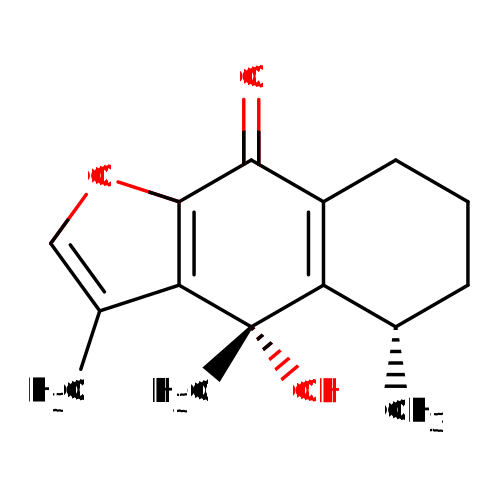
| Common Name | Cacalon |
|---|
| Description | Cacalone belongs to the class of organic compounds known as eremophilane, 8,9-secoeremophilane and furoeremophilane sesquiterpenoids. These are sesquiterpenoids with a structure based either on the eremophilane skeleton, its 8,9-seco derivative, or the furoeremophilane skeleton. Eremophilanes have been shown to be derived from eudesmanes by migration of the methyl group at C-10 to C-5. Cacalon is found in Cacalia decomposita, Ligularia cyathiceps and Ligularia virgaurea. Cacalon was first documented in 2006 (PMID: 16307855). Based on a literature review a small amount of articles have been published on Cacalone (PMID: 34068304) (PMID: 30572603) (PMID: 22908555) (PMID: 19501281). |
|---|
| Structure | C[C@H]1CCCC2=C1[C@@](C)(O)C1=C(OC=C1C)C2=O InChI=1S/C15H18O3/c1-8-5-4-6-10-11(8)15(3,17)12-9(2)7-18-14(12)13(10)16/h7-8,17H,4-6H2,1-3H3/t8-,15+/m0/s1 |
|---|
| Synonyms | Not Available |
|---|
| Chemical Formula | C15H18O3 |
|---|
| Average Mass | 246.3060 Da |
|---|
| Monoisotopic Mass | 246.12559 Da |
|---|
| IUPAC Name | (4R,5S)-4-hydroxy-3,4,5-trimethyl-4H,5H,6H,7H,8H,9H-naphtho[2,3-b]furan-9-one |
|---|
| Traditional Name | (4R,5S)-4-hydroxy-3,4,5-trimethyl-5H,6H,7H,8H-naphtho[2,3-b]furan-9-one |
|---|
| CAS Registry Number | Not Available |
|---|
| SMILES | C[C@H]1CCCC2=C1[C@@](C)(O)C1=C(OC=C1C)C2=O |
|---|
| InChI Identifier | InChI=1S/C15H18O3/c1-8-5-4-6-10-11(8)15(3,17)12-9(2)7-18-14(12)13(10)16/h7-8,17H,4-6H2,1-3H3/t8-,15+/m0/s1 |
|---|
| InChI Key | VNNQNPHIASWXBS-VXJOIVPMSA-N |
|---|
| Experimental Spectra |
|---|
|
| Not Available | | Predicted Spectra |
|---|
|
| | Spectrum Type | Description | Depositor ID | Depositor Organization | Depositor | Deposition Date | View |
|---|
| 1D NMR | 13C NMR Spectrum (1D, 25 MHz, D2O, predicted) | Wishart Lab | Wishart Lab | David Wishart | 2021-06-20 | View Spectrum | | 1D NMR | 1H NMR Spectrum (1D, 100 MHz, D2O, predicted) | Wishart Lab | Wishart Lab | David Wishart | 2021-06-20 | View Spectrum | | 1D NMR | 13C NMR Spectrum (1D, 252 MHz, D2O, predicted) | Wishart Lab | Wishart Lab | David Wishart | 2021-06-20 | View Spectrum | | 1D NMR | 1H NMR Spectrum (1D, 1000 MHz, D2O, predicted) | Wishart Lab | Wishart Lab | David Wishart | 2021-06-20 | View Spectrum | | 1D NMR | 13C NMR Spectrum (1D, 50 MHz, D2O, predicted) | Wishart Lab | Wishart Lab | David Wishart | 2021-06-20 | View Spectrum | | 1D NMR | 1H NMR Spectrum (1D, 200 MHz, D2O, predicted) | Wishart Lab | Wishart Lab | David Wishart | 2021-06-20 | View Spectrum | | 1D NMR | 13C NMR Spectrum (1D, 75 MHz, D2O, predicted) | Wishart Lab | Wishart Lab | David Wishart | 2021-06-20 | View Spectrum | | 1D NMR | 1H NMR Spectrum (1D, 300 MHz, D2O, predicted) | Wishart Lab | Wishart Lab | David Wishart | 2021-06-20 | View Spectrum | | 1D NMR | 13C NMR Spectrum (1D, 101 MHz, D2O, predicted) | Wishart Lab | Wishart Lab | David Wishart | 2021-06-20 | View Spectrum | | 1D NMR | 1H NMR Spectrum (1D, 400 MHz, D2O, predicted) | Wishart Lab | Wishart Lab | David Wishart | 2021-06-20 | View Spectrum | | 1D NMR | 13C NMR Spectrum (1D, 126 MHz, D2O, predicted) | Wishart Lab | Wishart Lab | David Wishart | 2021-06-20 | View Spectrum | | 1D NMR | 1H NMR Spectrum (1D, 500 MHz, D2O, predicted) | Wishart Lab | Wishart Lab | David Wishart | 2021-06-20 | View Spectrum | | 1D NMR | 13C NMR Spectrum (1D, 151 MHz, D2O, predicted) | Wishart Lab | Wishart Lab | David Wishart | 2021-06-20 | View Spectrum | | 1D NMR | 1H NMR Spectrum (1D, 600 MHz, D2O, predicted) | Wishart Lab | Wishart Lab | David Wishart | 2021-06-20 | View Spectrum | | 1D NMR | 13C NMR Spectrum (1D, 176 MHz, D2O, predicted) | Wishart Lab | Wishart Lab | David Wishart | 2021-06-20 | View Spectrum | | 1D NMR | 1H NMR Spectrum (1D, 700 MHz, D2O, predicted) | Wishart Lab | Wishart Lab | David Wishart | 2021-06-20 | View Spectrum | | 1D NMR | 13C NMR Spectrum (1D, 201 MHz, D2O, predicted) | Wishart Lab | Wishart Lab | David Wishart | 2021-06-20 | View Spectrum | | 1D NMR | 1H NMR Spectrum (1D, 800 MHz, D2O, predicted) | Wishart Lab | Wishart Lab | David Wishart | 2021-06-20 | View Spectrum | | 1D NMR | 13C NMR Spectrum (1D, 226 MHz, D2O, predicted) | Wishart Lab | Wishart Lab | David Wishart | 2021-06-20 | View Spectrum | | 1D NMR | 1H NMR Spectrum (1D, 900 MHz, D2O, predicted) | Wishart Lab | Wishart Lab | David Wishart | 2021-06-20 | View Spectrum |
| | Chemical Shift Submissions |
|---|
|
| Not Available | | Species |
|---|
| Species of Origin | |
|---|
| Chemical Taxonomy |
|---|
| Description | Belongs to the class of organic compounds known as eremophilane, 8,9-secoeremophilane and furoeremophilane sesquiterpenoids. These are sesquiterpenoids with a structure based either on the eremophilane skeleton, its 8,9-seco derivative, or the furoeremophilane skeleton. Eremophilanes have been shown to be derived from eudesmanes by migration of the methyl group at C-10 to C-5. |
|---|
| Kingdom | Organic compounds |
|---|
| Super Class | Lipids and lipid-like molecules |
|---|
| Class | Prenol lipids |
|---|
| Sub Class | Sesquiterpenoids |
|---|
| Direct Parent | Eremophilane, 8,9-secoeremophilane and furoeremophilane sesquiterpenoids |
|---|
| Alternative Parents | |
|---|
| Substituents | - Furoeremophilane sesquiterpenoid
- Naphthofuran
- Aryl ketone
- Heteroaromatic compound
- Tertiary alcohol
- Furan
- Ketone
- Oxacycle
- Organoheterocyclic compound
- Organic oxygen compound
- Organic oxide
- Hydrocarbon derivative
- Organooxygen compound
- Alcohol
- Aromatic heteropolycyclic compound
|
|---|
| Molecular Framework | Aromatic heteropolycyclic compounds |
|---|
| External Descriptors | Not Available |
|---|
| Physical Properties |
|---|
| State | Not Available |
|---|
| Experimental Properties | | Property | Value | Reference |
|---|
| Melting Point | Not Available | Not Available | | Boiling Point | Not Available | Not Available | | Water Solubility | Not Available | Not Available | | LogP | Not Available | Not Available |
|
|---|
| Predicted Properties | |
|---|
| General References | - Jimenez-Estrada M, Huerta-Reyes M, Tavera-Hernandez R, Alvarado-Sansininea JJ, Alvarez AB: Contributions from Mexican Flora for the Treatment of Diabetes Mellitus: Molecules of Psacalium decompositum (A. Gray) H. Rob & Brettell. Molecules. 2021 May 13;26(10). pii: molecules26102892. doi: 10.3390/molecules26102892. [PubMed:34068304 ]
- Castillo-Arellano JI, Gomez-Verjan JC, Rojano-Vilchis NA, Mendoza-Cruz M, Jimenez-Estrada M, Lopez-Valdes HE, Martinez-Coria H, Gutierrez-Juarez R, Gonzalez-Espinosa C, Reyes-Chilpa R, Arrieta-Cruz I: Chemoinformatic Analysis of Selected Cacalolides from Psacalium decompositum (A. Gray) H. Rob. & Brettell and Psacalium peltatum (Kunth) Cass. and Their Effects on FcepsilonRI-Dependent Degranulation in Mast Cells. Molecules. 2018 Dec 19;23(12). pii: molecules23123367. doi: 10.3390/molecules23123367. [PubMed:30572603 ]
- Garduno-Ramirez ML, Clares B, Dominguez-Villegas V, Peraire C, Ruiz MA, Garcia ML, Calpena AC: Skin permeation of cacalol, cacalone and 6-epi-cacalone sesquiterpenes from a nanoemulsion. Nat Prod Commun. 2012 Jul;7(7):821-3. [PubMed:22908555 ]
- Campos MG, Oropeza M, Torres-Sosa C, Jimenez-Estrada M, Reyes-Chilpa R: Sesquiterpenoids from antidiabetic Psacalium decompositum block ATP sensitive potassium channels. J Ethnopharmacol. 2009 Jun 25;123(3):489-93. doi: 10.1016/j.jep.2009.03.003. Epub 2009 Mar 20. [PubMed:19501281 ]
- Jimenez-Estrada M, Chilpa RR, Apan TR, Lledias F, Hansberg W, Arrieta D, Aguilar FJ: Anti-inflammatory activity of cacalol and cacalone sesquiterpenes isolated from Psacalium decompositum. J Ethnopharmacol. 2006 Apr 21;105(1-2):34-8. doi: 10.1016/j.jep.2005.09.039. Epub 2005 Nov 22. [PubMed:16307855 ]
|
|---|