| Record Information |
|---|
| Version | 2.0 |
|---|
| Created at | 2022-04-28 06:06:06 UTC |
|---|
| Updated at | 2022-04-28 06:06:06 UTC |
|---|
| NP-MRD ID | NP0061240 |
|---|
| Secondary Accession Numbers | None |
|---|
| Natural Product Identification |
|---|
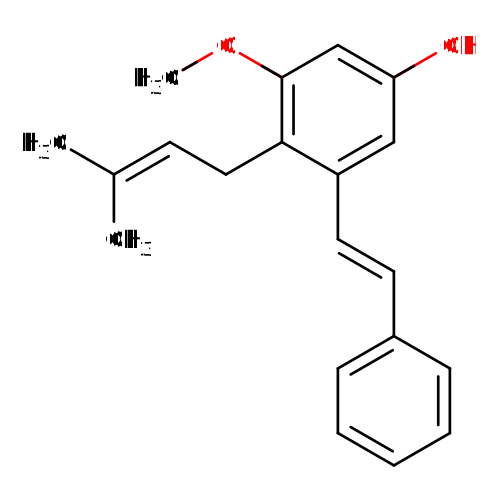
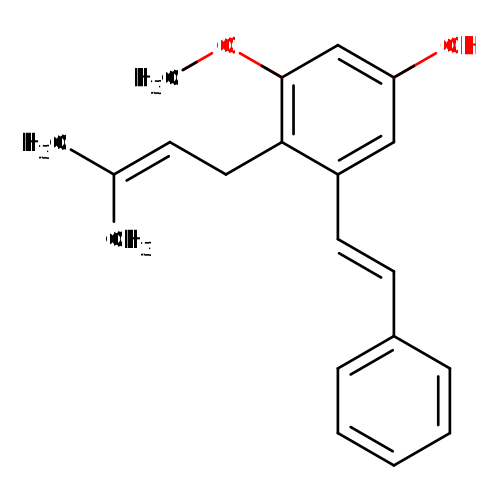
| Common Name | 5-Hydroxy-2-isopentenyl-3-methoxystilbene |
|---|
| Description | Longistylin C belongs to the class of organic compounds known as stilbenes. These are organic compounds containing a 1,2-diphenylethylene moiety. Stilbenes (C6-C2-C6 ) are derived from the common phenylpropene (C6-C3) skeleton building block. The introduction of one or more hydroxyl groups to a phenyl ring lead to stilbenoids. 5-Hydroxy-2-isopentenyl-3-methoxystilbene is found in Cajanus cajan , Lonchocarpus chiricanus, Lonchocarpus longifolius, Lonchocarpus peninsularis and Lonchocarpus violaceus. 5-Hydroxy-2-isopentenyl-3-methoxystilbene was first documented in 2007 (PMID: 17211658). Based on a literature review a small amount of articles have been published on Longistylin C (PMID: 30653252) (PMID: 25908631) (PMID: 22242429) (PMID: 20064598). |
|---|
| Structure | COC1=C(CC=C(C)C)C(\C=C\C2=CC=CC=C2)=CC(O)=C1 InChI=1S/C20H22O2/c1-15(2)9-12-19-17(13-18(21)14-20(19)22-3)11-10-16-7-5-4-6-8-16/h4-11,13-14,21H,12H2,1-3H3/b11-10+ |
|---|
| Synonyms | | Value | Source |
|---|
| Longistyline C | MeSH |
|
|---|
| Chemical Formula | C20H22O2 |
|---|
| Average Mass | 294.3940 Da |
|---|
| Monoisotopic Mass | 294.16198 Da |
|---|
| IUPAC Name | 3-methoxy-4-(3-methylbut-2-en-1-yl)-5-[(E)-2-phenylethenyl]phenol |
|---|
| Traditional Name | 3-methoxy-4-(3-methylbut-2-en-1-yl)-5-[(E)-2-phenylethenyl]phenol |
|---|
| CAS Registry Number | Not Available |
|---|
| SMILES | COC1=C(CC=C(C)C)C(\C=C\C2=CC=CC=C2)=CC(O)=C1 |
|---|
| InChI Identifier | InChI=1S/C20H22O2/c1-15(2)9-12-19-17(13-18(21)14-20(19)22-3)11-10-16-7-5-4-6-8-16/h4-11,13-14,21H,12H2,1-3H3/b11-10+ |
|---|
| InChI Key | NFAWEPOBHKEHPO-ZHACJKMWSA-N |
|---|
| Experimental Spectra |
|---|
|
| Not Available | | Predicted Spectra |
|---|
|
| | Spectrum Type | Description | Depositor ID | Depositor Organization | Depositor | Deposition Date | View |
|---|
| 1D NMR | 13C NMR Spectrum (1D, 25 MHz, D2O, predicted) | Wishart Lab | Wishart Lab | David Wishart | 2021-06-20 | View Spectrum | | 1D NMR | 1H NMR Spectrum (1D, 100 MHz, D2O, predicted) | Wishart Lab | Wishart Lab | David Wishart | 2021-06-20 | View Spectrum | | 1D NMR | 13C NMR Spectrum (1D, 252 MHz, D2O, predicted) | Wishart Lab | Wishart Lab | David Wishart | 2021-06-20 | View Spectrum | | 1D NMR | 1H NMR Spectrum (1D, 1000 MHz, D2O, predicted) | Wishart Lab | Wishart Lab | David Wishart | 2021-06-20 | View Spectrum | | 1D NMR | 13C NMR Spectrum (1D, 50 MHz, D2O, predicted) | Wishart Lab | Wishart Lab | David Wishart | 2021-06-20 | View Spectrum | | 1D NMR | 1H NMR Spectrum (1D, 200 MHz, D2O, predicted) | Wishart Lab | Wishart Lab | David Wishart | 2021-06-20 | View Spectrum | | 1D NMR | 13C NMR Spectrum (1D, 75 MHz, D2O, predicted) | Wishart Lab | Wishart Lab | David Wishart | 2021-06-20 | View Spectrum | | 1D NMR | 1H NMR Spectrum (1D, 300 MHz, D2O, predicted) | Wishart Lab | Wishart Lab | David Wishart | 2021-06-20 | View Spectrum | | 1D NMR | 13C NMR Spectrum (1D, 101 MHz, D2O, predicted) | Wishart Lab | Wishart Lab | David Wishart | 2021-06-20 | View Spectrum | | 1D NMR | 1H NMR Spectrum (1D, 400 MHz, D2O, predicted) | Wishart Lab | Wishart Lab | David Wishart | 2021-06-20 | View Spectrum | | 1D NMR | 13C NMR Spectrum (1D, 126 MHz, D2O, predicted) | Wishart Lab | Wishart Lab | David Wishart | 2021-06-20 | View Spectrum | | 1D NMR | 1H NMR Spectrum (1D, 500 MHz, D2O, predicted) | Wishart Lab | Wishart Lab | David Wishart | 2021-06-20 | View Spectrum | | 1D NMR | 13C NMR Spectrum (1D, 151 MHz, D2O, predicted) | Wishart Lab | Wishart Lab | David Wishart | 2021-06-20 | View Spectrum | | 1D NMR | 1H NMR Spectrum (1D, 600 MHz, D2O, predicted) | Wishart Lab | Wishart Lab | David Wishart | 2021-06-20 | View Spectrum | | 1D NMR | 13C NMR Spectrum (1D, 176 MHz, D2O, predicted) | Wishart Lab | Wishart Lab | David Wishart | 2021-06-20 | View Spectrum | | 1D NMR | 1H NMR Spectrum (1D, 700 MHz, D2O, predicted) | Wishart Lab | Wishart Lab | David Wishart | 2021-06-20 | View Spectrum | | 1D NMR | 13C NMR Spectrum (1D, 201 MHz, D2O, predicted) | Wishart Lab | Wishart Lab | David Wishart | 2021-06-20 | View Spectrum | | 1D NMR | 1H NMR Spectrum (1D, 800 MHz, D2O, predicted) | Wishart Lab | Wishart Lab | David Wishart | 2021-06-20 | View Spectrum | | 1D NMR | 13C NMR Spectrum (1D, 226 MHz, D2O, predicted) | Wishart Lab | Wishart Lab | David Wishart | 2021-06-20 | View Spectrum | | 1D NMR | 1H NMR Spectrum (1D, 900 MHz, D2O, predicted) | Wishart Lab | Wishart Lab | David Wishart | 2021-06-20 | View Spectrum |
| | Chemical Shift Submissions |
|---|
|
| Not Available | | Species |
|---|
| Species of Origin | |
|---|
| Chemical Taxonomy |
|---|
| Description | Belongs to the class of organic compounds known as stilbenes. These are organic compounds containing a 1,2-diphenylethylene moiety. Stilbenes (C6-C2-C6 ) are derived from the common phenylpropene (C6-C3) skeleton building block. The introduction of one or more hydroxyl groups to a phenyl ring lead to stilbenoids. |
|---|
| Kingdom | Organic compounds |
|---|
| Super Class | Phenylpropanoids and polyketides |
|---|
| Class | Stilbenes |
|---|
| Sub Class | Not Available |
|---|
| Direct Parent | Stilbenes |
|---|
| Alternative Parents | |
|---|
| Substituents | - Stilbene
- Methoxyphenol
- Phenoxy compound
- Anisole
- Phenol ether
- Methoxybenzene
- Styrene
- Alkyl aryl ether
- 1-hydroxy-2-unsubstituted benzenoid
- Phenol
- Monocyclic benzene moiety
- Benzenoid
- Ether
- Organooxygen compound
- Organic oxygen compound
- Hydrocarbon derivative
- Aromatic homomonocyclic compound
|
|---|
| Molecular Framework | Aromatic homomonocyclic compounds |
|---|
| External Descriptors | Not Available |
|---|
| Physical Properties |
|---|
| State | Not Available |
|---|
| Experimental Properties | | Property | Value | Reference |
|---|
| Melting Point | Not Available | Not Available | | Boiling Point | Not Available | Not Available | | Water Solubility | Not Available | Not Available | | LogP | Not Available | Not Available |
|
|---|
| Predicted Properties | |
|---|
| General References | - He X, Zhang H, Liang X: Separation of six compounds from pigeon pea leaves by elution-extrusion counter-current chromatography. J Sep Sci. 2019 Mar;42(6):1202-1209. doi: 10.1002/jssc.201801111. Epub 2019 Feb 7. [PubMed:30653252 ]
- Shan Y, Hong T, Wang YF, Zhang NL, Yu B, Lu Y, Qiu SX: Synthesis and cytotoxicity of longistylin C derivatives. Chin J Nat Med. 2015 Apr;13(4):311-5. doi: 10.1016/S1875-5364(15)30021-2. [PubMed:25908631 ]
- Wang D, Xiao M, Li Y, Shen X, Lu Y, Liu K, Li Z, Hu Y: [Determination of longistylin A and longistylin C in Cajanus cajan]. Zhongguo Zhong Yao Za Zhi. 2011 Oct;36(19):2680-3. [PubMed:22242429 ]
- Ashidi JS, Houghton PJ, Hylands PJ, Efferth T: Ethnobotanical survey and cytotoxicity testing of plants of South-western Nigeria used to treat cancer, with isolation of cytotoxic constituents from Cajanus cajan Millsp. leaves. J Ethnopharmacol. 2010 Mar 24;128(2):501-12. doi: 10.1016/j.jep.2010.01.009. Epub 2010 Jan 11. [PubMed:20064598 ]
- Son IH, Chung IM, Lee SJ, Moon HI: Antiplasmodial activity of novel stilbene derivatives isolated from Parthenocissus tricuspidata from South Korea. Parasitol Res. 2007 Jun;101(1):237-41. doi: 10.1007/s00436-006-0454-y. Epub 2007 Jan 9. [PubMed:17211658 ]
|
|---|