| Record Information |
|---|
| Version | 2.0 |
|---|
| Created at | 2022-04-28 04:39:05 UTC |
|---|
| Updated at | 2022-04-28 04:39:05 UTC |
|---|
| NP-MRD ID | NP0059403 |
|---|
| Secondary Accession Numbers | None |
|---|
| Natural Product Identification |
|---|
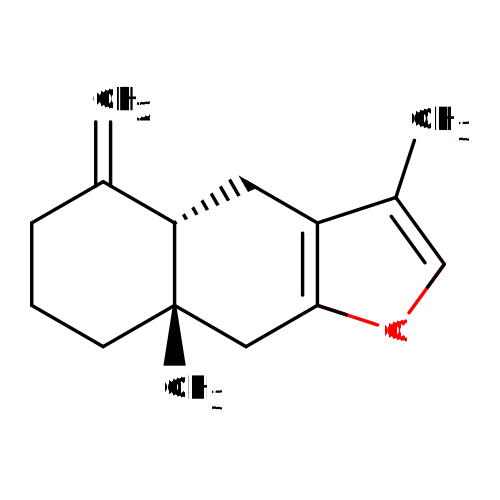
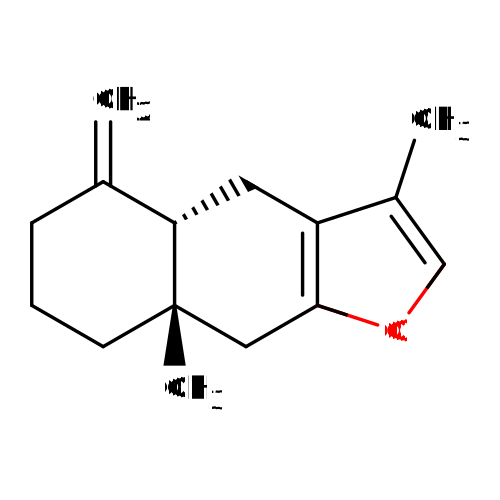
| Common Name | 4,4aalpha,5,6,7,8,8a,9-Octahydro-3,8alphabeta-dimethyl-5-methylenenaphtho[2,3-b]furan |
|---|
| Description | Atractylon, also known as atractyloxide, belongs to the class of organic compounds known as eremophilane, 8,9-secoeremophilane and furoeremophilane sesquiterpenoids. These are sesquiterpenoids with a structure based either on the eremophilane skeleton, its 8,9-seco derivative, or the furoeremophilane skeleton. Eremophilanes have been shown to be derived from eudesmanes by migration of the methyl group at C-10 to C-5. 4,4aalpha,5,6,7,8,8a,9-Octahydro-3,8alphabeta-dimethyl-5-methylenenaphtho[2,3-b]furan is found in Actaea simplex, Atractylodes japonica, Atractylis ovata , Atractylodes macrocephala, Eugenia uniflora and Prumnopitys andina. 4,4aalpha,5,6,7,8,8a,9-Octahydro-3,8alphabeta-dimethyl-5-methylenenaphtho[2,3-b]furan was first documented in 2021 (PMID: 34885880). Based on a literature review a small amount of articles have been published on Atractylon (PMID: 35371119) (PMID: 34963032) (PMID: 35119084) (PMID: 35104500). |
|---|
| Structure | CC1=COC2=C1C[C@H]1C(=C)CCC[C@]1(C)C2 InChI=1S/C15H20O/c1-10-5-4-6-15(3)8-14-12(7-13(10)15)11(2)9-16-14/h9,13H,1,4-8H2,2-3H3/t13-,15+/m0/s1 |
|---|
| Synonyms | | Value | Source |
|---|
| Atractylol | Kegg | | Atractyloxide | Kegg |
|
|---|
| Chemical Formula | C15H20O |
|---|
| Average Mass | 216.3240 Da |
|---|
| Monoisotopic Mass | 216.15142 Da |
|---|
| IUPAC Name | (4aS,8aR)-3,8a-dimethyl-5-methylidene-4H,4aH,5H,6H,7H,8H,8aH,9H-naphtho[2,3-b]furan |
|---|
| Traditional Name | (4aS,8aR)-3,8a-dimethyl-5-methylidene-4H,4aH,6H,7H,8H,9H-naphtho[2,3-b]furan |
|---|
| CAS Registry Number | Not Available |
|---|
| SMILES | CC1=COC2=C1C[C@H]1C(=C)CCC[C@]1(C)C2 |
|---|
| InChI Identifier | InChI=1S/C15H20O/c1-10-5-4-6-15(3)8-14-12(7-13(10)15)11(2)9-16-14/h9,13H,1,4-8H2,2-3H3/t13-,15+/m0/s1 |
|---|
| InChI Key | TYPSVDGIQAOBAD-DZGCQCFKSA-N |
|---|
| Experimental Spectra |
|---|
|
| Not Available | | Predicted Spectra |
|---|
|
| | Spectrum Type | Description | Depositor ID | Depositor Organization | Depositor | Deposition Date | View |
|---|
| 1D NMR | 13C NMR Spectrum (1D, 25 MHz, D2O, predicted) | Wishart Lab | Wishart Lab | David Wishart | 2021-06-20 | View Spectrum | | 1D NMR | 1H NMR Spectrum (1D, 100 MHz, D2O, predicted) | Wishart Lab | Wishart Lab | David Wishart | 2021-06-20 | View Spectrum | | 1D NMR | 13C NMR Spectrum (1D, 252 MHz, D2O, predicted) | Wishart Lab | Wishart Lab | David Wishart | 2021-06-20 | View Spectrum | | 1D NMR | 1H NMR Spectrum (1D, 1000 MHz, D2O, predicted) | Wishart Lab | Wishart Lab | David Wishart | 2021-06-20 | View Spectrum | | 1D NMR | 13C NMR Spectrum (1D, 50 MHz, D2O, predicted) | Wishart Lab | Wishart Lab | David Wishart | 2021-06-20 | View Spectrum | | 1D NMR | 1H NMR Spectrum (1D, 200 MHz, D2O, predicted) | Wishart Lab | Wishart Lab | David Wishart | 2021-06-20 | View Spectrum | | 1D NMR | 13C NMR Spectrum (1D, 75 MHz, D2O, predicted) | Wishart Lab | Wishart Lab | David Wishart | 2021-06-20 | View Spectrum | | 1D NMR | 1H NMR Spectrum (1D, 300 MHz, D2O, predicted) | Wishart Lab | Wishart Lab | David Wishart | 2021-06-20 | View Spectrum | | 1D NMR | 13C NMR Spectrum (1D, 101 MHz, D2O, predicted) | Wishart Lab | Wishart Lab | David Wishart | 2021-06-20 | View Spectrum | | 1D NMR | 1H NMR Spectrum (1D, 400 MHz, D2O, predicted) | Wishart Lab | Wishart Lab | David Wishart | 2021-06-20 | View Spectrum | | 1D NMR | 13C NMR Spectrum (1D, 126 MHz, D2O, predicted) | Wishart Lab | Wishart Lab | David Wishart | 2021-06-20 | View Spectrum | | 1D NMR | 1H NMR Spectrum (1D, 500 MHz, D2O, predicted) | Wishart Lab | Wishart Lab | David Wishart | 2021-06-20 | View Spectrum | | 1D NMR | 13C NMR Spectrum (1D, 151 MHz, D2O, predicted) | Wishart Lab | Wishart Lab | David Wishart | 2021-06-20 | View Spectrum | | 1D NMR | 1H NMR Spectrum (1D, 600 MHz, D2O, predicted) | Wishart Lab | Wishart Lab | David Wishart | 2021-06-20 | View Spectrum | | 1D NMR | 13C NMR Spectrum (1D, 176 MHz, D2O, predicted) | Wishart Lab | Wishart Lab | David Wishart | 2021-06-20 | View Spectrum | | 1D NMR | 1H NMR Spectrum (1D, 700 MHz, D2O, predicted) | Wishart Lab | Wishart Lab | David Wishart | 2021-06-20 | View Spectrum | | 1D NMR | 13C NMR Spectrum (1D, 201 MHz, D2O, predicted) | Wishart Lab | Wishart Lab | David Wishart | 2021-06-20 | View Spectrum | | 1D NMR | 1H NMR Spectrum (1D, 800 MHz, D2O, predicted) | Wishart Lab | Wishart Lab | David Wishart | 2021-06-20 | View Spectrum | | 1D NMR | 13C NMR Spectrum (1D, 226 MHz, D2O, predicted) | Wishart Lab | Wishart Lab | David Wishart | 2021-06-20 | View Spectrum | | 1D NMR | 1H NMR Spectrum (1D, 900 MHz, D2O, predicted) | Wishart Lab | Wishart Lab | David Wishart | 2021-06-20 | View Spectrum |
| | Chemical Shift Submissions |
|---|
|
| Not Available | | Species |
|---|
| Species of Origin | |
|---|
| Chemical Taxonomy |
|---|
| Description | Belongs to the class of organic compounds known as eremophilane, 8,9-secoeremophilane and furoeremophilane sesquiterpenoids. These are sesquiterpenoids with a structure based either on the eremophilane skeleton, its 8,9-seco derivative, or the furoeremophilane skeleton. Eremophilanes have been shown to be derived from eudesmanes by migration of the methyl group at C-10 to C-5. |
|---|
| Kingdom | Organic compounds |
|---|
| Super Class | Lipids and lipid-like molecules |
|---|
| Class | Prenol lipids |
|---|
| Sub Class | Sesquiterpenoids |
|---|
| Direct Parent | Eremophilane, 8,9-secoeremophilane and furoeremophilane sesquiterpenoids |
|---|
| Alternative Parents | |
|---|
| Substituents | - Furoeremophilane sesquiterpenoid
- Naphthofuran
- Benzofuran
- Heteroaromatic compound
- Furan
- Oxacycle
- Organoheterocyclic compound
- Organic oxygen compound
- Hydrocarbon derivative
- Organooxygen compound
- Aromatic heteropolycyclic compound
|
|---|
| Molecular Framework | Aromatic heteropolycyclic compounds |
|---|
| External Descriptors | |
|---|
| Physical Properties |
|---|
| State | Not Available |
|---|
| Experimental Properties | | Property | Value | Reference |
|---|
| Melting Point | Not Available | Not Available | | Boiling Point | Not Available | Not Available | | Water Solubility | Not Available | Not Available | | LogP | Not Available | Not Available |
|
|---|
| Predicted Properties | |
|---|
| General References | - Sun J, Luo H, Jiang Y, Wang L, Xiao C, Weng L: Influence of Nutrient (NPK) Factors on Growth, and Pharmacodynamic Component Biosynthesis of Atractylodes chinensis: An Insight on Acetyl-CoA Carboxylase (ACC), 3-Hydroxy-3-Methylglutaryl-CoA Reductase (HMGR), and Farnesyl Pyrophosphate Synthase (FPPS) Signaling Responses. Front Plant Sci. 2022 Mar 18;13:799201. doi: 10.3389/fpls.2022.799201. eCollection 2022. [PubMed:35371119 ]
- Zhu Q, Lin M, Zhuo W, Li Y: Chemical Constituents from the Wild Atractylodes macrocephala Koidz and Acetylcholinesterase Inhibitory Activity Evaluation as Well as Molecular Docking Study. Molecules. 2021 Dec 1;26(23). pii: molecules26237299. doi: 10.3390/molecules26237299. [PubMed:34885880 ]
- Xu R, Lu J, Wu J, Yu D, Chu S, Guan F, Liu W, Hu J, Peng H, Zha L: Comparative analysis in different organs and tissue-specific metabolite profiling of Atractylodes lancea from four regions by GC-MS and laser microdissection. J Sep Sci. 2022 Mar;45(5):1067-1079. doi: 10.1002/jssc.202100924. Epub 2022 Jan 3. [PubMed:34963032 ]
- Cheng Y, Ping J, Chen J, Fu Y, Zhao H, Xue J: Molecular mechanism of atractylon in the invasion and migration of hepatic cancer cells based on highthroughput sequencing. Mol Med Rep. 2022 Apr;25(4). pii: 112. doi: 10.3892/mmr.2022.12628. Epub 2022 Feb 4. [PubMed:35119084 ]
- Li H, Wang F, Zhou Z, Jiang X, Li F, Feng Y, Liu C, Zhang Y, Fan S, Wu X, Huang C: Atractylon, a novel dopamine 2 receptor agonist, ameliorates Parkinsonian like motor dysfunctions in MPTP-induced mice. Neurotoxicology. 2022 Mar;89:121-126. doi: 10.1016/j.neuro.2022.01.010. Epub 2022 Jan 31. [PubMed:35104500 ]
|
|---|