| Record Information |
|---|
| Version | 2.0 |
|---|
| Created at | 2022-04-28 02:36:19 UTC |
|---|
| Updated at | 2022-04-28 02:36:19 UTC |
|---|
| NP-MRD ID | NP0057037 |
|---|
| Secondary Accession Numbers | None |
|---|
| Natural Product Identification |
|---|
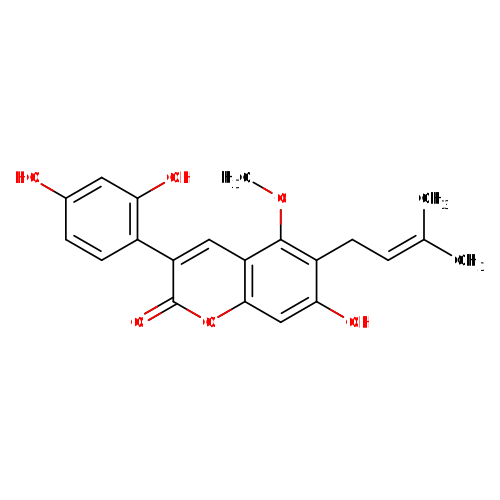
| Common Name | Glycycoumarin |
|---|
| Description | Glycycoumarin belongs to the class of organic compounds known as hydroxyisoflavonoids. These are organic compounds containing an isoflavonoid skeleton carrying one or more hydroxyl groups. Thus, glycycoumarin is considered to be a flavonoid lipid molecule. Glycycoumarin is a very hydrophobic molecule, practically insoluble (in water), and relatively neutral. Outside of the human body, Glycycoumarin has been detected, but not quantified in, root vegetables. Glycycoumarin is found in Glycyrrhiza aspera, Glycyrrhiza glabra , Glycyrrhiza inflata and Glycyrrhiza uralensis . Glycycoumarin was first documented in 2003 (PMID: 12808302). This could make glycycoumarin a potential biomarker for the consumption of these foods (PMID: 20724155) (PMID: 16387459) (PMID: 23164761). |
|---|
| Structure | COC1=C(CC=C(C)C)C(O)=CC2=C1C=C(C(=O)O2)C1=C(O)C=C(O)C=C1 InChI=1S/C21H20O6/c1-11(2)4-6-14-18(24)10-19-16(20(14)26-3)9-15(21(25)27-19)13-7-5-12(22)8-17(13)23/h4-5,7-10,22-24H,6H2,1-3H3 |
|---|
| Synonyms | | Value | Source |
|---|
| 3-(2,4-Dihydroxy-phenyl)-7-hydroxy-5-methoxy-6-(3-methyl-but-2-enyl)-1-benzopyran-2-one | ChEBI | | 3-(2,4-Dihydroxyphenyl)-7-hydroxy-5-methoxy-6-(3-methyl-2-butenyl)-2H-1-benzopyran-2-one, 9ci | HMDB |
|
|---|
| Chemical Formula | C21H20O6 |
|---|
| Average Mass | 368.3799 Da |
|---|
| Monoisotopic Mass | 368.12599 Da |
|---|
| IUPAC Name | 3-(2,4-dihydroxyphenyl)-7-hydroxy-5-methoxy-6-(3-methylbut-2-en-1-yl)-2H-chromen-2-one |
|---|
| Traditional Name | glycycoumarin |
|---|
| CAS Registry Number | Not Available |
|---|
| SMILES | COC1=C(CC=C(C)C)C(O)=CC2=C1C=C(C(=O)O2)C1=C(O)C=C(O)C=C1 |
|---|
| InChI Identifier | InChI=1S/C21H20O6/c1-11(2)4-6-14-18(24)10-19-16(20(14)26-3)9-15(21(25)27-19)13-7-5-12(22)8-17(13)23/h4-5,7-10,22-24H,6H2,1-3H3 |
|---|
| InChI Key | NZYSZZDSYIBYLC-UHFFFAOYSA-N |
|---|
| Experimental Spectra |
|---|
|
| Not Available | | Predicted Spectra |
|---|
|
| | Spectrum Type | Description | Depositor ID | Depositor Organization | Depositor | Deposition Date | View |
|---|
| 1D NMR | 13C NMR Spectrum (1D, 25 MHz, D2O, predicted) | Wishart Lab | Wishart Lab | David Wishart | 2021-06-20 | View Spectrum | | 1D NMR | 1H NMR Spectrum (1D, 100 MHz, D2O, predicted) | Wishart Lab | Wishart Lab | David Wishart | 2021-06-20 | View Spectrum | | 1D NMR | 13C NMR Spectrum (1D, 252 MHz, D2O, predicted) | Wishart Lab | Wishart Lab | David Wishart | 2021-06-20 | View Spectrum | | 1D NMR | 1H NMR Spectrum (1D, 1000 MHz, D2O, predicted) | Wishart Lab | Wishart Lab | David Wishart | 2021-06-20 | View Spectrum | | 1D NMR | 13C NMR Spectrum (1D, 50 MHz, D2O, predicted) | Wishart Lab | Wishart Lab | David Wishart | 2021-06-20 | View Spectrum | | 1D NMR | 1H NMR Spectrum (1D, 200 MHz, D2O, predicted) | Wishart Lab | Wishart Lab | David Wishart | 2021-06-20 | View Spectrum | | 1D NMR | 13C NMR Spectrum (1D, 75 MHz, D2O, predicted) | Wishart Lab | Wishart Lab | David Wishart | 2021-06-20 | View Spectrum | | 1D NMR | 1H NMR Spectrum (1D, 300 MHz, D2O, predicted) | Wishart Lab | Wishart Lab | David Wishart | 2021-06-20 | View Spectrum | | 1D NMR | 13C NMR Spectrum (1D, 101 MHz, D2O, predicted) | Wishart Lab | Wishart Lab | David Wishart | 2021-06-20 | View Spectrum | | 1D NMR | 1H NMR Spectrum (1D, 400 MHz, D2O, predicted) | Wishart Lab | Wishart Lab | David Wishart | 2021-06-20 | View Spectrum | | 1D NMR | 13C NMR Spectrum (1D, 126 MHz, D2O, predicted) | Wishart Lab | Wishart Lab | David Wishart | 2021-06-20 | View Spectrum | | 1D NMR | 1H NMR Spectrum (1D, 500 MHz, D2O, predicted) | Wishart Lab | Wishart Lab | David Wishart | 2021-06-20 | View Spectrum | | 1D NMR | 13C NMR Spectrum (1D, 151 MHz, D2O, predicted) | Wishart Lab | Wishart Lab | David Wishart | 2021-06-20 | View Spectrum | | 1D NMR | 1H NMR Spectrum (1D, 600 MHz, D2O, predicted) | Wishart Lab | Wishart Lab | David Wishart | 2021-06-20 | View Spectrum | | 1D NMR | 13C NMR Spectrum (1D, 176 MHz, D2O, predicted) | Wishart Lab | Wishart Lab | David Wishart | 2021-06-20 | View Spectrum | | 1D NMR | 1H NMR Spectrum (1D, 700 MHz, D2O, predicted) | Wishart Lab | Wishart Lab | David Wishart | 2021-06-20 | View Spectrum | | 1D NMR | 13C NMR Spectrum (1D, 201 MHz, D2O, predicted) | Wishart Lab | Wishart Lab | David Wishart | 2021-06-20 | View Spectrum | | 1D NMR | 1H NMR Spectrum (1D, 800 MHz, D2O, predicted) | Wishart Lab | Wishart Lab | David Wishart | 2021-06-20 | View Spectrum | | 1D NMR | 13C NMR Spectrum (1D, 226 MHz, D2O, predicted) | Wishart Lab | Wishart Lab | David Wishart | 2021-06-20 | View Spectrum | | 1D NMR | 1H NMR Spectrum (1D, 900 MHz, D2O, predicted) | Wishart Lab | Wishart Lab | David Wishart | 2021-06-20 | View Spectrum |
| | Chemical Shift Submissions |
|---|
|
| Not Available | | Species |
|---|
| Species of Origin | |
|---|
| Chemical Taxonomy |
|---|
| Description | Belongs to the class of organic compounds known as hydroxyisoflavonoids. These are organic compounds containing an isoflavonoid skeleton carrying one or more hydroxyl groups. |
|---|
| Kingdom | Organic compounds |
|---|
| Super Class | Phenylpropanoids and polyketides |
|---|
| Class | Isoflavonoids |
|---|
| Sub Class | Hydroxyisoflavonoids |
|---|
| Direct Parent | Hydroxyisoflavonoids |
|---|
| Alternative Parents | |
|---|
| Substituents | - Hydroxyisoflavonoid
- Isoflav-3-enone skeleton
- 7-hydroxycoumarin
- Hydroxycoumarin
- Coumarin
- Benzopyran
- 1-benzopyran
- Anisole
- Resorcinol
- 1-hydroxy-4-unsubstituted benzenoid
- Alkyl aryl ether
- 1-hydroxy-2-unsubstituted benzenoid
- Phenol
- Pyranone
- Monocyclic benzene moiety
- Pyran
- Benzenoid
- Heteroaromatic compound
- Lactone
- Ether
- Oxacycle
- Organoheterocyclic compound
- Organooxygen compound
- Hydrocarbon derivative
- Organic oxide
- Organic oxygen compound
- Aromatic heteropolycyclic compound
|
|---|
| Molecular Framework | Aromatic heteropolycyclic compounds |
|---|
| External Descriptors | |
|---|
| Physical Properties |
|---|
| State | Not Available |
|---|
| Experimental Properties | | Property | Value | Reference |
|---|
| Melting Point | Not Available | Not Available | | Boiling Point | Not Available | Not Available | | Water Solubility | Not Available | Not Available | | LogP | Not Available | Not Available |
|
|---|
| Predicted Properties | |
|---|
| General References | - Li S, Li W, Wang Y, Asada Y, Koike K: Prenylflavonoids from Glycyrrhiza uralensis and their protein tyrosine phosphatase-1B inhibitory activities. Bioorg Med Chem Lett. 2010 Sep 15;20(18):5398-401. doi: 10.1016/j.bmcl.2010.07.110. Epub 2010 Aug 1. [PubMed:20724155 ]
- Hayashi H, Hattori S, Inoue K, Sarsenbaev K, Ito M, Honda G: Field survey of Glycyrrhiza plants in Central Asia (1). Characterization of G. uralensis, G. glabra and the putative intermediate collected in Kazakhstan. Biol Pharm Bull. 2003 Jun;26(6):867-71. doi: 10.1248/bpb.26.867. [PubMed:12808302 ]
- Sato Y, Akao T, He JX, Nojima H, Kuraishi Y, Morota T, Asano T, Tani T: Glycycoumarin from Glycyrrhizae Radix acts as a potent antispasmodic through inhibition of phosphodiesterase 3. J Ethnopharmacol. 2006 May 24;105(3):409-14. doi: 10.1016/j.jep.2005.11.017. Epub 2006 Jan 4. [PubMed:16387459 ]
- Lee KK, Omiya Y, Yuzurihara M, Kase Y, Kobayashi H: Antispasmodic effect of shakuyakukanzoto extract on experimental muscle cramps in vivo: role of the active constituents of Glycyrrhizae radix. J Ethnopharmacol. 2013 Jan 9;145(1):286-93. doi: 10.1016/j.jep.2012.11.005. Epub 2012 Nov 17. [PubMed:23164761 ]
|
|---|