| Record Information |
|---|
| Version | 2.0 |
|---|
| Created at | 2022-04-28 01:17:38 UTC |
|---|
| Updated at | 2022-04-28 01:17:38 UTC |
|---|
| NP-MRD ID | NP0055158 |
|---|
| Secondary Accession Numbers | None |
|---|
| Natural Product Identification |
|---|
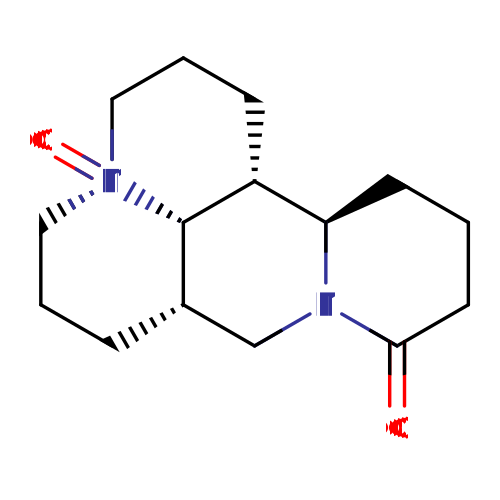
| Common Name | (+)-Matrine N-oxide |
|---|
| Description | Oxymatrine belongs to the class of organic compounds known as matrine alkaloids. These are lupin alkaloids with a structure based on the matrine skeleton, a four-ring skeleton that based on a saturated dipyrido[2,1-f:3',2',1'-Ij][1,6]naphthyridin-10-one skeleton. (+)-Matrine N-oxide is found in Ammothamnus lehmanni, Ammothamnus songoricus, Corydalis yanhusuo , Daphniphyllum oldhami, Genista aucheri, Sophora alopecuroides, Sophora davidii, Sophora flavescens , Sophora flavescens var. angustifolia , Sophora moorcroftiana Benth. , Sophora pachycarpa Schrenk., Sophora subprostate, Sophora subprostrata, Sophora tonkinensis, Sophora viciifolia and Sophorae flavescentis. (+)-Matrine N-oxide was first documented in 2021 (PMID: 35252223). Based on a literature review a small amount of articles have been published on Oxymatrine (PMID: 35335977) (PMID: 35432866) (PMID: 35310033) (PMID: 35290143). |
|---|
| Structure | [O-][N@+]12CCC[C@H]3CN4[C@H](CCCC4=O)[C@@H](CCC1)[C@@H]23 InChI=1S/C15H24N2O2/c18-14-7-1-6-13-12-5-3-9-17(19)8-2-4-11(15(12)17)10-16(13)14/h11-13,15H,1-10H2/t11-,12+,13+,15-,17+/m0/s1 |
|---|
| Synonyms | Not Available |
|---|
| Chemical Formula | C15H24N2O2 |
|---|
| Average Mass | 264.3690 Da |
|---|
| Monoisotopic Mass | 264.18378 Da |
|---|
| IUPAC Name | (1R,2R,9S,13R,17S)-6-oxo-7,13-diazatetracyclo[7.7.1.0^{2,7}.0^{13,17}]heptadecan-13-ium-13-olate |
|---|
| Traditional Name | (1R,2R,9S,13R,17S)-6-oxo-7,13-diazatetracyclo[7.7.1.0^{2,7}.0^{13,17}]heptadecan-13-ium-13-olate |
|---|
| CAS Registry Number | Not Available |
|---|
| SMILES | [O-][N@+]12CCC[C@H]3CN4[C@H](CCCC4=O)[C@@H](CCC1)[C@@H]23 |
|---|
| InChI Identifier | InChI=1S/C15H24N2O2/c18-14-7-1-6-13-12-5-3-9-17(19)8-2-4-11(15(12)17)10-16(13)14/h11-13,15H,1-10H2/t11-,12+,13+,15-,17+/m0/s1 |
|---|
| InChI Key | XVPBINOPNYFXID-JARXUMMXSA-N |
|---|
| Experimental Spectra |
|---|
|
| Not Available | | Predicted Spectra |
|---|
|
| | Spectrum Type | Description | Depositor ID | Depositor Organization | Depositor | Deposition Date | View |
|---|
| 1D NMR | 13C NMR Spectrum (1D, 25 MHz, D2O, predicted) | Wishart Lab | Wishart Lab | David Wishart | 2021-06-20 | View Spectrum | | 1D NMR | 1H NMR Spectrum (1D, 100 MHz, D2O, predicted) | Wishart Lab | Wishart Lab | David Wishart | 2021-06-20 | View Spectrum | | 1D NMR | 13C NMR Spectrum (1D, 252 MHz, D2O, predicted) | Wishart Lab | Wishart Lab | David Wishart | 2021-06-20 | View Spectrum | | 1D NMR | 1H NMR Spectrum (1D, 1000 MHz, D2O, predicted) | Wishart Lab | Wishart Lab | David Wishart | 2021-06-20 | View Spectrum | | 1D NMR | 13C NMR Spectrum (1D, 50 MHz, D2O, predicted) | Wishart Lab | Wishart Lab | David Wishart | 2021-06-20 | View Spectrum | | 1D NMR | 1H NMR Spectrum (1D, 200 MHz, D2O, predicted) | Wishart Lab | Wishart Lab | David Wishart | 2021-06-20 | View Spectrum | | 1D NMR | 13C NMR Spectrum (1D, 75 MHz, D2O, predicted) | Wishart Lab | Wishart Lab | David Wishart | 2021-06-20 | View Spectrum | | 1D NMR | 1H NMR Spectrum (1D, 300 MHz, D2O, predicted) | Wishart Lab | Wishart Lab | David Wishart | 2021-06-20 | View Spectrum | | 1D NMR | 13C NMR Spectrum (1D, 101 MHz, D2O, predicted) | Wishart Lab | Wishart Lab | David Wishart | 2021-06-20 | View Spectrum | | 1D NMR | 1H NMR Spectrum (1D, 400 MHz, D2O, predicted) | Wishart Lab | Wishart Lab | David Wishart | 2021-06-20 | View Spectrum | | 1D NMR | 13C NMR Spectrum (1D, 126 MHz, D2O, predicted) | Wishart Lab | Wishart Lab | David Wishart | 2021-06-20 | View Spectrum | | 1D NMR | 1H NMR Spectrum (1D, 500 MHz, D2O, predicted) | Wishart Lab | Wishart Lab | David Wishart | 2021-06-20 | View Spectrum | | 1D NMR | 13C NMR Spectrum (1D, 151 MHz, D2O, predicted) | Wishart Lab | Wishart Lab | David Wishart | 2021-06-20 | View Spectrum | | 1D NMR | 1H NMR Spectrum (1D, 600 MHz, D2O, predicted) | Wishart Lab | Wishart Lab | David Wishart | 2021-06-20 | View Spectrum | | 1D NMR | 13C NMR Spectrum (1D, 176 MHz, D2O, predicted) | Wishart Lab | Wishart Lab | David Wishart | 2021-06-20 | View Spectrum | | 1D NMR | 1H NMR Spectrum (1D, 700 MHz, D2O, predicted) | Wishart Lab | Wishart Lab | David Wishart | 2021-06-20 | View Spectrum | | 1D NMR | 13C NMR Spectrum (1D, 201 MHz, D2O, predicted) | Wishart Lab | Wishart Lab | David Wishart | 2021-06-20 | View Spectrum | | 1D NMR | 1H NMR Spectrum (1D, 800 MHz, D2O, predicted) | Wishart Lab | Wishart Lab | David Wishart | 2021-06-20 | View Spectrum | | 1D NMR | 13C NMR Spectrum (1D, 226 MHz, D2O, predicted) | Wishart Lab | Wishart Lab | David Wishart | 2021-06-20 | View Spectrum | | 1D NMR | 1H NMR Spectrum (1D, 900 MHz, D2O, predicted) | Wishart Lab | Wishart Lab | David Wishart | 2021-06-20 | View Spectrum |
| | Chemical Shift Submissions |
|---|
|
| Not Available | | Species |
|---|
| Species of Origin | |
|---|
| Chemical Taxonomy |
|---|
| Description | Belongs to the class of organic compounds known as matrine alkaloids. These are lupin alkaloids with a structure based on the matrine skeleton, a four-ring skeleton that based on a saturated dipyrido[2,1-f:3',2',1'-Ij][1,6]naphthyridin-10-one skeleton. |
|---|
| Kingdom | Organic compounds |
|---|
| Super Class | Alkaloids and derivatives |
|---|
| Class | Lupin alkaloids |
|---|
| Sub Class | Matrine alkaloids |
|---|
| Direct Parent | Matrine alkaloids |
|---|
| Alternative Parents | |
|---|
| Substituents | - Matrine
- Quinolizidinone
- Diazanaphthalene
- Quinolizidine
- Naphthyridine
- Piperidinone
- Delta-lactam
- Piperidine
- Trialkyl amine oxide
- Tertiary carboxylic acid amide
- Lactam
- Carboxamide group
- Azacycle
- Organoheterocyclic compound
- Trisubstituted n-oxide
- Carboxylic acid derivative
- N-oxide
- Organic nitrogen compound
- Organic oxygen compound
- Organopnictogen compound
- Organic oxide
- Hydrocarbon derivative
- Organooxygen compound
- Organonitrogen compound
- Carbonyl group
- Aliphatic heteropolycyclic compound
|
|---|
| Molecular Framework | Aliphatic heteropolycyclic compounds |
|---|
| External Descriptors | Not Available |
|---|
| Physical Properties |
|---|
| State | Not Available |
|---|
| Experimental Properties | | Property | Value | Reference |
|---|
| Melting Point | Not Available | Not Available | | Boiling Point | Not Available | Not Available | | Water Solubility | Not Available | Not Available | | LogP | Not Available | Not Available |
|
|---|
| Predicted Properties | |
|---|
| General References | - Hu D, Chen X, Li D, Zhang H, Duan Y, Huang Y: Sustained Release of Co-Amorphous Matrine-Type Alkaloids and Resveratrol with Anti-COVID-19 Potential. Pharmaceutics. 2022 Mar 10;14(3). pii: pharmaceutics14030603. doi: 10.3390/pharmaceutics14030603. [PubMed:35335977 ]
- Kikuchi T, Ogawa M, Okamura T, Gee AD, Zhang MR: Rapid 'on-column' preparation of hydrogen [(11)C]cyanide from [(11)C]methyl iodide via [(11)C]formaldehyde. Chem Sci. 2022 Mar 8;13(12):3556-3562. doi: 10.1039/d1sc07033a. eCollection 2022 Mar 24. [PubMed:35432866 ]
- Aryal B, Raut BK, Bhattarai S, Bhandari S, Tandan P, Gyawali K, Sharma K, Ranabhat D, Thapa R, Aryal D, Ojha A, Devkota HP, Parajuli N: Potential Therapeutic Applications of Plant-Derived Alkaloids against Inflammatory and Neurodegenerative Diseases. Evid Based Complement Alternat Med. 2022 Mar 9;2022:7299778. doi: 10.1155/2022/7299778. eCollection 2022. [PubMed:35310033 ]
- Li S, Feng G, Zhang M, Zhang X, Lu J, Feng C, Zhu F: Oxymatrine attenuates TNBS-induced colinutis in rats through TLR9/Myd88/NF-kappaB signal pathway. Hum Exp Toxicol. 2022 Jan-Dec;41:9603271221078866. doi: 10.1177/09603271221078866. [PubMed:35290143 ]
- Das A, Kashyap O, Singh A, Shree J, Namdeo KP, Bodakhe SH: Oxymatrine Protects TGFbeta1-Induced Retinal Fibrosis in an Animal Model of Glaucoma. Front Med (Lausanne). 2022 Feb 18;8:750342. doi: 10.3389/fmed.2021.750342. eCollection 2021. [PubMed:35252223 ]
|
|---|