| Record Information |
|---|
| Version | 2.0 |
|---|
| Created at | 2022-04-28 01:08:15 UTC |
|---|
| Updated at | 2022-04-28 01:08:15 UTC |
|---|
| NP-MRD ID | NP0054937 |
|---|
| Secondary Accession Numbers | None |
|---|
| Natural Product Identification |
|---|
| Common Name | Uroporphyrinogen III |
|---|
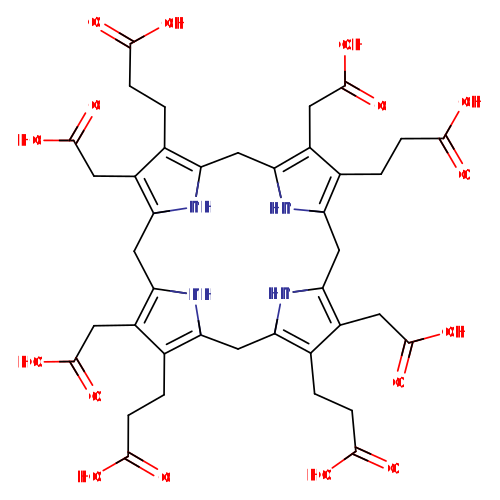
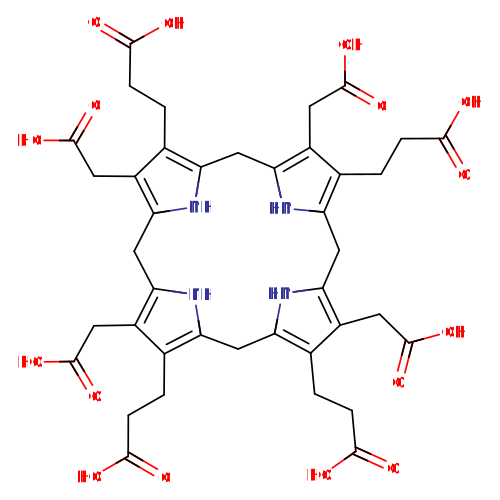
| Description | Uroporphyrinogen III, also known as uro'gen III, belongs to the class of organic compounds known as porphyrins. Porphyrins are compounds containing a fundamental skeleton of four pyrrole nuclei united through the alpha-positions by four methine groups to form a macrocyclic structure. Uroporphyrinogen III is a weakly acidic compound (based on its pKa). Uroporphyrinogen III exists in all living species, ranging from bacteria to humans. In humans, uroporphyrinogen III is involved in the metabolic disorder called the acute intermittent porphyria pathway. Outside of the human body, Uroporphyrinogen III has been detected, but not quantified in, several different foods, such as rices, gram beans, garden onions, grapes, and natal plums. This could make uroporphyrinogen III a potential biomarker for the consumption of these foods. The molecular structure of uroporphyrinogen III can be described as a hexahydroporphine core, where each pyrrole ring has the hydrogen atoms on its two outermost carbons replaced by an acetic acid group (−CH2−COOH, "A") and a propionic acid group (−CH2−CH2−COOH, "P"). If uroporphyrinogen-III synthase is not present or inactive, the hydroxymethylbilane will spontaneously cyclise into the structural isomer uroporphyrinogen I, which differs from the III isomer in that the acetic acid ("A") and propionic acid ("P") groups are arranged in a rotationally symmetric order, AP-AP-AP-AP. In the biosynthesis of sirohemes, uroporphyrinogen III is converted by two methyl transferases to dihydrosirohydrochlorin, which is subsequently oxidized sirohydrochlorin, a precursor to the siroheme prosthetic group. It is a colorless compound, like other porphyrinogens. The conversion entails a reversal of the last pyrrole unit (thus swapping the acetic and propionic acid groups) and a condensation reaction that closes the macrocycle by eliminating the final hydroxyl −OH with a hydrogen atom of the first ring. Uroporphyrinogen III is a tetrapyrrole, the first macrocyclic intermediate in the biosynthesis of heme, chlorophyll, vitamin B12, and siroheme. The groups are attached in an asymmetric way: Going around the macrocycle, the order is AP-AP-AP-PA.In the general porphyrin biosynthesis pathway, uroporphyrinogen III is derived from the linear tetrapyrrole preuroporphyrinogen (a substituted hydroxymethylbilane) by the action of the enzyme uroporphyrinogen-III cosynthase. Uroporphyrinogen III is found in Apis cerana, Arabidopsis thaliana and Escherichia coli K12. Uroporphyrinogen III was first documented in 2000 (PMID: 11112350). In the biosynthesis of hemes and chlorophylls, uroporphyrinogen III is converted into coproporphyrinogen III by the enzyme uroporphyrinogen III decarboxylase (PMID: 11524417). |
|---|
| Structure | OC(=O)CCC1=C2CC3=C(CCC(O)=O)C(CC(O)=O)=C(CC4=C(CC(O)=O)C(CCC(O)=O)=C(CC5=C(CC(O)=O)C(CCC(O)=O)=C(CC(N2)=C1CC(O)=O)N5)N4)N3 InChI=1S/C40H44N4O16/c45-33(46)5-1-17-21(9-37(53)54)29-14-27-19(3-7-35(49)50)22(10-38(55)56)30(43-27)15-28-20(4-8-36(51)52)24(12-40(59)60)32(44-28)16-31-23(11-39(57)58)18(2-6-34(47)48)26(42-31)13-25(17)41-29/h41-44H,1-16H2,(H,45,46)(H,47,48)(H,49,50)(H,51,52)(H,53,54)(H,55,56)(H,57,58)(H,59,60) |
|---|
| Synonyms | | Value | Source |
|---|
| 3,8,13,17-Tetrakis(carboxymethyl)-5,10,15,20,22,24-hexahydro-21H,23H-porphine-2,7,12,18-tetrapropanoic acid | ChEBI | | 3,8,13,17-Tetrakis(carboxymethyl)-5,10,15,20,22,24-hexahydroporphyrin-2,7,12,18-tetrapropionic acid | ChEBI | | Uro'gen III | ChEBI | | 3,8,13,17-Tetrakis(carboxymethyl)-5,10,15,20,22,24-hexahydro-21H,23H-porphine-2,7,12,18-tetrapropanoate | Generator | | 3,8,13,17-Tetrakis(carboxymethyl)-5,10,15,20,22,24-hexahydroporphyrin-2,7,12,18-tetrapropionate | Generator | | 3,8,13,17-Tetrakis(carboxymethyl)-5,10,15,20,22,24-hexahydro-2,7,12,18-porphinetetrapropionate | HMDB | | 3,8,13,17-Tetrakis(carboxymethyl)-5,10,15,20,22,24-hexahydro-2,7,12,18-porphinetetrapropionic acid | HMDB | | 3,8,13,17-Tetrakis(carboxymethyl)-5,10,15,20,22,24-hexahydroporphyrin-2,7,12,18-tetrapropanoate | HMDB | | 3,8,13,17-Tetrakis(carboxymethyl)-5,10,15,20,22,24-hexahydroporphyrin-2,7,12,18-tetrapropanoic acid | HMDB | | Urogen III | HMDB | | Uroporphyrinogen-III | HMDB | | Uroporphyrinogens | HMDB |
|
|---|
| Chemical Formula | C40H44N4O16 |
|---|
| Average Mass | 836.7946 Da |
|---|
| Monoisotopic Mass | 836.27523 Da |
|---|
| IUPAC Name | 3-[9,14,20-tris(2-carboxyethyl)-5,10,15,19-tetrakis(carboxymethyl)-21,22,23,24-tetraazapentacyclo[16.2.1.1³,⁶.1⁸,¹¹.1¹³,¹⁶]tetracosa-1(20),3,5,8,10,13,15,18-octaen-4-yl]propanoic acid |
|---|
| Traditional Name | uroporphyrinogen-III |
|---|
| CAS Registry Number | Not Available |
|---|
| SMILES | OC(=O)CCC1=C2CC3=C(CCC(O)=O)C(CC(O)=O)=C(CC4=C(CC(O)=O)C(CCC(O)=O)=C(CC5=C(CC(O)=O)C(CCC(O)=O)=C(CC(N2)=C1CC(O)=O)N5)N4)N3 |
|---|
| InChI Identifier | InChI=1S/C40H44N4O16/c45-33(46)5-1-17-21(9-37(53)54)29-14-27-19(3-7-35(49)50)22(10-38(55)56)30(43-27)15-28-20(4-8-36(51)52)24(12-40(59)60)32(44-28)16-31-23(11-39(57)58)18(2-6-34(47)48)26(42-31)13-25(17)41-29/h41-44H,1-16H2,(H,45,46)(H,47,48)(H,49,50)(H,51,52)(H,53,54)(H,55,56)(H,57,58)(H,59,60) |
|---|
| InChI Key | HUHWZXWWOFSFKF-UHFFFAOYSA-N |
|---|
| Experimental Spectra |
|---|
|
| Not Available | | Predicted Spectra |
|---|
|
| | Spectrum Type | Description | Depositor ID | Depositor Organization | Depositor | Deposition Date | View |
|---|
| 1D NMR | 13C NMR Spectrum (1D, 25 MHz, D2O, predicted) | Wishart Lab | Wishart Lab | David Wishart | 2021-06-20 | View Spectrum | | 1D NMR | 1H NMR Spectrum (1D, 100 MHz, D2O, predicted) | Wishart Lab | Wishart Lab | David Wishart | 2021-06-20 | View Spectrum | | 1D NMR | 13C NMR Spectrum (1D, 252 MHz, D2O, predicted) | Wishart Lab | Wishart Lab | David Wishart | 2021-06-20 | View Spectrum | | 1D NMR | 1H NMR Spectrum (1D, 1000 MHz, D2O, predicted) | Wishart Lab | Wishart Lab | David Wishart | 2021-06-20 | View Spectrum | | 1D NMR | 13C NMR Spectrum (1D, 50 MHz, D2O, predicted) | Wishart Lab | Wishart Lab | David Wishart | 2021-06-20 | View Spectrum | | 1D NMR | 1H NMR Spectrum (1D, 200 MHz, D2O, predicted) | Wishart Lab | Wishart Lab | David Wishart | 2021-06-20 | View Spectrum | | 1D NMR | 13C NMR Spectrum (1D, 75 MHz, D2O, predicted) | Wishart Lab | Wishart Lab | David Wishart | 2021-06-20 | View Spectrum | | 1D NMR | 1H NMR Spectrum (1D, 300 MHz, D2O, predicted) | Wishart Lab | Wishart Lab | David Wishart | 2021-06-20 | View Spectrum | | 1D NMR | 13C NMR Spectrum (1D, 101 MHz, D2O, predicted) | Wishart Lab | Wishart Lab | David Wishart | 2021-06-20 | View Spectrum | | 1D NMR | 1H NMR Spectrum (1D, 400 MHz, D2O, predicted) | Wishart Lab | Wishart Lab | David Wishart | 2021-06-20 | View Spectrum | | 1D NMR | 13C NMR Spectrum (1D, 126 MHz, D2O, predicted) | Wishart Lab | Wishart Lab | David Wishart | 2021-06-20 | View Spectrum | | 1D NMR | 1H NMR Spectrum (1D, 500 MHz, D2O, predicted) | Wishart Lab | Wishart Lab | David Wishart | 2021-06-20 | View Spectrum | | 1D NMR | 13C NMR Spectrum (1D, 151 MHz, D2O, predicted) | Wishart Lab | Wishart Lab | David Wishart | 2021-06-20 | View Spectrum | | 1D NMR | 1H NMR Spectrum (1D, 600 MHz, D2O, predicted) | Wishart Lab | Wishart Lab | David Wishart | 2021-06-20 | View Spectrum | | 1D NMR | 13C NMR Spectrum (1D, 176 MHz, D2O, predicted) | Wishart Lab | Wishart Lab | David Wishart | 2021-06-20 | View Spectrum | | 1D NMR | 1H NMR Spectrum (1D, 700 MHz, D2O, predicted) | Wishart Lab | Wishart Lab | David Wishart | 2021-06-20 | View Spectrum | | 1D NMR | 13C NMR Spectrum (1D, 201 MHz, D2O, predicted) | Wishart Lab | Wishart Lab | David Wishart | 2021-06-20 | View Spectrum | | 1D NMR | 1H NMR Spectrum (1D, 800 MHz, D2O, predicted) | Wishart Lab | Wishart Lab | David Wishart | 2021-06-20 | View Spectrum | | 1D NMR | 13C NMR Spectrum (1D, 226 MHz, D2O, predicted) | Wishart Lab | Wishart Lab | David Wishart | 2021-06-20 | View Spectrum | | 1D NMR | 1H NMR Spectrum (1D, 900 MHz, D2O, predicted) | Wishart Lab | Wishart Lab | David Wishart | 2021-06-20 | View Spectrum |
| | Chemical Shift Submissions |
|---|
|
| Not Available | | Species |
|---|
| Species of Origin | |
|---|
| Chemical Taxonomy |
|---|
| Description | Belongs to the class of organic compounds known as porphyrins. Porphyrins are compounds containing a fundamental skeleton of four pyrrole nuclei united through the alpha-positions by four methine groups to form a macrocyclic structure. |
|---|
| Kingdom | Organic compounds |
|---|
| Super Class | Organoheterocyclic compounds |
|---|
| Class | Tetrapyrroles and derivatives |
|---|
| Sub Class | Porphyrins |
|---|
| Direct Parent | Porphyrins |
|---|
| Alternative Parents | |
|---|
| Substituents | - Porphyrin
- Substituted pyrrole
- Pyrrole
- Heteroaromatic compound
- Carboxylic acid derivative
- Carboxylic acid
- Azacycle
- Carbonyl group
- Hydrocarbon derivative
- Organic oxide
- Organopnictogen compound
- Organooxygen compound
- Organonitrogen compound
- Organic oxygen compound
- Organic nitrogen compound
- Aromatic heteropolycyclic compound
|
|---|
| Molecular Framework | Aromatic heteropolycyclic compounds |
|---|
| External Descriptors | |
|---|
| Physical Properties |
|---|
| State | Not Available |
|---|
| Experimental Properties | | Property | Value | Reference |
|---|
| Melting Point | Not Available | Not Available | | Boiling Point | Not Available | Not Available | | Water Solubility | Not Available | Not Available | | LogP | Not Available | Not Available |
|
|---|
| Predicted Properties | |
|---|