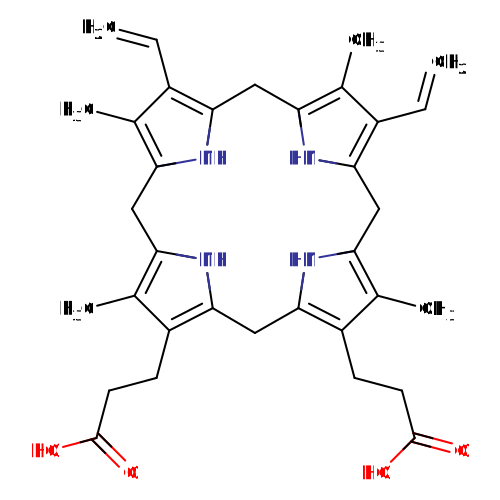
| Record Information |
|---|
| Version | 2.0 |
|---|
| Created at | 2022-04-28 01:08:11 UTC |
|---|
| Updated at | 2022-04-28 01:08:11 UTC |
|---|
| NP-MRD ID | NP0054936 |
|---|
| Secondary Accession Numbers | None |
|---|
| Natural Product Identification |
|---|
| Common Name | Protoporphyrinogen IX |
|---|
| Description | Protoporphyrinogen IX belongs to the class of organic compounds known as porphyrins. Porphyrins are compounds containing a fundamental skeleton of four pyrrole nuclei united through the alpha-positions by four methine groups to form a macrocyclic structure. By the action of protoporphyrinogen oxidase, protoporphyrinogen IX is later converted into protoporphyrin IX, the first colored tetrapyrrole in the biosynthesis of hemes. Protoporphyrinogen IX is a weakly acidic compound (based on its pKa). In coproporphyrinogen III, the substituents on the pyrrole rings have the arrangement MP-MP-MP-PM, where M and P are methyl and propionic acid, respectively. Protoporphyrinogen IX exists in all living species, ranging from bacteria to humans. The compound is synthesized in most organisms from coproporphyrinogen III by the enzyme coproporphyrinogen oxidase:The process entails conversion of two of four propionic acid groups to vinyl groups. Like most porphyrinogens, it is colorless. In humans, protoporphyrinogen IX is involved in the metabolic disorder called the acute intermittent porphyria pathway. Outside of the human body, Protoporphyrinogen IX has been detected, but not quantified in, several different foods, such as okra, canada blueberries, sourdocks, spearmints, and grapefruits. This could make protoporphyrinogen IX a potential biomarker for the consumption of these foods. Protoporphyrinogen IX is a potentially toxic compound. It is a direct precursor of protoporphyrin IX.The compound is a porphyrinogen, meaning that it has a non-aromatic hexahydroporphine core, which will be oxidized to a porphine core in later stages of the heme synthesis. Protoporphyrinogen IX is an organic chemical compound which is produced along the synthesis of porphyrins, a class of critical biochemicals that include hemoglobin and chlorophyll. Protoporphyrinogen IX is found in Arabidopsis thaliana. Protoporphyrinogen IX was first documented in 1981 (PMID: 7252240). In protoporphyrinogen IX, the sequence becomes MV-MV-MP-PM, where V is vinyl (PMID: 15554680) (PMID: 2007776) (PMID: 9431441) (PMID: 15660919). |
|---|
| Structure | CC1=C2CC3=C(C)C(C=C)=C(CC4=C(C)C(C=C)=C(CC5=C(C)C(CCC(O)=O)=C(CC(N2)=C1CCC(O)=O)N5)N4)N3 InChI=1S/C34H40N4O4/c1-7-21-17(3)25-13-26-19(5)23(9-11-33(39)40)31(37-26)16-32-24(10-12-34(41)42)20(6)28(38-32)15-30-22(8-2)18(4)27(36-30)14-29(21)35-25/h7-8,35-38H,1-2,9-16H2,3-6H3,(H,39,40)(H,41,42) |
|---|
| Synonyms | | Value | Source |
|---|
| 7,12-Diethenyl-3,8,13,17-tetramethyl-5,10,15,20,22,24-hexahydroporphyrin-2,18-dipropanoic acid | ChEBI | | 7,12-Diethenyl-3,8,13,17-tetramethyl-5,10,15,20,22,24-hexahydroporphyrin-2,18-dipropanoate | Generator | | 5,10,15,20,22,24-Hexahydro protoporphyrin IX deriv. | HMDB | | 7,12-Diethenyl-5,10,15,20,22,24-hexahydro-3,8,13,17-tetramethyl-21H,23H-porphine-2,18-dipropanoate | HMDB | | 7,12-Diethenyl-5,10,15,20,22,24-hexahydro-3,8,13,17-tetramethyl-21H,23H-porphine-2,18-dipropanoic acid | HMDB | | Protoporphyrinogen | HMDB | | Protoporphyrinogen-IX | HMDB |
|
|---|
| Chemical Formula | C34H40N4O4 |
|---|
| Average Mass | 568.7058 Da |
|---|
| Monoisotopic Mass | 568.30496 Da |
|---|
| IUPAC Name | 3-[20-(2-carboxyethyl)-9,14-diethenyl-5,10,15,19-tetramethyl-21,22,23,24-tetraazapentacyclo[16.2.1.1^{3,6}.1^{8,11}.1^{13,16}]tetracosa-1(20),3,5,8,10,13,15,18-octaen-4-yl]propanoic acid |
|---|
| Traditional Name | 3-[20-(2-carboxyethyl)-9,14-diethenyl-5,10,15,19-tetramethyl-21,22,23,24-tetraazapentacyclo[16.2.1.1^{3,6}.1^{8,11}.1^{13,16}]tetracosa-1(20),3,5,8,10,13,15,18-octaen-4-yl]propanoic acid |
|---|
| CAS Registry Number | Not Available |
|---|
| SMILES | CC1=C2CC3=C(C)C(C=C)=C(CC4=C(C)C(C=C)=C(CC5=C(C)C(CCC(O)=O)=C(CC(N2)=C1CCC(O)=O)N5)N4)N3 |
|---|
| InChI Identifier | InChI=1S/C34H40N4O4/c1-7-21-17(3)25-13-26-19(5)23(9-11-33(39)40)31(37-26)16-32-24(10-12-34(41)42)20(6)28(38-32)15-30-22(8-2)18(4)27(36-30)14-29(21)35-25/h7-8,35-38H,1-2,9-16H2,3-6H3,(H,39,40)(H,41,42) |
|---|
| InChI Key | UHSGPDMIQQYNAX-UHFFFAOYSA-N |
|---|
| Experimental Spectra |
|---|
|
| Not Available | | Predicted Spectra |
|---|
|
| | Spectrum Type | Description | Depositor ID | Depositor Organization | Depositor | Deposition Date | View |
|---|
| 1D NMR | 13C NMR Spectrum (1D, 25 MHz, D2O, predicted) | Wishart Lab | Wishart Lab | David Wishart | 2021-06-20 | View Spectrum | | 1D NMR | 1H NMR Spectrum (1D, 100 MHz, D2O, predicted) | Wishart Lab | Wishart Lab | David Wishart | 2021-06-20 | View Spectrum | | 1D NMR | 13C NMR Spectrum (1D, 252 MHz, D2O, predicted) | Wishart Lab | Wishart Lab | David Wishart | 2021-06-20 | View Spectrum | | 1D NMR | 1H NMR Spectrum (1D, 1000 MHz, D2O, predicted) | Wishart Lab | Wishart Lab | David Wishart | 2021-06-20 | View Spectrum | | 1D NMR | 13C NMR Spectrum (1D, 50 MHz, D2O, predicted) | Wishart Lab | Wishart Lab | David Wishart | 2021-06-20 | View Spectrum | | 1D NMR | 1H NMR Spectrum (1D, 200 MHz, D2O, predicted) | Wishart Lab | Wishart Lab | David Wishart | 2021-06-20 | View Spectrum | | 1D NMR | 13C NMR Spectrum (1D, 75 MHz, D2O, predicted) | Wishart Lab | Wishart Lab | David Wishart | 2021-06-20 | View Spectrum | | 1D NMR | 1H NMR Spectrum (1D, 300 MHz, D2O, predicted) | Wishart Lab | Wishart Lab | David Wishart | 2021-06-20 | View Spectrum | | 1D NMR | 13C NMR Spectrum (1D, 101 MHz, D2O, predicted) | Wishart Lab | Wishart Lab | David Wishart | 2021-06-20 | View Spectrum | | 1D NMR | 1H NMR Spectrum (1D, 400 MHz, D2O, predicted) | Wishart Lab | Wishart Lab | David Wishart | 2021-06-20 | View Spectrum | | 1D NMR | 13C NMR Spectrum (1D, 126 MHz, D2O, predicted) | Wishart Lab | Wishart Lab | David Wishart | 2021-06-20 | View Spectrum | | 1D NMR | 1H NMR Spectrum (1D, 500 MHz, D2O, predicted) | Wishart Lab | Wishart Lab | David Wishart | 2021-06-20 | View Spectrum | | 1D NMR | 13C NMR Spectrum (1D, 151 MHz, D2O, predicted) | Wishart Lab | Wishart Lab | David Wishart | 2021-06-20 | View Spectrum | | 1D NMR | 1H NMR Spectrum (1D, 600 MHz, D2O, predicted) | Wishart Lab | Wishart Lab | David Wishart | 2021-06-20 | View Spectrum | | 1D NMR | 13C NMR Spectrum (1D, 176 MHz, D2O, predicted) | Wishart Lab | Wishart Lab | David Wishart | 2021-06-20 | View Spectrum | | 1D NMR | 1H NMR Spectrum (1D, 700 MHz, D2O, predicted) | Wishart Lab | Wishart Lab | David Wishart | 2021-06-20 | View Spectrum | | 1D NMR | 13C NMR Spectrum (1D, 201 MHz, D2O, predicted) | Wishart Lab | Wishart Lab | David Wishart | 2021-06-20 | View Spectrum | | 1D NMR | 1H NMR Spectrum (1D, 800 MHz, D2O, predicted) | Wishart Lab | Wishart Lab | David Wishart | 2021-06-20 | View Spectrum | | 1D NMR | 13C NMR Spectrum (1D, 226 MHz, D2O, predicted) | Wishart Lab | Wishart Lab | David Wishart | 2021-06-20 | View Spectrum | | 1D NMR | 1H NMR Spectrum (1D, 900 MHz, D2O, predicted) | Wishart Lab | Wishart Lab | David Wishart | 2021-06-20 | View Spectrum |
| | Chemical Shift Submissions |
|---|
|
| Not Available | | Species |
|---|
| Species of Origin | |
|---|
| Chemical Taxonomy |
|---|
| Description | Belongs to the class of organic compounds known as porphyrins. Porphyrins are compounds containing a fundamental skeleton of four pyrrole nuclei united through the alpha-positions by four methine groups to form a macrocyclic structure. |
|---|
| Kingdom | Organic compounds |
|---|
| Super Class | Organoheterocyclic compounds |
|---|
| Class | Tetrapyrroles and derivatives |
|---|
| Sub Class | Porphyrins |
|---|
| Direct Parent | Porphyrins |
|---|
| Alternative Parents | |
|---|
| Substituents | - Porphyrin
- Dicarboxylic acid or derivatives
- Substituted pyrrole
- Pyrrole
- Heteroaromatic compound
- Azacycle
- Carboxylic acid
- Carboxylic acid derivative
- Carbonyl group
- Organopnictogen compound
- Organic oxygen compound
- Organooxygen compound
- Organonitrogen compound
- Organic nitrogen compound
- Hydrocarbon derivative
- Organic oxide
- Aromatic heteropolycyclic compound
|
|---|
| Molecular Framework | Aromatic heteropolycyclic compounds |
|---|
| External Descriptors | |
|---|
| Physical Properties |
|---|
| State | Not Available |
|---|
| Experimental Properties | | Property | Value | Reference |
|---|
| Melting Point | Not Available | Not Available | | Boiling Point | Not Available | Not Available | | Water Solubility | Not Available | Not Available | | LogP | Not Available | Not Available |
|
|---|
| Predicted Properties | |
|---|