| Record Information |
|---|
| Version | 2.0 |
|---|
| Created at | 2022-04-28 01:05:29 UTC |
|---|
| Updated at | 2022-04-28 01:05:29 UTC |
|---|
| NP-MRD ID | NP0054880 |
|---|
| Secondary Accession Numbers | None |
|---|
| Natural Product Identification |
|---|
| Common Name | (+)-Taxiresinol |
|---|
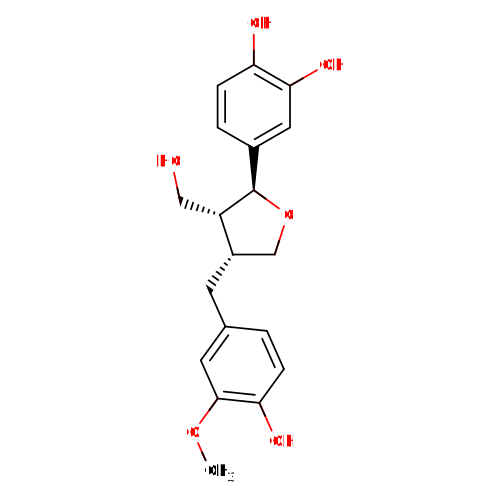
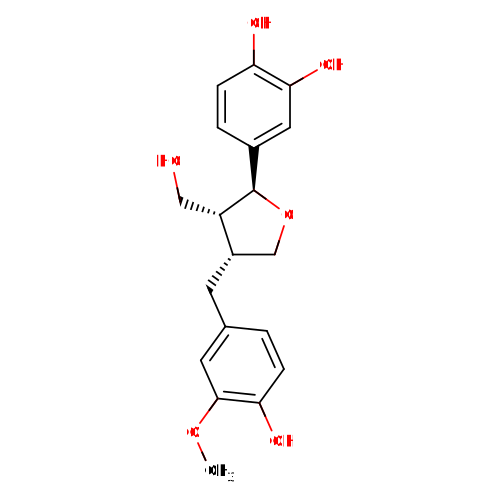
| Description | Taxiresinol belongs to the class of organic compounds known as 7,9'-epoxylignans. These are lignans that contain the 7,9'-epoxylignan skeleton, which consists of a tetrahydrofuran that carries a phenyl group, a methyl group, and a benzyl group at the 2-, 3-, 4-position, respectively. Taxiresinol is a secondary metabolite. Secondary metabolites are metabolically or physiologically non-essential metabolites that may serve a role as defense or signalling molecules. In some cases they are simply molecules that arise from the incomplete metabolism of other secondary metabolites. (+)-Taxiresinol is found in Daphne oleoides, Daphne oleoides spp. , Taxus baccata , Taxus cuspidata , Taxus mairei and Taxus wallichiana . (+)-Taxiresinol was first documented in 2003 (PMID: 14611890). Based on a literature review a significant number of articles have been published on taxiresinol (PMID: 21138310) (PMID: 25856716) (PMID: 22210027) (PMID: 21544613) (PMID: 20469636) (PMID: 19124280). |
|---|
| Structure | COC1=CC(C[C@H]2CO[C@@H]([C@H]2CO)C2=CC(O)=C(O)C=C2)=CC=C1O InChI=1S/C19H22O6/c1-24-18-7-11(2-4-16(18)22)6-13-10-25-19(14(13)9-20)12-3-5-15(21)17(23)8-12/h2-5,7-8,13-14,19-23H,6,9-10H2,1H3/t13-,14-,19+/m0/s1 |
|---|
| Synonyms | Not Available |
|---|
| Chemical Formula | C19H22O6 |
|---|
| Average Mass | 346.3790 Da |
|---|
| Monoisotopic Mass | 346.14164 Da |
|---|
| IUPAC Name | 4-[(2S,3R,4R)-4-[(4-hydroxy-3-methoxyphenyl)methyl]-3-(hydroxymethyl)oxolan-2-yl]benzene-1,2-diol |
|---|
| Traditional Name | 4-[(2S,3R,4R)-4-[(4-hydroxy-3-methoxyphenyl)methyl]-3-(hydroxymethyl)oxolan-2-yl]benzene-1,2-diol |
|---|
| CAS Registry Number | Not Available |
|---|
| SMILES | COC1=CC(C[C@H]2CO[C@@H]([C@H]2CO)C2=CC(O)=C(O)C=C2)=CC=C1O |
|---|
| InChI Identifier | InChI=1S/C19H22O6/c1-24-18-7-11(2-4-16(18)22)6-13-10-25-19(14(13)9-20)12-3-5-15(21)17(23)8-12/h2-5,7-8,13-14,19-23H,6,9-10H2,1H3/t13-,14-,19+/m0/s1 |
|---|
| InChI Key | SNZZAHRDXCGWEM-CKFHNAJUSA-N |
|---|
| Experimental Spectra |
|---|
|
| Not Available | | Predicted Spectra |
|---|
|
| | Spectrum Type | Description | Depositor ID | Depositor Organization | Depositor | Deposition Date | View |
|---|
| 1D NMR | 13C NMR Spectrum (1D, 25 MHz, D2O, predicted) | Wishart Lab | Wishart Lab | David Wishart | 2021-06-20 | View Spectrum | | 1D NMR | 1H NMR Spectrum (1D, 100 MHz, D2O, predicted) | Wishart Lab | Wishart Lab | David Wishart | 2021-06-20 | View Spectrum | | 1D NMR | 13C NMR Spectrum (1D, 252 MHz, D2O, predicted) | Wishart Lab | Wishart Lab | David Wishart | 2021-06-20 | View Spectrum | | 1D NMR | 1H NMR Spectrum (1D, 1000 MHz, D2O, predicted) | Wishart Lab | Wishart Lab | David Wishart | 2021-06-20 | View Spectrum | | 1D NMR | 13C NMR Spectrum (1D, 50 MHz, D2O, predicted) | Wishart Lab | Wishart Lab | David Wishart | 2021-06-20 | View Spectrum | | 1D NMR | 1H NMR Spectrum (1D, 200 MHz, D2O, predicted) | Wishart Lab | Wishart Lab | David Wishart | 2021-06-20 | View Spectrum | | 1D NMR | 13C NMR Spectrum (1D, 75 MHz, D2O, predicted) | Wishart Lab | Wishart Lab | David Wishart | 2021-06-20 | View Spectrum | | 1D NMR | 1H NMR Spectrum (1D, 300 MHz, D2O, predicted) | Wishart Lab | Wishart Lab | David Wishart | 2021-06-20 | View Spectrum | | 1D NMR | 13C NMR Spectrum (1D, 101 MHz, D2O, predicted) | Wishart Lab | Wishart Lab | David Wishart | 2021-06-20 | View Spectrum | | 1D NMR | 1H NMR Spectrum (1D, 400 MHz, D2O, predicted) | Wishart Lab | Wishart Lab | David Wishart | 2021-06-20 | View Spectrum | | 1D NMR | 13C NMR Spectrum (1D, 126 MHz, D2O, predicted) | Wishart Lab | Wishart Lab | David Wishart | 2021-06-20 | View Spectrum | | 1D NMR | 1H NMR Spectrum (1D, 500 MHz, D2O, predicted) | Wishart Lab | Wishart Lab | David Wishart | 2021-06-20 | View Spectrum | | 1D NMR | 13C NMR Spectrum (1D, 151 MHz, D2O, predicted) | Wishart Lab | Wishart Lab | David Wishart | 2021-06-20 | View Spectrum | | 1D NMR | 1H NMR Spectrum (1D, 600 MHz, D2O, predicted) | Wishart Lab | Wishart Lab | David Wishart | 2021-06-20 | View Spectrum | | 1D NMR | 13C NMR Spectrum (1D, 176 MHz, D2O, predicted) | Wishart Lab | Wishart Lab | David Wishart | 2021-06-20 | View Spectrum | | 1D NMR | 1H NMR Spectrum (1D, 700 MHz, D2O, predicted) | Wishart Lab | Wishart Lab | David Wishart | 2021-06-20 | View Spectrum | | 1D NMR | 13C NMR Spectrum (1D, 201 MHz, D2O, predicted) | Wishart Lab | Wishart Lab | David Wishart | 2021-06-20 | View Spectrum | | 1D NMR | 1H NMR Spectrum (1D, 800 MHz, D2O, predicted) | Wishart Lab | Wishart Lab | David Wishart | 2021-06-20 | View Spectrum | | 1D NMR | 13C NMR Spectrum (1D, 226 MHz, D2O, predicted) | Wishart Lab | Wishart Lab | David Wishart | 2021-06-20 | View Spectrum | | 1D NMR | 1H NMR Spectrum (1D, 900 MHz, D2O, predicted) | Wishart Lab | Wishart Lab | David Wishart | 2021-06-20 | View Spectrum |
| | Chemical Shift Submissions |
|---|
|
| Not Available | | Species |
|---|
| Species of Origin | |
|---|
| Chemical Taxonomy |
|---|
| Description | Belongs to the class of organic compounds known as 7,9'-epoxylignans. These are lignans that contain the 7,9'-epoxylignan skeleton, which consists of a tetrahydrofuran that carries a phenyl group, a methyl group, and a benzyl group at the 2-, 3-, 4-position, respectively. |
|---|
| Kingdom | Organic compounds |
|---|
| Super Class | Lignans, neolignans and related compounds |
|---|
| Class | Furanoid lignans |
|---|
| Sub Class | Tetrahydrofuran lignans |
|---|
| Direct Parent | 7,9'-epoxylignans |
|---|
| Alternative Parents | |
|---|
| Substituents | - 7,9p-epoxylignan
- Methoxyphenol
- Phenoxy compound
- Anisole
- Methoxybenzene
- Catechol
- Phenol ether
- 1-hydroxy-4-unsubstituted benzenoid
- 1-hydroxy-2-unsubstituted benzenoid
- Alkyl aryl ether
- Phenol
- Monocyclic benzene moiety
- Benzenoid
- Tetrahydrofuran
- Oxacycle
- Organoheterocyclic compound
- Dialkyl ether
- Ether
- Organic oxygen compound
- Alcohol
- Hydrocarbon derivative
- Primary alcohol
- Organooxygen compound
- Aromatic heteromonocyclic compound
|
|---|
| Molecular Framework | Aromatic heteromonocyclic compounds |
|---|
| External Descriptors | |
|---|
| Physical Properties |
|---|
| State | Not Available |
|---|
| Experimental Properties | | Property | Value | Reference |
|---|
| Melting Point | Not Available | Not Available | | Boiling Point | Not Available | Not Available | | Water Solubility | Not Available | Not Available | | LogP | Not Available | Not Available |
|
|---|
| Predicted Properties | |
|---|
| General References | - Tezuka Y, Morikawa K, Li F, Auw L, Awale S, Nobukawa T, Kadota S: Cytochrome P450 3A4 inhibitory constituents of the wood of Taxus yunnanensis. J Nat Prod. 2011 Jan 28;74(1):102-5. doi: 10.1021/np100665j. Epub 2010 Dec 7. [PubMed:21138310 ]
- Kupeli E, Erdemoglu N, Yesilada E, Sener B: Anti-inflammatory and antinociceptive activity of taxoids and lignans from the heartwood of Taxus baccata L. J Ethnopharmacol. 2003 Dec;89(2-3):265-70. doi: 10.1016/j.jep.2003.09.005. [PubMed:14611890 ]
- Ahmad I, Waheed A, Tahir NB, Rais AK: Anti-inflammatory constituents from Perovskia atriplicifolia. Pharm Biol. 2015;53(11):1628-31. doi: 10.3109/13880209.2014.997250. Epub 2015 Apr 9. [PubMed:25856716 ]
- Lee DG, Lee SM, Bang MH, Park HJ, Lee TH, Kim YH, Kim JY, Baek NI: Lignans from the flowers of Osmanthus fragrans var. aurantiacus and their inhibition effect on NO production. Arch Pharm Res. 2011 Dec;34(12):2029-35. doi: 10.1007/s12272-011-1204-y. Epub 2011 Dec 31. [PubMed:22210027 ]
- Bulgakov VP, Tchernoded GK, Veselova MV, Fedoreyev SA, Muzarok TI, Zhuravlev YN: Catechin production in cultured cells of Taxus cuspidata and Taxus baccata. Biotechnol Lett. 2011 Sep;33(9):1879-83. doi: 10.1007/s10529-011-0632-6. Epub 2011 May 5. [PubMed:21544613 ]
- Kucukboyaci N, Orhan I, Sener B, Nawaz SA, Choudhary MI: Assessment of enzyme inhibitory and antioxidant activities of lignans from Taxus baccata L. Z Naturforsch C J Biosci. 2010 Mar-Apr;65(3-4):187-94. doi: 10.1515/znc-2010-3-404. [PubMed:20469636 ]
- Koyama J, Takeuchi A, Tode C, Shimizu M, Morita I, Nobukawa M, Nobukawa M, Kobayashi N: Development of an LC-ESI-MS/MS method for the determination of histamine: application to the quantitative measurement of histamine degranulation by KU812 cells. J Chromatogr B Analyt Technol Biomed Life Sci. 2009 Jan 15;877(3):207-12. doi: 10.1016/j.jchromb.2008.12.012. Epub 2008 Dec 11. [PubMed:19124280 ]
- Koyama J, Morita I, Kobayashi N, Hirai K, Simamura E, Nobukawa T, Kadota S: Antiallergic activity of aqueous extracts and constituents of Taxus yunnanensis. Biol Pharm Bull. 2006 Nov;29(11):2310-2. doi: 10.1248/bpb.29.2310. [PubMed:17077536 ]
- Banskota AH, Nguyen NT, Tezuka Y, Nobukawa T, Kadota S: Hypoglycemic effects of the wood of Taxus yunnanensis on streptozotocin-induced diabetic rats and its active components. Phytomedicine. 2006 Jan;13(1-2):109-14. doi: 10.1016/j.phymed.2004.01.015. Epub 2005 Aug 15. [PubMed:16360940 ]
- Erdemoglu N, Sener B, Choudhary MI: Bioactivity of Lignans from Taxus baccata. Z Naturforsch C J Biosci. 2004 Jul-Aug;59(7-8):494-8. doi: 10.1515/znc-2004-7-807. [PubMed:15813367 ]
- Gurbuz I, Erdemoglu N, Yesilada E, Sener B: Anti-ulcerogenic lignans from Taxus baccata L. Z Naturforsch C J Biosci. 2004 Mar-Apr;59(3-4):233-6. doi: 10.1515/znc-2004-3-420. [PubMed:15241933 ]
- Nguyen NT, Banskota AH, Tezuka Y, Le Tran Q, Nobukawa T, Kurashige Y, Sasahara M, Kadota S: Hepatoprotective effect of taxiresinol and (7'R)-7'-hydroxylariciresinol on D-galactosamine and lipopolysaccharide-induced liver injury in mice. Planta Med. 2004 Jan;70(1):29-33. doi: 10.1055/s-2004-815451. [PubMed:14765289 ]
- Chattopadhyay SK, Kumar TR, Maulik PR, Srivastava S, Garg A, Sharon A, Negi AS, Khanuja SP: Absolute configuration and anticancer activity of taxiresinol and related lignans of Taxus wallichiana. Bioorg Med Chem. 2003 Nov 17;11(23):4945-8. doi: 10.1016/j.bmc.2003.09.010. [PubMed:14604656 ]
|
|---|