| Record Information |
|---|
| Version | 2.0 |
|---|
| Created at | 2022-04-28 00:08:51 UTC |
|---|
| Updated at | 2022-04-28 00:08:52 UTC |
|---|
| NP-MRD ID | NP0053512 |
|---|
| Secondary Accession Numbers | None |
|---|
| Natural Product Identification |
|---|
| Common Name | Reynoutrin |
|---|
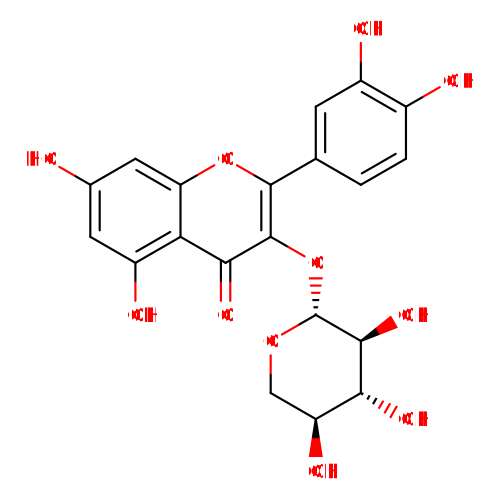
| Description | Reynoutrin belongs to the class of organic compounds known as flavonoid-3-o-glycosides. These are phenolic compounds containing a flavonoid moiety which is O-glycosidically linked to carbohydrate moiety at the C3-position. Reynoutrin is found in Aylthonia riedeliana, Begonia glaucophylla, Erythroxylum spp., Geranium niveum, Heuchera spp., Leptarrhena pyrolifolia, Patersonia maxwellii, Reynoutria japonoca, Ricinus communis , Rosa multiflora , Saxifraga ferruginea, Securidaca diversifolia , Solanum spp. and Woodfordia fruticosa . Reynoutrin was first documented in 2020 (PMID: 33187387). Based on a literature review a small amount of articles have been published on Reynoutrin (PMID: 34899946) (PMID: 34685955) (PMID: 34366855) (PMID: 33554403). |
|---|
| Structure | O[C@H]1CO[C@H](OC2=C(OC3=CC(O)=CC(O)=C3C2=O)C2=CC=C(O)C(O)=C2)[C@@H](O)[C@@H]1O InChI=1S/C20H18O11/c21-8-4-11(24)14-13(5-8)30-18(7-1-2-9(22)10(23)3-7)19(16(14)27)31-20-17(28)15(26)12(25)6-29-20/h1-5,12,15,17,20-26,28H,6H2/t12-,15+,17-,20+/m0/s1 |
|---|
| Synonyms | Not Available |
|---|
| Chemical Formula | C20H18O11 |
|---|
| Average Mass | 434.3530 Da |
|---|
| Monoisotopic Mass | 434.08491 Da |
|---|
| IUPAC Name | 2-(3,4-dihydroxyphenyl)-5,7-dihydroxy-3-{[(2R,3S,4R,5S)-3,4,5-trihydroxyoxan-2-yl]oxy}-4H-chromen-4-one |
|---|
| Traditional Name | 2-(3,4-dihydroxyphenyl)-5,7-dihydroxy-3-{[(2R,3S,4R,5S)-3,4,5-trihydroxyoxan-2-yl]oxy}chromen-4-one |
|---|
| CAS Registry Number | Not Available |
|---|
| SMILES | O[C@H]1CO[C@H](OC2=C(OC3=CC(O)=CC(O)=C3C2=O)C2=CC=C(O)C(O)=C2)[C@@H](O)[C@@H]1O |
|---|
| InChI Identifier | InChI=1S/C20H18O11/c21-8-4-11(24)14-13(5-8)30-18(7-1-2-9(22)10(23)3-7)19(16(14)27)31-20-17(28)15(26)12(25)6-29-20/h1-5,12,15,17,20-26,28H,6H2/t12-,15+,17-,20+/m0/s1 |
|---|
| InChI Key | PZZRDJXEMZMZFD-ODPGBAFUSA-N |
|---|
| Experimental Spectra |
|---|
|
| Not Available | | Predicted Spectra |
|---|
|
| | Spectrum Type | Description | Depositor ID | Depositor Organization | Depositor | Deposition Date | View |
|---|
| 1D NMR | 13C NMR Spectrum (1D, 25 MHz, D2O, predicted) | Wishart Lab | Wishart Lab | David Wishart | 2021-06-20 | View Spectrum | | 1D NMR | 1H NMR Spectrum (1D, 100 MHz, D2O, predicted) | Wishart Lab | Wishart Lab | David Wishart | 2021-06-20 | View Spectrum | | 1D NMR | 13C NMR Spectrum (1D, 252 MHz, D2O, predicted) | Wishart Lab | Wishart Lab | David Wishart | 2021-06-20 | View Spectrum | | 1D NMR | 1H NMR Spectrum (1D, 1000 MHz, D2O, predicted) | Wishart Lab | Wishart Lab | David Wishart | 2021-06-20 | View Spectrum | | 1D NMR | 13C NMR Spectrum (1D, 50 MHz, D2O, predicted) | Wishart Lab | Wishart Lab | David Wishart | 2021-06-20 | View Spectrum | | 1D NMR | 1H NMR Spectrum (1D, 200 MHz, D2O, predicted) | Wishart Lab | Wishart Lab | David Wishart | 2021-06-20 | View Spectrum | | 1D NMR | 13C NMR Spectrum (1D, 75 MHz, D2O, predicted) | Wishart Lab | Wishart Lab | David Wishart | 2021-06-20 | View Spectrum | | 1D NMR | 1H NMR Spectrum (1D, 300 MHz, D2O, predicted) | Wishart Lab | Wishart Lab | David Wishart | 2021-06-20 | View Spectrum | | 1D NMR | 13C NMR Spectrum (1D, 101 MHz, D2O, predicted) | Wishart Lab | Wishart Lab | David Wishart | 2021-06-20 | View Spectrum | | 1D NMR | 1H NMR Spectrum (1D, 400 MHz, D2O, predicted) | Wishart Lab | Wishart Lab | David Wishart | 2021-06-20 | View Spectrum | | 1D NMR | 13C NMR Spectrum (1D, 126 MHz, D2O, predicted) | Wishart Lab | Wishart Lab | David Wishart | 2021-06-20 | View Spectrum | | 1D NMR | 1H NMR Spectrum (1D, 500 MHz, D2O, predicted) | Wishart Lab | Wishart Lab | David Wishart | 2021-06-20 | View Spectrum | | 1D NMR | 13C NMR Spectrum (1D, 151 MHz, D2O, predicted) | Wishart Lab | Wishart Lab | David Wishart | 2021-06-20 | View Spectrum | | 1D NMR | 1H NMR Spectrum (1D, 600 MHz, D2O, predicted) | Wishart Lab | Wishart Lab | David Wishart | 2021-06-20 | View Spectrum | | 1D NMR | 13C NMR Spectrum (1D, 176 MHz, D2O, predicted) | Wishart Lab | Wishart Lab | David Wishart | 2021-06-20 | View Spectrum | | 1D NMR | 1H NMR Spectrum (1D, 700 MHz, D2O, predicted) | Wishart Lab | Wishart Lab | David Wishart | 2021-06-20 | View Spectrum | | 1D NMR | 13C NMR Spectrum (1D, 201 MHz, D2O, predicted) | Wishart Lab | Wishart Lab | David Wishart | 2021-06-20 | View Spectrum | | 1D NMR | 1H NMR Spectrum (1D, 800 MHz, D2O, predicted) | Wishart Lab | Wishart Lab | David Wishart | 2021-06-20 | View Spectrum | | 1D NMR | 13C NMR Spectrum (1D, 226 MHz, D2O, predicted) | Wishart Lab | Wishart Lab | David Wishart | 2021-06-20 | View Spectrum | | 1D NMR | 1H NMR Spectrum (1D, 900 MHz, D2O, predicted) | Wishart Lab | Wishart Lab | David Wishart | 2021-06-20 | View Spectrum |
| | Chemical Shift Submissions |
|---|
|
| Not Available | | Species |
|---|
| Species of Origin | |
|---|
| Chemical Taxonomy |
|---|
| Description | Belongs to the class of organic compounds known as flavonoid-3-o-glycosides. These are phenolic compounds containing a flavonoid moiety which is O-glycosidically linked to carbohydrate moiety at the C3-position. |
|---|
| Kingdom | Organic compounds |
|---|
| Super Class | Phenylpropanoids and polyketides |
|---|
| Class | Flavonoids |
|---|
| Sub Class | Flavonoid glycosides |
|---|
| Direct Parent | Flavonoid-3-O-glycosides |
|---|
| Alternative Parents | |
|---|
| Substituents | - Flavonoid-3-o-glycoside
- Hydroxyflavonoid
- 3'-hydroxyflavonoid
- 4'-hydroxyflavonoid
- 5-hydroxyflavonoid
- 7-hydroxyflavonoid
- Flavone
- O-glycosyl compound
- Glycosyl compound
- Chromone
- 1-benzopyran
- Benzopyran
- Catechol
- 1-hydroxy-2-unsubstituted benzenoid
- Phenol
- 1-hydroxy-4-unsubstituted benzenoid
- Pyranone
- Monocyclic benzene moiety
- Benzenoid
- Pyran
- Monosaccharide
- Oxane
- Vinylogous acid
- Heteroaromatic compound
- Secondary alcohol
- Organoheterocyclic compound
- Oxacycle
- Polyol
- Acetal
- Organic oxide
- Organic oxygen compound
- Alcohol
- Hydrocarbon derivative
- Organooxygen compound
- Aromatic heteropolycyclic compound
|
|---|
| Molecular Framework | Aromatic heteropolycyclic compounds |
|---|
| External Descriptors | Not Available |
|---|
| Physical Properties |
|---|
| State | Not Available |
|---|
| Experimental Properties | | Property | Value | Reference |
|---|
| Melting Point | Not Available | Not Available | | Boiling Point | Not Available | Not Available | | Water Solubility | Not Available | Not Available | | LogP | Not Available | Not Available |
|
|---|
| Predicted Properties | |
|---|
| General References | - Li D, Yang S, Ding HY, Chen HP, Liu YP, Hu Y: Hypoglycemic and Hepatoprotective Effects of Dried and Rice-Fried Psidium guajava Leaves in Diabetic Rats. Evid Based Complement Alternat Med. 2021 Dec 2;2021:3346676. doi: 10.1155/2021/3346676. eCollection 2021. [PubMed:34899946 ]
- Kostikova VA, Chernonosov AA, Kuznetsov AA, Petrova NV, Krivenko DA, Chernysheva OA, Wang W, Erst AS: Identification of Flavonoids in the Leaves of Eranthis longistipitata (Ranunculaceae) by Liquid Chromatography with High-Resolution Mass Spectrometry (LC-HRMS). Plants (Basel). 2021 Oct 10;10(10). pii: plants10102146. doi: 10.3390/plants10102146. [PubMed:34685955 ]
- Yang W, Tu H, Tang K, Huang H, Ou S, Wu J: Reynoutrin Improves Ischemic Heart Failure in Rats Via Targeting S100A1. Front Pharmacol. 2021 Jul 23;12:703962. doi: 10.3389/fphar.2021.703962. eCollection 2021. [PubMed:34366855 ]
- Santos AL, Soares MG, de Medeiros LS, Ferreira MJP, Sartorelli P: Identification of flavonoid-3-O-glycosides from leaves of Casearia arborea (Salicaceae) by UHPLC-DAD-ESI-HRMS/MS combined with molecular networking and NMR. Phytochem Anal. 2021 Nov;32(6):891-898. doi: 10.1002/pca.3032. Epub 2021 Feb 8. [PubMed:33554403 ]
- Butkeviciute A, Liaudanskas M, Kviklys D, Gelvonauskiene D, Janulis V: The Qualitative and Quantitative Compositions of Phenolic Compounds in Fruits of Lithuanian Heirloom Apple Cultivars. Molecules. 2020 Nov 11;25(22). pii: molecules25225263. doi: 10.3390/molecules25225263. [PubMed:33187387 ]
|
|---|