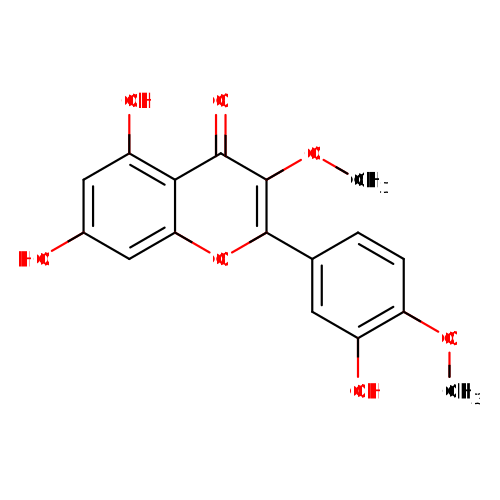
| Record Information |
|---|
| Version | 2.0 |
|---|
| Created at | 2022-04-27 23:48:01 UTC |
|---|
| Updated at | 2022-04-27 23:48:01 UTC |
|---|
| NP-MRD ID | NP0052918 |
|---|
| Secondary Accession Numbers | None |
|---|
| Natural Product Identification |
|---|
| Common Name | 5,7-Dihydroxy-2-(3-hydroxy-4-methoxyphenyl)-3-methoxy-4H-1-benzopyran-4-one |
|---|
| Description | Quercetin 3,4'-dimethyl ether belongs to the class of organic compounds known as 4'-o-methylated flavonoids. These are flavonoids with methoxy groups attached to the C4' atom of the flavonoid backbone. Thus, quercetin 3,4'-dimethyl ether is considered to be a flavonoid lipid molecule. 5,7-Dihydroxy-2-(3-hydroxy-4-methoxyphenyl)-3-methoxy-4H-1-benzopyran-4-one is found in Artemisia abrotanum, Artemisia incanescens, Asteriscus graveolens, Baccharis sarothroides, Balsamorhiza deltoidea, Balsamorhiza macrophylla, Blumea balsamifera, Brickellia arguta, Calycadenia truncata, Chiliadenus montanus, Chrysothamnus viscidiflorus, Cyperus alopecuroides, Eucryphia milliganii, Flourensia cernua, Grindelia tarapacana, Gutierrezia texana, Heterotheca inuloides, Jasonia montana, Petunia surfinia, Psiadia dentata and Vellozia streptophylla. Quercetin 3,4'-dimethyl ether is a very hydrophobic molecule, practically insoluble (in water), and relatively neutral. |
|---|
| Structure | COC1=CC=C(C=C1O)C1=C(OC)C(=O)C2=C(O)C=C(O)C=C2O1 InChI=1S/C17H14O7/c1-22-12-4-3-8(5-10(12)19)16-17(23-2)15(21)14-11(20)6-9(18)7-13(14)24-16/h3-7,18-20H,1-2H3 |
|---|
| Synonyms | | Value | Source |
|---|
| 5,7,3'-Trihydroxy-3,4'-dimethoxyflavone | ChEBI |
|
|---|
| Chemical Formula | C17H14O7 |
|---|
| Average Mass | 330.2920 Da |
|---|
| Monoisotopic Mass | 330.07395 Da |
|---|
| IUPAC Name | 5,7-dihydroxy-2-(3-hydroxy-4-methoxyphenyl)-3-methoxy-4H-chromen-4-one |
|---|
| Traditional Name | quercetin 3,4'-dimethyl ether |
|---|
| CAS Registry Number | Not Available |
|---|
| SMILES | COC1=CC=C(C=C1O)C1=C(OC)C(=O)C2=C(O)C=C(O)C=C2O1 |
|---|
| InChI Identifier | InChI=1S/C17H14O7/c1-22-12-4-3-8(5-10(12)19)16-17(23-2)15(21)14-11(20)6-9(18)7-13(14)24-16/h3-7,18-20H,1-2H3 |
|---|
| InChI Key | ZSPZNFOLWQEVQJ-UHFFFAOYSA-N |
|---|
| Experimental Spectra |
|---|
|
| Not Available | | Predicted Spectra |
|---|
|
| | Spectrum Type | Description | Depositor ID | Depositor Organization | Depositor | Deposition Date | View |
|---|
| 1D NMR | 13C NMR Spectrum (1D, 25 MHz, D2O, predicted) | Wishart Lab | Wishart Lab | David Wishart | 2021-06-20 | View Spectrum | | 1D NMR | 1H NMR Spectrum (1D, 100 MHz, D2O, predicted) | Wishart Lab | Wishart Lab | David Wishart | 2021-06-20 | View Spectrum | | 1D NMR | 13C NMR Spectrum (1D, 252 MHz, D2O, predicted) | Wishart Lab | Wishart Lab | David Wishart | 2021-06-20 | View Spectrum | | 1D NMR | 1H NMR Spectrum (1D, 1000 MHz, D2O, predicted) | Wishart Lab | Wishart Lab | David Wishart | 2021-06-20 | View Spectrum | | 1D NMR | 13C NMR Spectrum (1D, 50 MHz, D2O, predicted) | Wishart Lab | Wishart Lab | David Wishart | 2021-06-20 | View Spectrum | | 1D NMR | 1H NMR Spectrum (1D, 200 MHz, D2O, predicted) | Wishart Lab | Wishart Lab | David Wishart | 2021-06-20 | View Spectrum | | 1D NMR | 13C NMR Spectrum (1D, 75 MHz, D2O, predicted) | Wishart Lab | Wishart Lab | David Wishart | 2021-06-20 | View Spectrum | | 1D NMR | 1H NMR Spectrum (1D, 300 MHz, D2O, predicted) | Wishart Lab | Wishart Lab | David Wishart | 2021-06-20 | View Spectrum | | 1D NMR | 13C NMR Spectrum (1D, 101 MHz, D2O, predicted) | Wishart Lab | Wishart Lab | David Wishart | 2021-06-20 | View Spectrum | | 1D NMR | 1H NMR Spectrum (1D, 400 MHz, D2O, predicted) | Wishart Lab | Wishart Lab | David Wishart | 2021-06-20 | View Spectrum | | 1D NMR | 13C NMR Spectrum (1D, 126 MHz, D2O, predicted) | Wishart Lab | Wishart Lab | David Wishart | 2021-06-20 | View Spectrum | | 1D NMR | 1H NMR Spectrum (1D, 500 MHz, D2O, predicted) | Wishart Lab | Wishart Lab | David Wishart | 2021-06-20 | View Spectrum | | 1D NMR | 13C NMR Spectrum (1D, 151 MHz, D2O, predicted) | Wishart Lab | Wishart Lab | David Wishart | 2021-06-20 | View Spectrum | | 1D NMR | 1H NMR Spectrum (1D, 600 MHz, D2O, predicted) | Wishart Lab | Wishart Lab | David Wishart | 2021-06-20 | View Spectrum | | 1D NMR | 13C NMR Spectrum (1D, 176 MHz, D2O, predicted) | Wishart Lab | Wishart Lab | David Wishart | 2021-06-20 | View Spectrum | | 1D NMR | 1H NMR Spectrum (1D, 700 MHz, D2O, predicted) | Wishart Lab | Wishart Lab | David Wishart | 2021-06-20 | View Spectrum | | 1D NMR | 13C NMR Spectrum (1D, 201 MHz, D2O, predicted) | Wishart Lab | Wishart Lab | David Wishart | 2021-06-20 | View Spectrum | | 1D NMR | 1H NMR Spectrum (1D, 800 MHz, D2O, predicted) | Wishart Lab | Wishart Lab | David Wishart | 2021-06-20 | View Spectrum | | 1D NMR | 13C NMR Spectrum (1D, 226 MHz, D2O, predicted) | Wishart Lab | Wishart Lab | David Wishart | 2021-06-20 | View Spectrum | | 1D NMR | 1H NMR Spectrum (1D, 900 MHz, D2O, predicted) | Wishart Lab | Wishart Lab | David Wishart | 2021-06-20 | View Spectrum |
| | Chemical Shift Submissions |
|---|
|
| Not Available | | Species |
|---|
| Species of Origin | |
|---|
| Chemical Taxonomy |
|---|
| Description | Belongs to the class of organic compounds known as 4'-o-methylated flavonoids. These are flavonoids with methoxy groups attached to the C4' atom of the flavonoid backbone. |
|---|
| Kingdom | Organic compounds |
|---|
| Super Class | Phenylpropanoids and polyketides |
|---|
| Class | Flavonoids |
|---|
| Sub Class | O-methylated flavonoids |
|---|
| Direct Parent | 4'-O-methylated flavonoids |
|---|
| Alternative Parents | |
|---|
| Substituents | - 3-methoxyflavonoid-skeleton
- 4p-methoxyflavonoid-skeleton
- Hydroxyflavonoid
- 3'-hydroxyflavonoid
- 5-hydroxyflavonoid
- 7-hydroxyflavonoid
- Flavone
- 3-methoxychromone
- Chromone
- Methoxyphenol
- Benzopyran
- 1-benzopyran
- Phenoxy compound
- Methoxybenzene
- Anisole
- Phenol ether
- Phenol
- Pyranone
- Alkyl aryl ether
- 1-hydroxy-2-unsubstituted benzenoid
- 1-hydroxy-4-unsubstituted benzenoid
- Monocyclic benzene moiety
- Benzenoid
- Pyran
- Vinylogous acid
- Heteroaromatic compound
- Organoheterocyclic compound
- Oxacycle
- Ether
- Organic oxide
- Organic oxygen compound
- Hydrocarbon derivative
- Organooxygen compound
- Aromatic heteropolycyclic compound
|
|---|
| Molecular Framework | Aromatic heteropolycyclic compounds |
|---|
| External Descriptors | |
|---|
| Physical Properties |
|---|
| State | Not Available |
|---|
| Experimental Properties | | Property | Value | Reference |
|---|
| Melting Point | Not Available | Not Available | | Boiling Point | Not Available | Not Available | | Water Solubility | Not Available | Not Available | | LogP | Not Available | Not Available |
|
|---|
| Predicted Properties | |
|---|