| Record Information |
|---|
| Version | 2.0 |
|---|
| Created at | 2022-04-27 23:32:56 UTC |
|---|
| Updated at | 2022-04-27 23:32:56 UTC |
|---|
| NP-MRD ID | NP0052543 |
|---|
| Secondary Accession Numbers | None |
|---|
| Natural Product Identification |
|---|
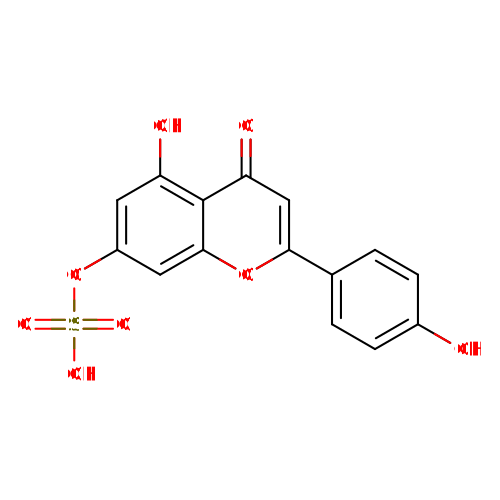
| Common Name | Apigenin 7-sulfate |
|---|
| Description | Apigenin 7-sulfate belongs to the class of organic compounds known as flavones. These are flavonoids with a structure based on the backbone of 2-phenylchromen-4-one (2-phenyl-1-benzopyran-4-one). Apigenin 7-sulfate is a very hydrophobic molecule, practically insoluble (in water), and relatively neutral. Apigenin 7-sulfate is isolated from Bixa orellana (annatto) Apigenin is a flavone that is the aglycone of several glycosides. Moreover, apigenin does not sensitize normal human peripheral blood mononuclear cells to TRAIL-induced apoptosis. Activation of hINV promoter activity by the green tea polyphenol, (-)-epigellocathecin-3-gallate, is also inhibited by apigenin, suggesting that the two chemopreventive agents can produce opposing actions in keratinocytes. Apigenin is a plant-derived flavonoid that has significant promise as a skin cancer chemopreventive agent. Apigenin suppresses the 12-O-tetradeconylphorbol-13-acetate-dependent increase in AP1 factor expression and binding to the hINV promoter and the increase in hINV promoter activity. This flavonoid provides selective activity to promote caspase-dependent-apoptosis of leukemia cells and uncover an essential role of PKCdelta during the induction of apoptosis by apigenin. Apigenin inhibits the expression of involucrin (hINV), a marker of keratinocyte differentiation, is increased by differentiating agents via a protein kinase Cdelta (PKCdelta), Ras, MEKK1, MEK3 cascade that increases AP1 factor level and AP1 factor binding to DNA elements in the hINV promoter. On the other hand, apigenin-mediated induction of DR5 expression is not observed in normal human peripheral blood mononuclear cells. Apigenin also inhibits the increase in promoter activity observed following overexpression of PKCdelta, constitutively active Ras, or MEKK1. The suppression of PKCdelta activity is associated with reduced phosphorylation of PKCdelta-Y311. Apigenin 7-sulfate is found in Bixa orellana and Fuchsia procumbens. It is a yellow crystalline solid that has been used to dye wool. |
|---|
| Structure | OC1=CC=C(C=C1)C1=CC(=O)C2=C(O)C=C(OS(O)(=O)=O)C=C2O1 InChI=1S/C15H10O8S/c16-9-3-1-8(2-4-9)13-7-12(18)15-11(17)5-10(6-14(15)22-13)23-24(19,20)21/h1-7,16-17H,(H,19,20,21) |
|---|
| Synonyms | | Value | Source |
|---|
| Apigenin 7-sulfuric acid | Generator | | Apigenin 7-sulphate | Generator | | Apigenin 7-sulphuric acid | Generator |
|
|---|
| Chemical Formula | C15H10O8S |
|---|
| Average Mass | 350.3000 Da |
|---|
| Monoisotopic Mass | 350.00964 Da |
|---|
| IUPAC Name | [5-hydroxy-2-(4-hydroxyphenyl)-4-oxo-4H-chromen-7-yl]oxidanesulfonic acid |
|---|
| Traditional Name | apigenin 7-sulfate |
|---|
| CAS Registry Number | Not Available |
|---|
| SMILES | OC1=CC=C(C=C1)C1=CC(=O)C2=C(O)C=C(OS(O)(=O)=O)C=C2O1 |
|---|
| InChI Identifier | InChI=1S/C15H10O8S/c16-9-3-1-8(2-4-9)13-7-12(18)15-11(17)5-10(6-14(15)22-13)23-24(19,20)21/h1-7,16-17H,(H,19,20,21) |
|---|
| InChI Key | UQUHXFINOFUDCC-UHFFFAOYSA-N |
|---|
| Experimental Spectra |
|---|
|
| Not Available | | Predicted Spectra |
|---|
|
| | Spectrum Type | Description | Depositor ID | Depositor Organization | Depositor | Deposition Date | View |
|---|
| 1D NMR | 13C NMR Spectrum (1D, 25 MHz, D2O, predicted) | Wishart Lab | Wishart Lab | David Wishart | 2021-06-20 | View Spectrum | | 1D NMR | 1H NMR Spectrum (1D, 100 MHz, D2O, predicted) | Wishart Lab | Wishart Lab | David Wishart | 2021-06-20 | View Spectrum | | 1D NMR | 13C NMR Spectrum (1D, 252 MHz, D2O, predicted) | Wishart Lab | Wishart Lab | David Wishart | 2021-06-20 | View Spectrum | | 1D NMR | 1H NMR Spectrum (1D, 1000 MHz, D2O, predicted) | Wishart Lab | Wishart Lab | David Wishart | 2021-06-20 | View Spectrum | | 1D NMR | 13C NMR Spectrum (1D, 50 MHz, D2O, predicted) | Wishart Lab | Wishart Lab | David Wishart | 2021-06-20 | View Spectrum | | 1D NMR | 1H NMR Spectrum (1D, 200 MHz, D2O, predicted) | Wishart Lab | Wishart Lab | David Wishart | 2021-06-20 | View Spectrum | | 1D NMR | 13C NMR Spectrum (1D, 75 MHz, D2O, predicted) | Wishart Lab | Wishart Lab | David Wishart | 2021-06-20 | View Spectrum | | 1D NMR | 1H NMR Spectrum (1D, 300 MHz, D2O, predicted) | Wishart Lab | Wishart Lab | David Wishart | 2021-06-20 | View Spectrum | | 1D NMR | 13C NMR Spectrum (1D, 101 MHz, D2O, predicted) | Wishart Lab | Wishart Lab | David Wishart | 2021-06-20 | View Spectrum | | 1D NMR | 1H NMR Spectrum (1D, 400 MHz, D2O, predicted) | Wishart Lab | Wishart Lab | David Wishart | 2021-06-20 | View Spectrum | | 1D NMR | 13C NMR Spectrum (1D, 126 MHz, D2O, predicted) | Wishart Lab | Wishart Lab | David Wishart | 2021-06-20 | View Spectrum | | 1D NMR | 1H NMR Spectrum (1D, 500 MHz, D2O, predicted) | Wishart Lab | Wishart Lab | David Wishart | 2021-06-20 | View Spectrum | | 1D NMR | 13C NMR Spectrum (1D, 151 MHz, D2O, predicted) | Wishart Lab | Wishart Lab | David Wishart | 2021-06-20 | View Spectrum | | 1D NMR | 1H NMR Spectrum (1D, 600 MHz, D2O, predicted) | Wishart Lab | Wishart Lab | David Wishart | 2021-06-20 | View Spectrum | | 1D NMR | 13C NMR Spectrum (1D, 176 MHz, D2O, predicted) | Wishart Lab | Wishart Lab | David Wishart | 2021-06-20 | View Spectrum | | 1D NMR | 1H NMR Spectrum (1D, 700 MHz, D2O, predicted) | Wishart Lab | Wishart Lab | David Wishart | 2021-06-20 | View Spectrum | | 1D NMR | 13C NMR Spectrum (1D, 201 MHz, D2O, predicted) | Wishart Lab | Wishart Lab | David Wishart | 2021-06-20 | View Spectrum | | 1D NMR | 1H NMR Spectrum (1D, 800 MHz, D2O, predicted) | Wishart Lab | Wishart Lab | David Wishart | 2021-06-20 | View Spectrum | | 1D NMR | 13C NMR Spectrum (1D, 226 MHz, D2O, predicted) | Wishart Lab | Wishart Lab | David Wishart | 2021-06-20 | View Spectrum | | 1D NMR | 1H NMR Spectrum (1D, 900 MHz, D2O, predicted) | Wishart Lab | Wishart Lab | David Wishart | 2021-06-20 | View Spectrum |
| | Chemical Shift Submissions |
|---|
|
| Not Available | | Species |
|---|
| Species of Origin | |
|---|
| Chemical Taxonomy |
|---|
| Description | Belongs to the class of organic compounds known as flavones. These are flavonoids with a structure based on the backbone of 2-phenylchromen-4-one (2-phenyl-1-benzopyran-4-one). |
|---|
| Kingdom | Organic compounds |
|---|
| Super Class | Phenylpropanoids and polyketides |
|---|
| Class | Flavonoids |
|---|
| Sub Class | Flavones |
|---|
| Direct Parent | Flavones |
|---|
| Alternative Parents | |
|---|
| Substituents | - 4'-hydroxyflavonoid
- 5-hydroxyflavonoid
- Flavone
- Hydroxyflavonoid
- Chromone
- Arylsulfate
- Benzopyran
- 1-benzopyran
- 1-hydroxy-4-unsubstituted benzenoid
- 1-hydroxy-2-unsubstituted benzenoid
- Phenol
- Pyranone
- Monocyclic benzene moiety
- Benzenoid
- Pyran
- Sulfuric acid monoester
- Sulfate-ester
- Sulfuric acid ester
- Organic sulfuric acid or derivatives
- Vinylogous acid
- Heteroaromatic compound
- Organoheterocyclic compound
- Oxacycle
- Organooxygen compound
- Organic oxide
- Organic oxygen compound
- Hydrocarbon derivative
- Aromatic heteropolycyclic compound
|
|---|
| Molecular Framework | Aromatic heteropolycyclic compounds |
|---|
| External Descriptors | |
|---|
| Physical Properties |
|---|
| State | Not Available |
|---|
| Experimental Properties | | Property | Value | Reference |
|---|
| Melting Point | Not Available | Not Available | | Boiling Point | Not Available | Not Available | | Water Solubility | Not Available | Not Available | | LogP | Not Available | Not Available |
|
|---|
| Predicted Properties | |
|---|