| Record Information |
|---|
| Version | 2.0 |
|---|
| Created at | 2022-04-27 23:22:00 UTC |
|---|
| Updated at | 2022-04-27 23:22:00 UTC |
|---|
| NP-MRD ID | NP0052230 |
|---|
| Secondary Accession Numbers | None |
|---|
| Natural Product Identification |
|---|
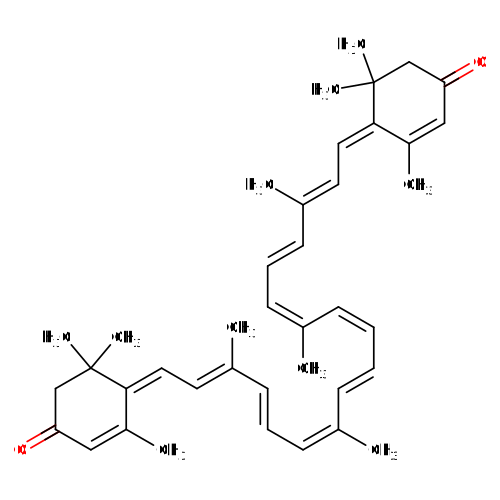
| Common Name | Rhodoxanthin |
|---|
| Description | Rhodoxanthin belongs to the class of organic compounds known as xanthophylls. These are carotenoids containing an oxygenated carotene backbone. Carotenes are characterized by the presence of two end-groups (mostly cyclohexene rings, but also cyclopentene rings or acyclic groups) linked by a long branched alkyl chain. Carotenes belonging form a subgroup of the carotenoids family. Xanthophylls arise by oxygenation of the carotene backbone. Thus, rhodoxanthin is considered to be an isoprenoid. Rhodoxanthin is found in Adiantum spp., Cladonia gracilis, Cladonia rangiferina, Ctenopharyngodon idella, Cyrtomium falcatum, Epicoccum nigrum, Epicoccum spp., Equisetum arvense , Ilicura militaris, Lonicera ruprechtiana, Metasequoia glyptostroboides, Micrococcus tetragenus, Potamogeton natans, Taxus baccata and Taxus cuspidata. Rhodoxanthin was first documented in 2013 (PMID: 24055537). Based on a literature review a significant number of articles have been published on Rhodoxanthin (PMID: 34957624) (PMID: 33845183) (PMID: 35344590) (PMID: 33373476) (PMID: 32645673) (PMID: 32426461). |
|---|
| Structure | C\C(\C=C\C=C\C(\C)=C\C=C\C(\C)=C\C=C1\C(C)=CC(=O)CC1(C)C)=C/C=C/C(/C)=C/C=C1/C(C)=CC(=O)CC1(C)C InChI=1S/C40H50O2/c1-29(17-13-19-31(3)21-23-37-33(5)25-35(41)27-39(37,7)8)15-11-12-16-30(2)18-14-20-32(4)22-24-38-34(6)26-36(42)28-40(38,9)10/h11-26H,27-28H2,1-10H3/b15-11+,16-12+,19-13+,20-14+,29-17+,30-18+,31-21+,32-22+,37-23-,38-24- |
|---|
| Synonyms | Not Available |
|---|
| Chemical Formula | C40H50O2 |
|---|
| Average Mass | 562.8380 Da |
|---|
| Monoisotopic Mass | 562.38108 Da |
|---|
| IUPAC Name | (4E)-3,5,5-trimethyl-4-[(2E,4E,6E,8E,10E,12E,14E,16E)-3,7,12,16-tetramethyl-18-[(1E)-2,6,6-trimethyl-4-oxocyclohex-2-en-1-ylidene]octadeca-2,4,6,8,10,12,14,16-octaen-1-ylidene]cyclohex-2-en-1-one |
|---|
| Traditional Name | rhodoxanthin |
|---|
| CAS Registry Number | Not Available |
|---|
| SMILES | C\C(\C=C\C=C\C(\C)=C\C=C\C(\C)=C\C=C1\C(C)=CC(=O)CC1(C)C)=C/C=C/C(/C)=C/C=C1/C(C)=CC(=O)CC1(C)C |
|---|
| InChI Identifier | InChI=1S/C40H50O2/c1-29(17-13-19-31(3)21-23-37-33(5)25-35(41)27-39(37,7)8)15-11-12-16-30(2)18-14-20-32(4)22-24-38-34(6)26-36(42)28-40(38,9)10/h11-26H,27-28H2,1-10H3/b15-11+,16-12+,19-13+,20-14+,29-17+,30-18+,31-21+,32-22+,37-23-,38-24- |
|---|
| InChI Key | VWXMLZQUDPCJPL-ZDHAIZATSA-N |
|---|
| Experimental Spectra |
|---|
|
| Not Available | | Predicted Spectra |
|---|
|
| | Spectrum Type | Description | Depositor ID | Depositor Organization | Depositor | Deposition Date | View |
|---|
| 1D NMR | 13C NMR Spectrum (1D, 25 MHz, D2O, predicted) | Wishart Lab | Wishart Lab | David Wishart | 2021-06-20 | View Spectrum | | 1D NMR | 1H NMR Spectrum (1D, 100 MHz, D2O, predicted) | Wishart Lab | Wishart Lab | David Wishart | 2021-06-20 | View Spectrum | | 1D NMR | 13C NMR Spectrum (1D, 252 MHz, D2O, predicted) | Wishart Lab | Wishart Lab | David Wishart | 2021-06-20 | View Spectrum | | 1D NMR | 1H NMR Spectrum (1D, 1000 MHz, D2O, predicted) | Wishart Lab | Wishart Lab | David Wishart | 2021-06-20 | View Spectrum | | 1D NMR | 13C NMR Spectrum (1D, 50 MHz, D2O, predicted) | Wishart Lab | Wishart Lab | David Wishart | 2021-06-20 | View Spectrum | | 1D NMR | 1H NMR Spectrum (1D, 200 MHz, D2O, predicted) | Wishart Lab | Wishart Lab | David Wishart | 2021-06-20 | View Spectrum | | 1D NMR | 13C NMR Spectrum (1D, 75 MHz, D2O, predicted) | Wishart Lab | Wishart Lab | David Wishart | 2021-06-20 | View Spectrum | | 1D NMR | 1H NMR Spectrum (1D, 300 MHz, D2O, predicted) | Wishart Lab | Wishart Lab | David Wishart | 2021-06-20 | View Spectrum | | 1D NMR | 13C NMR Spectrum (1D, 101 MHz, D2O, predicted) | Wishart Lab | Wishart Lab | David Wishart | 2021-06-20 | View Spectrum | | 1D NMR | 1H NMR Spectrum (1D, 400 MHz, D2O, predicted) | Wishart Lab | Wishart Lab | David Wishart | 2021-06-20 | View Spectrum | | 1D NMR | 13C NMR Spectrum (1D, 126 MHz, D2O, predicted) | Wishart Lab | Wishart Lab | David Wishart | 2021-06-20 | View Spectrum | | 1D NMR | 1H NMR Spectrum (1D, 500 MHz, D2O, predicted) | Wishart Lab | Wishart Lab | David Wishart | 2021-06-20 | View Spectrum | | 1D NMR | 13C NMR Spectrum (1D, 151 MHz, D2O, predicted) | Wishart Lab | Wishart Lab | David Wishart | 2021-06-20 | View Spectrum | | 1D NMR | 1H NMR Spectrum (1D, 600 MHz, D2O, predicted) | Wishart Lab | Wishart Lab | David Wishart | 2021-06-20 | View Spectrum | | 1D NMR | 13C NMR Spectrum (1D, 176 MHz, D2O, predicted) | Wishart Lab | Wishart Lab | David Wishart | 2021-06-20 | View Spectrum | | 1D NMR | 1H NMR Spectrum (1D, 700 MHz, D2O, predicted) | Wishart Lab | Wishart Lab | David Wishart | 2021-06-20 | View Spectrum | | 1D NMR | 13C NMR Spectrum (1D, 201 MHz, D2O, predicted) | Wishart Lab | Wishart Lab | David Wishart | 2021-06-20 | View Spectrum | | 1D NMR | 1H NMR Spectrum (1D, 800 MHz, D2O, predicted) | Wishart Lab | Wishart Lab | David Wishart | 2021-06-20 | View Spectrum | | 1D NMR | 13C NMR Spectrum (1D, 226 MHz, D2O, predicted) | Wishart Lab | Wishart Lab | David Wishart | 2021-06-20 | View Spectrum | | 1D NMR | 1H NMR Spectrum (1D, 900 MHz, D2O, predicted) | Wishart Lab | Wishart Lab | David Wishart | 2021-06-20 | View Spectrum |
| | Chemical Shift Submissions |
|---|
|
| Not Available | | Species |
|---|
| Species of Origin | |
|---|
| Chemical Taxonomy |
|---|
| Description | Belongs to the class of organic compounds known as xanthophylls. These are carotenoids containing an oxygenated carotene backbone. Carotenes are characterized by the presence of two end-groups (mostly cyclohexene rings, but also cyclopentene rings or acyclic groups) linked by a long branched alkyl chain. Carotenes belonging form a subgroup of the carotenoids family. Xanthophylls arise by oxygenation of the carotene backbone. |
|---|
| Kingdom | Organic compounds |
|---|
| Super Class | Lipids and lipid-like molecules |
|---|
| Class | Prenol lipids |
|---|
| Sub Class | Tetraterpenoids |
|---|
| Direct Parent | Xanthophylls |
|---|
| Alternative Parents | |
|---|
| Substituents | - Xanthophyll
- Cyclohexenone
- Cyclic ketone
- Ketone
- Organic oxygen compound
- Organic oxide
- Hydrocarbon derivative
- Organooxygen compound
- Carbonyl group
- Aliphatic homomonocyclic compound
|
|---|
| Molecular Framework | Aliphatic homomonocyclic compounds |
|---|
| External Descriptors | |
|---|
| Physical Properties |
|---|
| State | Not Available |
|---|
| Experimental Properties | | Property | Value | Reference |
|---|
| Melting Point | Not Available | Not Available | | Boiling Point | Not Available | Not Available | | Water Solubility | Not Available | Not Available | | LogP | Not Available | Not Available |
|
|---|
| Predicted Properties | |
|---|
| General References | - Schex R, Schweiggert R, Steingass CB: Atmospheric pressure chemical ionization mass spectrometry of retro-carotenoids. Rapid Commun Mass Spectrom. 2022 Apr 15;36(7):e9250. doi: 10.1002/rcm.9250. [PubMed:34957624 ]
- Schex R, Lieb VM, Schafer C, Schweiggert R, Steingass CB: Carotenoid profiles of red- and yellow-colored arils of cultivars of Taxus baccata L. and Taxus x media Rehder. Phytochemistry. 2021 Jun;186:112741. doi: 10.1016/j.phytochem.2021.112741. Epub 2021 Apr 10. [PubMed:33845183 ]
- Furubayashi M, Maoka T, Mitani Y: Promiscuous activity of beta-carotene hydroxylase CrtZ on epoxycarotenoids leads to the formation of rare carotenoids with 6-hydroxy-3-keto-epsilon-ends. FEBS Lett. 2022 Mar 28. doi: 10.1002/1873-3468.14342. [PubMed:35344590 ]
- Khan T, Litvin R, Sebelik V, Polivka T: Excited-State Evolution of Keto-Carotenoids after Excess Energy Excitation in the UV Region. Chemphyschem. 2021 Mar 3;22(5):471-480. doi: 10.1002/cphc.202000982. Epub 2021 Feb 2. [PubMed:33373476 ]
- Schex R, Bonrath W, Schafer C, Schweiggert R: The impact of (E/Z)-isomerization and aggregation on the color of rhodoxanthin formulations for food and beverages. Food Chem. 2020 Dec 1;332:127370. doi: 10.1016/j.foodchem.2020.127370. Epub 2020 Jun 23. [PubMed:32645673 ]
- Royer J, Shanklin J, Balch-Kenney N, Mayorga M, Houston P, de Jong RM, McMahon J, Laprade L, Blomquist P, Berry T, Cai Y, LoBuglio K, Trueheart J, Chevreux B: Rhodoxanthin synthase from honeysuckle; a membrane diiron enzyme catalyzes the multistep conversation of beta-carotene to rhodoxanthin. Sci Adv. 2020 Apr 22;6(17):eaay9226. doi: 10.1126/sciadv.aay9226. eCollection 2020 Apr. [PubMed:32426461 ]
- Schex R, Schweiggert F, Wustenberg B, Bonrath W, Schafer C, Schweiggert R: Kinetic and Thermodynamic Study of the Thermally Induced (E/Z)-Isomerization of the retro-Carotenoid Rhodoxanthin. J Agric Food Chem. 2020 May 6;68(18):5259-5269. doi: 10.1021/acs.jafc.0c00933. Epub 2020 Apr 21. [PubMed:32314916 ]
- Poliak P, Skorna P, Klein E, Lukes V: Thermodynamics of radical scavenging of symmetric carotenoids and their charged species. Food Chem. 2018 Dec 1;268:542-549. doi: 10.1016/j.foodchem.2018.06.063. Epub 2018 Jun 14. [PubMed:30064795 ]
- Berg CJ, LaFountain AM, Prum RO, Frank HA, Tauber MJ: Vibrational and electronic spectroscopy of the retro-carotenoid rhodoxanthin in avian plumage, solid-state films, and solution. Arch Biochem Biophys. 2013 Nov 15;539(2):142-55. doi: 10.1016/j.abb.2013.09.009. Epub 2013 Sep 19. [PubMed:24055537 ]
- Subhash Y, Tushar L, Sasikala C, Ramana CV: Mongoliicoccus alkaliphilus sp. nov. and Litoribacter alkaliphilus sp. nov., isolated from salt pans. Int J Syst Evol Microbiol. 2013 Sep;63(Pt 9):3457-3462. doi: 10.1099/ijs.0.049924-0. Epub 2013 Mar 29. [PubMed:23543498 ]
|
|---|