| Record Information |
|---|
| Version | 2.0 |
|---|
| Created at | 2022-04-27 23:14:15 UTC |
|---|
| Updated at | 2022-04-27 23:14:15 UTC |
|---|
| NP-MRD ID | NP0052059 |
|---|
| Secondary Accession Numbers | None |
|---|
| Natural Product Identification |
|---|
| Common Name | Triptolide |
|---|
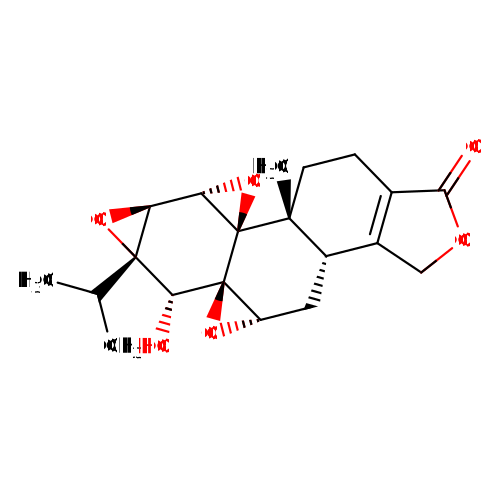
| Description | Triptolide belongs to the class of organic compounds known as oxepanes. Oxepanes are compounds containing an oxepane ring, which is a seven-member saturated aliphatic heterocycle with one oxygen and six carbon atoms. Cys342 of XPB was identified as the residue that undergoes covalent modification by the 12,13-epoxide group of triptolide, and the XPB-C342T mutant rendered the T7115 cell line nearly completely resistant to triptolide. Several putative target proteins of triptolide have been reported, including polycystin-2, ADAM10, DCTPP1, TAB1, and XPB. Triptolide is an extremely weak basic (essentially neutral) compound (based on its pKa). Its Phase II clinical trials are expected to conclude in February 2019. In a preclinical mouse model of pancreatic cancer, it was "even more effective than gemcitabine". The level of resistance conferred by the C342T mutation is about 100-fold higher than the most triptolide-resistant mutants previously identified. Consequently, a synthetic water-soluble prodrug, minnelide, is being studied clinically instead. Triptolide is a diterpenoid epoxide which is produced by the thunder god vine, Tripterygium wilfordii. However, no triptolide-resistant mutations were found in polycystin-2, ADAM10, DCTPP1 and TAB1. Water-soluble prodrugs Minnelide is a more water-soluble synthetic analog of triptolide which is converted to triptolide in vivo. Triptolide is found in Tripterygium hypoglaucum and Tripterygium wilfordii . Glutriptolide, a glucose conjugate of triptolide with better solubility and lower toxicity, did not inhibit XPB activity in vitro, but exhibited tumor control in vivo, which is likely due to sustained stepwise release of active triptolide within cancer cells. |
|---|
| Structure | CC(C)[C@]12O[C@H]1[C@@H]1O[C@]11[C@]3(O[C@H]3C[C@H]3C4=C(CC[C@]13C)C(=O)OC4)[C@@H]2O InChI=1S/C20H24O6/c1-8(2)18-13(25-18)14-20(26-14)17(3)5-4-9-10(7-23-15(9)21)11(17)6-12-19(20,24-12)16(18)22/h8,11-14,16,22H,4-7H2,1-3H3/t11-,12-,13-,14-,16+,17-,18-,19+,20+/m0/s1 |
|---|
| Synonyms | Not Available |
|---|
| Chemical Formula | C20H24O6 |
|---|
| Average Mass | 360.4060 Da |
|---|
| Monoisotopic Mass | 360.15729 Da |
|---|
| IUPAC Name | (1S,2S,4S,5S,7R,8R,9S,11S,13S)-8-hydroxy-1-methyl-7-(propan-2-yl)-3,6,10,16-tetraoxaheptacyclo[11.7.0.0^{2,4}.0^{2,9}.0^{5,7}.0^{9,11}.0^{14,18}]icos-14(18)-en-17-one |
|---|
| Traditional Name | (1S,2S,4S,5S,7R,8R,9S,11S,13S)-8-hydroxy-7-isopropyl-1-methyl-3,6,10,16-tetraoxaheptacyclo[11.7.0.0^{2,4}.0^{2,9}.0^{5,7}.0^{9,11}.0^{14,18}]icos-14(18)-en-17-one |
|---|
| CAS Registry Number | Not Available |
|---|
| SMILES | CC(C)[C@]12O[C@H]1[C@@H]1O[C@]11[C@]3(O[C@H]3C[C@H]3C4=C(CC[C@]13C)C(=O)OC4)[C@@H]2O |
|---|
| InChI Identifier | InChI=1S/C20H24O6/c1-8(2)18-13(25-18)14-20(26-14)17(3)5-4-9-10(7-23-15(9)21)11(17)6-12-19(20,24-12)16(18)22/h8,11-14,16,22H,4-7H2,1-3H3/t11-,12-,13-,14-,16+,17-,18-,19+,20+/m0/s1 |
|---|
| InChI Key | DFBIRQPKNDILPW-CIVMWXNOSA-N |
|---|
| Experimental Spectra |
|---|
|
| Not Available | | Predicted Spectra |
|---|
|
| | Spectrum Type | Description | Depositor ID | Depositor Organization | Depositor | Deposition Date | View |
|---|
| 1D NMR | 13C NMR Spectrum (1D, 25 MHz, D2O, predicted) | Wishart Lab | Wishart Lab | David Wishart | 2021-06-20 | View Spectrum | | 1D NMR | 1H NMR Spectrum (1D, 100 MHz, D2O, predicted) | Wishart Lab | Wishart Lab | David Wishart | 2021-06-20 | View Spectrum | | 1D NMR | 13C NMR Spectrum (1D, 252 MHz, D2O, predicted) | Wishart Lab | Wishart Lab | David Wishart | 2021-06-20 | View Spectrum | | 1D NMR | 1H NMR Spectrum (1D, 1000 MHz, D2O, predicted) | Wishart Lab | Wishart Lab | David Wishart | 2021-06-20 | View Spectrum | | 1D NMR | 13C NMR Spectrum (1D, 50 MHz, D2O, predicted) | Wishart Lab | Wishart Lab | David Wishart | 2021-06-20 | View Spectrum | | 1D NMR | 1H NMR Spectrum (1D, 200 MHz, D2O, predicted) | Wishart Lab | Wishart Lab | David Wishart | 2021-06-20 | View Spectrum | | 1D NMR | 13C NMR Spectrum (1D, 75 MHz, D2O, predicted) | Wishart Lab | Wishart Lab | David Wishart | 2021-06-20 | View Spectrum | | 1D NMR | 1H NMR Spectrum (1D, 300 MHz, D2O, predicted) | Wishart Lab | Wishart Lab | David Wishart | 2021-06-20 | View Spectrum | | 1D NMR | 13C NMR Spectrum (1D, 101 MHz, D2O, predicted) | Wishart Lab | Wishart Lab | David Wishart | 2021-06-20 | View Spectrum | | 1D NMR | 1H NMR Spectrum (1D, 400 MHz, D2O, predicted) | Wishart Lab | Wishart Lab | David Wishart | 2021-06-20 | View Spectrum | | 1D NMR | 13C NMR Spectrum (1D, 126 MHz, D2O, predicted) | Wishart Lab | Wishart Lab | David Wishart | 2021-06-20 | View Spectrum | | 1D NMR | 1H NMR Spectrum (1D, 500 MHz, D2O, predicted) | Wishart Lab | Wishart Lab | David Wishart | 2021-06-20 | View Spectrum | | 1D NMR | 13C NMR Spectrum (1D, 151 MHz, D2O, predicted) | Wishart Lab | Wishart Lab | David Wishart | 2021-06-20 | View Spectrum | | 1D NMR | 1H NMR Spectrum (1D, 600 MHz, D2O, predicted) | Wishart Lab | Wishart Lab | David Wishart | 2021-06-20 | View Spectrum | | 1D NMR | 13C NMR Spectrum (1D, 176 MHz, D2O, predicted) | Wishart Lab | Wishart Lab | David Wishart | 2021-06-20 | View Spectrum | | 1D NMR | 1H NMR Spectrum (1D, 700 MHz, D2O, predicted) | Wishart Lab | Wishart Lab | David Wishart | 2021-06-20 | View Spectrum | | 1D NMR | 13C NMR Spectrum (1D, 201 MHz, D2O, predicted) | Wishart Lab | Wishart Lab | David Wishart | 2021-06-20 | View Spectrum | | 1D NMR | 1H NMR Spectrum (1D, 800 MHz, D2O, predicted) | Wishart Lab | Wishart Lab | David Wishart | 2021-06-20 | View Spectrum | | 1D NMR | 13C NMR Spectrum (1D, 226 MHz, D2O, predicted) | Wishart Lab | Wishart Lab | David Wishart | 2021-06-20 | View Spectrum | | 1D NMR | 1H NMR Spectrum (1D, 900 MHz, D2O, predicted) | Wishart Lab | Wishart Lab | David Wishart | 2021-06-20 | View Spectrum |
| | Chemical Shift Submissions |
|---|
|
| Not Available | | Species |
|---|
| Species of Origin | |
|---|
| Chemical Taxonomy |
|---|
| Description | Belongs to the class of organic compounds known as oxepanes. Oxepanes are compounds containing an oxepane ring, which is a seven-member saturated aliphatic heterocycle with one oxygen and six carbon atoms. |
|---|
| Kingdom | Organic compounds |
|---|
| Super Class | Organoheterocyclic compounds |
|---|
| Class | Oxepanes |
|---|
| Sub Class | Not Available |
|---|
| Direct Parent | Oxepanes |
|---|
| Alternative Parents | |
|---|
| Substituents | - Oxepane
- 2-furanone
- Cyclic alcohol
- Dihydrofuran
- Alpha,beta-unsaturated carboxylic ester
- Enoate ester
- Carboxylic acid ester
- Lactone
- Secondary alcohol
- Monocarboxylic acid or derivatives
- Ether
- Oxirane
- Dialkyl ether
- Carboxylic acid derivative
- Oxacycle
- Hydrocarbon derivative
- Organic oxide
- Alcohol
- Carbonyl group
- Organooxygen compound
- Organic oxygen compound
- Aliphatic heteropolycyclic compound
|
|---|
| Molecular Framework | Aliphatic heteropolycyclic compounds |
|---|
| External Descriptors | |
|---|
| Physical Properties |
|---|
| State | Not Available |
|---|
| Experimental Properties | | Property | Value | Reference |
|---|
| Melting Point | Not Available | Not Available | | Boiling Point | Not Available | Not Available | | Water Solubility | Not Available | Not Available | | LogP | Not Available | Not Available |
|
|---|
| Predicted Properties | |
|---|