| Record Information |
|---|
| Version | 2.0 |
|---|
| Created at | 2022-04-27 23:11:46 UTC |
|---|
| Updated at | 2022-04-27 23:11:46 UTC |
|---|
| NP-MRD ID | NP0052000 |
|---|
| Secondary Accession Numbers | None |
|---|
| Natural Product Identification |
|---|
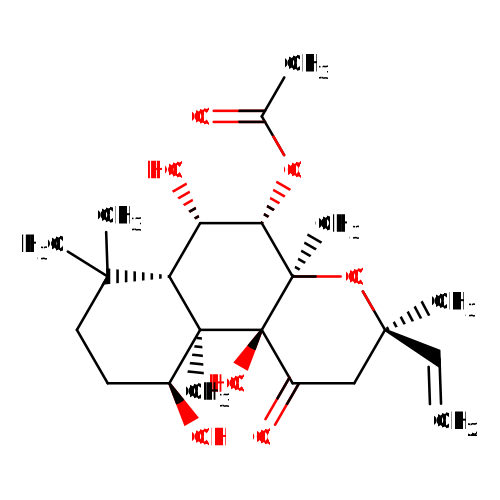
| Common Name | Coleonol |
|---|
| Description | Colforsin, also known as coleonol or forskolin, belongs to the class of organic compounds known as triterpenoids. These are terpene molecules containing six isoprene units. Thus, colforsin is considered to be an isoprenoid lipid molecule. Colforsin is a very hydrophobic molecule, practically insoluble (in water), and relatively neutral. Coleonol is found in Apis cerana and Coleus forskohlii. Coleonol was first documented in 1992 (PMID: 1547891). Colforsin is a potentially toxic compound (PMID: 11816015) (PMID: 12676767) (PMID: 12836714) (PMID: 14691682) (PMID: 15135319) (PMID: 15380183). |
|---|
| Structure | [H][C@]1(O)CCC(C)(C)[C@]2([H])[C@]([H])(O)[C@]([H])(OC(C)=O)[C@@]3(C)O[C@](C)(CC(=O)[C@]3(O)[C@@]12C)C=C InChI=1S/C22H34O7/c1-8-19(5)11-14(25)22(27)20(6)13(24)9-10-18(3,4)16(20)15(26)17(28-12(2)23)21(22,7)29-19/h8,13,15-17,24,26-27H,1,9-11H2,2-7H3/t13-,15-,16-,17-,19-,20-,21+,22-/m0/s1 |
|---|
| Synonyms | | Value | Source |
|---|
| 7beta-Acetoxy-8,13-epoxy-1alpha,6beta,9alpha-trihydroxylabd-14-en-11-one | ChEBI | | Coleonol | ChEBI | | Coleonolk | ChEBI | | Colforsina | ChEBI | | Colforsine | ChEBI | | Colforsinum | ChEBI | | Forskolin | Kegg | | 7b-Acetoxy-8,13-epoxy-1a,6b,9a-trihydroxylabd-14-en-11-one | Generator | | 7Β-acetoxy-8,13-epoxy-1α,6β,9α-trihydroxylabd-14-en-11-one | Generator | | Colforsin | ChEBI | | N,N-Dimethyl-beta-alanine-5-(acetyloxy)-3-ethenyldodecahydro-10,10b-dihydroxy-3,4a,7,7,10a-pentamethyl-1-oxo-1H-naphtho(2,1-b)pyran-6-yl ester HCL | MeSH | | NKH 477 | MeSH | | NKH-477 | MeSH |
|
|---|
| Chemical Formula | C22H34O7 |
|---|
| Average Mass | 410.5012 Da |
|---|
| Monoisotopic Mass | 410.23045 Da |
|---|
| IUPAC Name | (3R,4aR,5S,6S,6aS,10S,10aR,10bS)-3-ethenyl-6,10,10b-trihydroxy-3,4a,7,7,10a-pentamethyl-1-oxo-dodecahydro-1H-naphtho[2,1-b]pyran-5-yl acetate |
|---|
| Traditional Name | forskolin |
|---|
| CAS Registry Number | Not Available |
|---|
| SMILES | [H][C@]1(O)CCC(C)(C)[C@]2([H])[C@]([H])(O)[C@]([H])(OC(C)=O)[C@@]3(C)O[C@](C)(CC(=O)[C@]3(O)[C@@]12C)C=C |
|---|
| InChI Identifier | InChI=1S/C22H34O7/c1-8-19(5)11-14(25)22(27)20(6)13(24)9-10-18(3,4)16(20)15(26)17(28-12(2)23)21(22,7)29-19/h8,13,15-17,24,26-27H,1,9-11H2,2-7H3/t13-,15-,16-,17-,19-,20-,21+,22-/m0/s1 |
|---|
| InChI Key | OHCQJHSOBUTRHG-KGGHGJDLSA-N |
|---|
| Experimental Spectra |
|---|
|
| Not Available | | Predicted Spectra |
|---|
|
| | Spectrum Type | Description | Depositor ID | Depositor Organization | Depositor | Deposition Date | View |
|---|
| 1D NMR | 13C NMR Spectrum (1D, 25 MHz, D2O, predicted) | Wishart Lab | Wishart Lab | David Wishart | 2021-06-20 | View Spectrum | | 1D NMR | 1H NMR Spectrum (1D, 100 MHz, D2O, predicted) | Wishart Lab | Wishart Lab | David Wishart | 2021-06-20 | View Spectrum | | 1D NMR | 13C NMR Spectrum (1D, 252 MHz, D2O, predicted) | Wishart Lab | Wishart Lab | David Wishart | 2021-06-20 | View Spectrum | | 1D NMR | 1H NMR Spectrum (1D, 1000 MHz, D2O, predicted) | Wishart Lab | Wishart Lab | David Wishart | 2021-06-20 | View Spectrum | | 1D NMR | 13C NMR Spectrum (1D, 50 MHz, D2O, predicted) | Wishart Lab | Wishart Lab | David Wishart | 2021-06-20 | View Spectrum | | 1D NMR | 1H NMR Spectrum (1D, 200 MHz, D2O, predicted) | Wishart Lab | Wishart Lab | David Wishart | 2021-06-20 | View Spectrum | | 1D NMR | 13C NMR Spectrum (1D, 75 MHz, D2O, predicted) | Wishart Lab | Wishart Lab | David Wishart | 2021-06-20 | View Spectrum | | 1D NMR | 1H NMR Spectrum (1D, 300 MHz, D2O, predicted) | Wishart Lab | Wishart Lab | David Wishart | 2021-06-20 | View Spectrum | | 1D NMR | 13C NMR Spectrum (1D, 101 MHz, D2O, predicted) | Wishart Lab | Wishart Lab | David Wishart | 2021-06-20 | View Spectrum | | 1D NMR | 1H NMR Spectrum (1D, 400 MHz, D2O, predicted) | Wishart Lab | Wishart Lab | David Wishart | 2021-06-20 | View Spectrum | | 1D NMR | 13C NMR Spectrum (1D, 126 MHz, D2O, predicted) | Wishart Lab | Wishart Lab | David Wishart | 2021-06-20 | View Spectrum | | 1D NMR | 1H NMR Spectrum (1D, 500 MHz, D2O, predicted) | Wishart Lab | Wishart Lab | David Wishart | 2021-06-20 | View Spectrum | | 1D NMR | 13C NMR Spectrum (1D, 151 MHz, D2O, predicted) | Wishart Lab | Wishart Lab | David Wishart | 2021-06-20 | View Spectrum | | 1D NMR | 1H NMR Spectrum (1D, 600 MHz, D2O, predicted) | Wishart Lab | Wishart Lab | David Wishart | 2021-06-20 | View Spectrum | | 1D NMR | 13C NMR Spectrum (1D, 176 MHz, D2O, predicted) | Wishart Lab | Wishart Lab | David Wishart | 2021-06-20 | View Spectrum | | 1D NMR | 1H NMR Spectrum (1D, 700 MHz, D2O, predicted) | Wishart Lab | Wishart Lab | David Wishart | 2021-06-20 | View Spectrum | | 1D NMR | 13C NMR Spectrum (1D, 201 MHz, D2O, predicted) | Wishart Lab | Wishart Lab | David Wishart | 2021-06-20 | View Spectrum | | 1D NMR | 1H NMR Spectrum (1D, 800 MHz, D2O, predicted) | Wishart Lab | Wishart Lab | David Wishart | 2021-06-20 | View Spectrum | | 1D NMR | 13C NMR Spectrum (1D, 226 MHz, D2O, predicted) | Wishart Lab | Wishart Lab | David Wishart | 2021-06-20 | View Spectrum | | 1D NMR | 1H NMR Spectrum (1D, 900 MHz, D2O, predicted) | Wishart Lab | Wishart Lab | David Wishart | 2021-06-20 | View Spectrum |
| | Chemical Shift Submissions |
|---|
|
| Not Available | | Species |
|---|
| Species of Origin | |
|---|
| Chemical Taxonomy |
|---|
| Description | Belongs to the class of organic compounds known as triterpenoids. These are terpene molecules containing six isoprene units. |
|---|
| Kingdom | Organic compounds |
|---|
| Super Class | Lipids and lipid-like molecules |
|---|
| Class | Prenol lipids |
|---|
| Sub Class | Triterpenoids |
|---|
| Direct Parent | Triterpenoids |
|---|
| Alternative Parents | |
|---|
| Substituents | - Polycyclic triterpenoid
- Triterpenoid
- Naphthopyran
- Naphthalene
- Pyran
- Oxane
- Cyclic alcohol
- Tertiary alcohol
- Carboxylic acid ester
- Ketone
- Secondary alcohol
- Carboxylic acid derivative
- Dialkyl ether
- Ether
- Monocarboxylic acid or derivatives
- Oxacycle
- Organoheterocyclic compound
- Polyol
- Carbonyl group
- Hydrocarbon derivative
- Alcohol
- Organic oxygen compound
- Organic oxide
- Organooxygen compound
- Aliphatic heteropolycyclic compound
|
|---|
| Molecular Framework | Aliphatic heteropolycyclic compounds |
|---|
| External Descriptors | |
|---|
| Physical Properties |
|---|
| State | Not Available |
|---|
| Experimental Properties | | Property | Value | Reference |
|---|
| Melting Point | Not Available | Not Available | | Boiling Point | Not Available | Not Available | | Water Solubility | Not Available | Not Available | | LogP | Not Available | Not Available |
|
|---|
| Predicted Properties | |
|---|
| General References | - Carruba G, Webber MM, Quader ST, Amoroso M, Cocciadiferro L, Saladino F, Trosko JE, Castagnetta LA: Regulation of cell-to-cell communication in non-tumorigenic and malignant human prostate epithelial cells. Prostate. 2002 Feb 1;50(2):73-82. doi: 10.1002/pros.10034. [PubMed:11816015 ]
- Tarpey SB, Sawmiller DR, Kelly C, Thompson WJ, Townsley MI: Phosphodiesterase 3 activity is reduced in dog lung following pacing-induced heart failure. Am J Physiol Lung Cell Mol Physiol. 2003 May;284(5):L766-73. doi: 10.1152/ajplung.00373.2002. Epub 2003 Jan 10. [PubMed:12676767 ]
- Sethi R, Dhalla NS: Inotropic responses to isoproterenol in congestive heart failure subsequent to myocardial infarction in rats. J Card Fail. 1995 Dec;1(5):391-9. doi: 10.1016/s1071-9164(05)80008-9. [PubMed:12836714 ]
- Luo XH, Liao EY, Su X, Wu XP: Parathyroid hormone inhibits the expression of membrane-type matrix metalloproteinase-1 (MT1-MMP) in osteoblast-like MG-63 cells. J Bone Miner Metab. 2004;22(1):19-25. doi: 10.1007/s00774-003-0442-6. [PubMed:14691682 ]
- Park YG, Kang SK, Noh SH, Park KK, Chang YC, Lee YC, Kim CH: PGE2 induces IL-1beta gene expression in mouse osteoblasts through a cAMP-PKA signaling pathway. Int Immunopharmacol. 2004 Jun;4(6):779-89. doi: 10.1016/j.intimp.2004.03.003. [PubMed:15135319 ]
- Wu X, Walker J, Zhang J, Ding S, Schultz PG: Purmorphamine induces osteogenesis by activation of the hedgehog signaling pathway. Chem Biol. 2004 Sep;11(9):1229-38. doi: 10.1016/j.chembiol.2004.06.010. [PubMed:15380183 ]
- Arata Y, Tada S, Ui M: Probable occurrence of toxin-susceptible G proteins in the nematode Caenorhabditis elegans. FEBS Lett. 1992 Mar 23;300(1):73-6. doi: 10.1016/0014-5793(92)80167-f. [PubMed:1547891 ]
- Liang HM, Tang M, Liu CJ, Luo HY, Song YL, Hu XW, Xi JY, Gao LL, Nie B, Li SY, Lai LL, Hescheler J: Muscarinic cholinergic regulation of L-type calcium channel in heart of embryonic mice at different developmental stages. Acta Pharmacol Sin. 2004 Nov;25(11):1450-7. [PubMed:15525467 ]
- Park YG, Kim YH, Kang SK, Kim CH: cAMP-PKA signaling pathway regulates bone resorption mediated by processing of cathepsin K in cultured mouse osteoclasts. Int Immunopharmacol. 2006 Jun;6(6):947-56. doi: 10.1016/j.intimp.2006.01.005. Epub 2006 Feb 3. [PubMed:16644480 ]
- Faherty S, Fitzgerald A, Keohan M, Quinlan LR: Self-renewal and differentiation of mouse embryonic stem cells as measured by Oct4 expression: the role of the cAMP/PKA pathway. In Vitro Cell Dev Biol Anim. 2007 Jan;43(1):37-47. doi: 10.1007/s11626-006-9001-5. [PubMed:17570033 ]
|
|---|