| Record Information |
|---|
| Version | 2.0 |
|---|
| Created at | 2022-04-27 23:09:42 UTC |
|---|
| Updated at | 2022-04-27 23:09:42 UTC |
|---|
| NP-MRD ID | NP0051949 |
|---|
| Secondary Accession Numbers | None |
|---|
| Natural Product Identification |
|---|
| Common Name | Picrotoxinin |
|---|
| Description | Picrotoxinin belongs to the class of organic compounds known as furopyrans. These are organic polycyclic compounds containing a furan ring fused to a pyran ring. Furan is a five-membered aromatic ring with four carbon atoms and one oxygen atom. Pyran a six-membered heterocyclic, non-aromatic ring, made up of five carbon atoms and one oxygen atom and containing two double bonds. Thus, picrotoxinin is considered to be an isoprenoid lipid molecule. Picrotoxinin is found in Anamirta cocculus and Cocculus indicus. Picrotoxinin was first documented in 1994 (PMID: 7916140). Picrotoxinin is a very hydrophobic molecule, practically insoluble (in water), and relatively neutral (PMID: 12770091) (PMID: 17405877) (PMID: 17675213) (PMID: 17714449) (PMID: 18031737) (PMID: 21505038). |
|---|
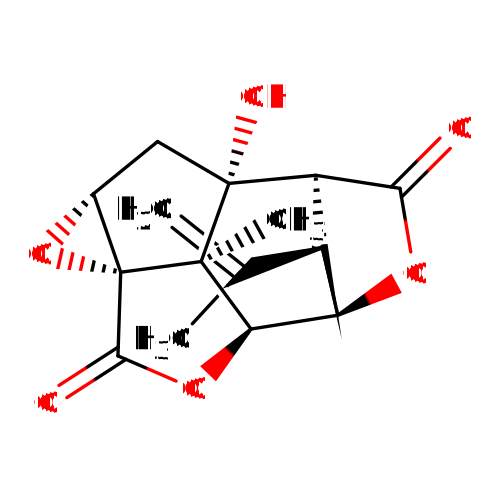
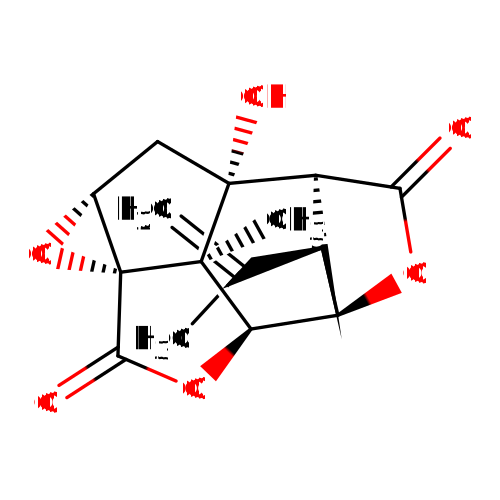
| Structure | [H][C@@]12C[C@@]3(O)[C@@]4([H])C(=O)O[C@@]([H])([C@@]5([H])OC(=O)[C@]1(O2)[C@@]35C)[C@@]4([H])C(C)=C InChI=1S/C15H16O6/c1-5(2)7-8-11(16)19-9(7)10-13(3)14(8,18)4-6-15(13,21-6)12(17)20-10/h6-10,18H,1,4H2,2-3H3/t6-,7+,8-,9-,10-,13-,14-,15+/m1/s1 |
|---|
| Synonyms | | Value | Source |
|---|
| (-)-Picrotoxinin | ChEBI | | Picrotoxinine | ChEBI | | Picrotoxinin | MeSH |
|
|---|
| Chemical Formula | C15H16O6 |
|---|
| Average Mass | 292.2839 Da |
|---|
| Monoisotopic Mass | 292.09469 Da |
|---|
| IUPAC Name | (1R,3R,5S,8S,9R,12S,13R,14R)-1-hydroxy-13-methyl-14-(prop-1-en-2-yl)-4,7,10-trioxapentacyclo[6.4.1.1⁹,¹².0³,⁵.0⁵,¹³]tetradecane-6,11-dione |
|---|
| Traditional Name | picrotoxinin |
|---|
| CAS Registry Number | Not Available |
|---|
| SMILES | [H][C@@]12C[C@@]3(O)[C@@]4([H])C(=O)O[C@@]([H])([C@@]5([H])OC(=O)[C@]1(O2)[C@@]35C)[C@@]4([H])C(C)=C |
|---|
| InChI Identifier | InChI=1S/C15H16O6/c1-5(2)7-8-11(16)19-9(7)10-13(3)14(8,18)4-6-15(13,21-6)12(17)20-10/h6-10,18H,1,4H2,2-3H3/t6-,7+,8-,9-,10-,13-,14-,15+/m1/s1 |
|---|
| InChI Key | PIMZUZSSNYHVCU-YKWPQBAZSA-N |
|---|
| Experimental Spectra |
|---|
|
| Not Available | | Predicted Spectra |
|---|
|
| | Spectrum Type | Description | Depositor ID | Depositor Organization | Depositor | Deposition Date | View |
|---|
| 1D NMR | 13C NMR Spectrum (1D, 25 MHz, D2O, predicted) | Wishart Lab | Wishart Lab | David Wishart | 2021-06-20 | View Spectrum | | 1D NMR | 1H NMR Spectrum (1D, 100 MHz, D2O, predicted) | Wishart Lab | Wishart Lab | David Wishart | 2021-06-20 | View Spectrum | | 1D NMR | 13C NMR Spectrum (1D, 252 MHz, D2O, predicted) | Wishart Lab | Wishart Lab | David Wishart | 2021-06-20 | View Spectrum | | 1D NMR | 1H NMR Spectrum (1D, 1000 MHz, D2O, predicted) | Wishart Lab | Wishart Lab | David Wishart | 2021-06-20 | View Spectrum | | 1D NMR | 13C NMR Spectrum (1D, 50 MHz, D2O, predicted) | Wishart Lab | Wishart Lab | David Wishart | 2021-06-20 | View Spectrum | | 1D NMR | 1H NMR Spectrum (1D, 200 MHz, D2O, predicted) | Wishart Lab | Wishart Lab | David Wishart | 2021-06-20 | View Spectrum | | 1D NMR | 13C NMR Spectrum (1D, 75 MHz, D2O, predicted) | Wishart Lab | Wishart Lab | David Wishart | 2021-06-20 | View Spectrum | | 1D NMR | 1H NMR Spectrum (1D, 300 MHz, D2O, predicted) | Wishart Lab | Wishart Lab | David Wishart | 2021-06-20 | View Spectrum | | 1D NMR | 13C NMR Spectrum (1D, 101 MHz, D2O, predicted) | Wishart Lab | Wishart Lab | David Wishart | 2021-06-20 | View Spectrum | | 1D NMR | 1H NMR Spectrum (1D, 400 MHz, D2O, predicted) | Wishart Lab | Wishart Lab | David Wishart | 2021-06-20 | View Spectrum | | 1D NMR | 13C NMR Spectrum (1D, 126 MHz, D2O, predicted) | Wishart Lab | Wishart Lab | David Wishart | 2021-06-20 | View Spectrum | | 1D NMR | 1H NMR Spectrum (1D, 500 MHz, D2O, predicted) | Wishart Lab | Wishart Lab | David Wishart | 2021-06-20 | View Spectrum | | 1D NMR | 13C NMR Spectrum (1D, 151 MHz, D2O, predicted) | Wishart Lab | Wishart Lab | David Wishart | 2021-06-20 | View Spectrum | | 1D NMR | 1H NMR Spectrum (1D, 600 MHz, D2O, predicted) | Wishart Lab | Wishart Lab | David Wishart | 2021-06-20 | View Spectrum | | 1D NMR | 13C NMR Spectrum (1D, 176 MHz, D2O, predicted) | Wishart Lab | Wishart Lab | David Wishart | 2021-06-20 | View Spectrum | | 1D NMR | 1H NMR Spectrum (1D, 700 MHz, D2O, predicted) | Wishart Lab | Wishart Lab | David Wishart | 2021-06-20 | View Spectrum | | 1D NMR | 13C NMR Spectrum (1D, 201 MHz, D2O, predicted) | Wishart Lab | Wishart Lab | David Wishart | 2021-06-20 | View Spectrum | | 1D NMR | 1H NMR Spectrum (1D, 800 MHz, D2O, predicted) | Wishart Lab | Wishart Lab | David Wishart | 2021-06-20 | View Spectrum | | 1D NMR | 13C NMR Spectrum (1D, 226 MHz, D2O, predicted) | Wishart Lab | Wishart Lab | David Wishart | 2021-06-20 | View Spectrum | | 1D NMR | 1H NMR Spectrum (1D, 900 MHz, D2O, predicted) | Wishart Lab | Wishart Lab | David Wishart | 2021-06-20 | View Spectrum |
| | Chemical Shift Submissions |
|---|
|
| Not Available | | Species |
|---|
| Species of Origin | |
|---|
| Chemical Taxonomy |
|---|
| Description | Belongs to the class of organic compounds known as furopyrans. These are organic polycyclic compounds containing a furan ring fused to a pyran ring. Furan is a five-membered aromatic ring with four carbon atoms and one oxygen atom. Pyran a six-membered heterocyclic, non-aromatic ring, made up of five carbon atoms and one oxygen atom and containing two double bonds. |
|---|
| Kingdom | Organic compounds |
|---|
| Super Class | Organoheterocyclic compounds |
|---|
| Class | Furopyrans |
|---|
| Sub Class | Not Available |
|---|
| Direct Parent | Furopyrans |
|---|
| Alternative Parents | |
|---|
| Substituents | - Furopyran
- Caprolactone
- Oxepane
- Dicarboxylic acid or derivatives
- Gamma butyrolactone
- Oxane
- Pyran
- Tetrahydrofuran
- Tertiary alcohol
- Cyclic alcohol
- Furan
- Carboxylic acid ester
- Lactone
- Oxacycle
- Carboxylic acid derivative
- Dialkyl ether
- Oxirane
- Ether
- Organooxygen compound
- Organic oxygen compound
- Alcohol
- Carbonyl group
- Hydrocarbon derivative
- Organic oxide
- Aliphatic heteropolycyclic compound
|
|---|
| Molecular Framework | Aliphatic heteropolycyclic compounds |
|---|
| External Descriptors | |
|---|
| Physical Properties |
|---|
| State | Not Available |
|---|
| Experimental Properties | | Property | Value | Reference |
|---|
| Melting Point | Not Available | Not Available | | Boiling Point | Not Available | Not Available | | Water Solubility | Not Available | Not Available | | LogP | Not Available | Not Available |
|
|---|
| Predicted Properties | |
|---|
| General References | - Le Corronc H, Alix P, Hue B: Differential sensitivity of two insect GABA-gated chloride channels to dieldrin, fipronil and picrotoxinin. J Insect Physiol. 2002 Apr;48(4):419-431. doi: 10.1016/s0022-1910(02)00061-6. [PubMed:12770091 ]
- Wang DS, Buckinx R, Lecorronc H, Mangin JM, Rigo JM, Legendre P: Mechanisms for picrotoxinin and picrotin blocks of alpha2 homomeric glycine receptors. J Biol Chem. 2007 Jun 1;282(22):16016-35. doi: 10.1074/jbc.M701502200. Epub 2007 Apr 3. [PubMed:17405877 ]
- Ju XL, Hao YL, Pei JF, Ozoe Y: Investigation of structural requirements for inhibitory activity at the rat and housefly picrotoxinin binding sites in ionotropic GABA receptors using DISCOtech and CoMFA. Chemosphere. 2007 Oct;69(6):864-71. doi: 10.1016/j.chemosphere.2007.06.040. Epub 2007 Aug 1. [PubMed:17675213 ]
- Yang Z, Cromer BA, Harvey RJ, Parker MW, Lynch JW: A proposed structural basis for picrotoxinin and picrotin binding in the glycine receptor pore. J Neurochem. 2007 Oct;103(2):580-9. doi: 10.1111/j.1471-4159.2007.04850.x. Epub 2007 Aug 20. [PubMed:17714449 ]
- Carland JE, Johnston GA, Chebib M: Relative impact of residues at the intracellular and extracellular ends of the human GABAC rho1 receptor M2 domain on picrotoxinin activity. Eur J Pharmacol. 2008 Feb 2;580(1-2):27-35. doi: 10.1016/j.ejphar.2007.10.036. Epub 2007 Oct 25. [PubMed:18031737 ]
- Thompson AJ, Duke RK, Lummis SC: Binding sites for bilobalide, diltiazem, ginkgolide, and picrotoxinin at the 5-HT3 receptor. Mol Pharmacol. 2011 Jul;80(1):183-90. doi: 10.1124/mol.111.071415. Epub 2011 Apr 19. [PubMed:21505038 ]
- Thompson AJ, Alqazzaz M, Price KL, Weston DA, Lummis SC: Phenylalanine in the pore of the Erwinia ligand-gated ion channel modulates picrotoxinin potency but not receptor function. Biochemistry. 2014 Oct 7;53(39):6183-8. doi: 10.1021/bi5008035. Epub 2014 Sep 19. [PubMed:25238029 ]
- Naffaa MM, Samad A: The binding mode of picrotoxinin in GABAA-rho receptors: Insight into the subunit's selectivity in the transmembrane domain. Comput Biol Chem. 2016 Oct;64:202-209. doi: 10.1016/j.compbiolchem.2016.07.003. Epub 2016 Jul 7. [PubMed:27423910 ]
- Anthony NM, Holyoke CW Jr, Sattelle DB: Blocking actions of picrotoxinin analogues on insect (Periplaneta americana) GABA receptors. Neurosci Lett. 1994 Apr 25;171(1-2):67-9. doi: 10.1016/0304-3940(94)90606-8. [PubMed:7916140 ]
|
|---|