| Record Information |
|---|
| Version | 2.0 |
|---|
| Created at | 2022-04-27 22:58:21 UTC |
|---|
| Updated at | 2022-04-27 22:58:21 UTC |
|---|
| NP-MRD ID | NP0051707 |
|---|
| Secondary Accession Numbers | None |
|---|
| Natural Product Identification |
|---|
| Common Name | Psorospermin |
|---|
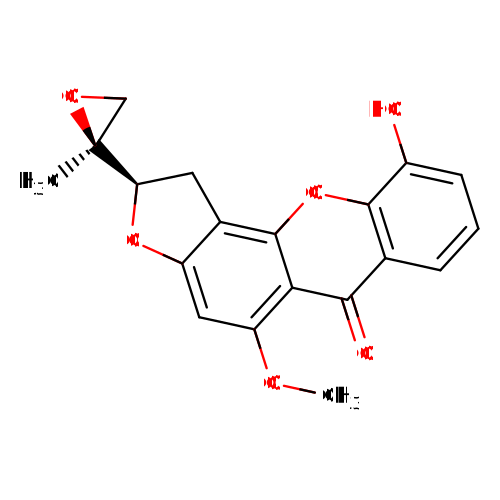
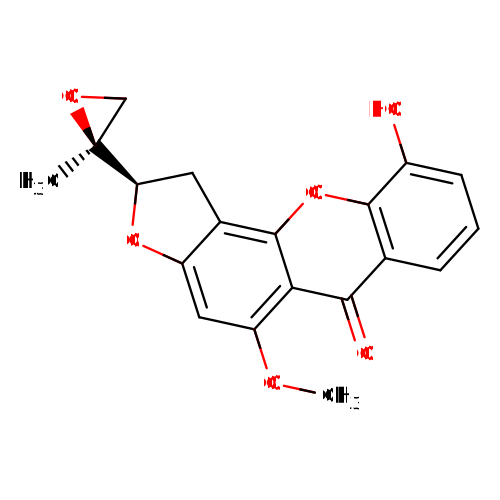
| Description | Psorospermin belongs to the class of organic compounds known as xanthones. These are polycyclic aromatic compounds containing a xanthene moiety conjugated to a ketone group at carbon 9. Xanthene is a tricyclic compound made up of two benzene rings linearly fused to each other through a pyran ring. Psorospermin is a secondary metabolite. Secondary metabolites are metabolically or physiologically non-essential metabolites that may serve a role as defense or signalling molecules. In some cases they are simply molecules that arise from the incomplete metabolism of other secondary metabolites. Psorospermin is found in psorospermum febrifugum and Psorospermum spp.. Psorospermin was first documented in 2005 (PMID: 16275994). Based on a literature review a significant number of articles have been published on psorospermin (PMID: 33935707) (PMID: 21885273) (PMID: 19926174) (PMID: 19594412) (PMID: 19191562) (PMID: 19149484). |
|---|
| Structure | COC1=C2C(=O)C3=CC=CC(O)=C3OC2=C2C[C@@H](OC2=C1)[C@@]1(C)CO1 InChI=1S/C19H16O6/c1-19(8-23-19)14-6-10-12(24-14)7-13(22-2)15-16(21)9-4-3-5-11(20)17(9)25-18(10)15/h3-5,7,14,20H,6,8H2,1-2H3/t14-,19-/m1/s1 |
|---|
| Synonyms | | Value | Source |
|---|
| Psorospermine | MeSH |
|
|---|
| Chemical Formula | C19H16O6 |
|---|
| Average Mass | 340.3310 Da |
|---|
| Monoisotopic Mass | 340.09469 Da |
|---|
| IUPAC Name | (2R)-10-hydroxy-5-methoxy-2-[(2R)-2-methyloxiran-2-yl]-1H,2H,6H-furo[2,3-c]xanthen-6-one |
|---|
| Traditional Name | psorospermin |
|---|
| CAS Registry Number | Not Available |
|---|
| SMILES | COC1=C2C(=O)C3=CC=CC(O)=C3OC2=C2C[C@@H](OC2=C1)[C@@]1(C)CO1 |
|---|
| InChI Identifier | InChI=1S/C19H16O6/c1-19(8-23-19)14-6-10-12(24-14)7-13(22-2)15-16(21)9-4-3-5-11(20)17(9)25-18(10)15/h3-5,7,14,20H,6,8H2,1-2H3/t14-,19-/m1/s1 |
|---|
| InChI Key | BBNDPXOGORGETN-AUUYWEPGSA-N |
|---|
| Experimental Spectra |
|---|
|
| Not Available | | Predicted Spectra |
|---|
|
| | Spectrum Type | Description | Depositor ID | Depositor Organization | Depositor | Deposition Date | View |
|---|
| 1D NMR | 13C NMR Spectrum (1D, 25 MHz, D2O, predicted) | Wishart Lab | Wishart Lab | David Wishart | 2021-06-20 | View Spectrum | | 1D NMR | 1H NMR Spectrum (1D, 100 MHz, D2O, predicted) | Wishart Lab | Wishart Lab | David Wishart | 2021-06-20 | View Spectrum | | 1D NMR | 13C NMR Spectrum (1D, 252 MHz, D2O, predicted) | Wishart Lab | Wishart Lab | David Wishart | 2021-06-20 | View Spectrum | | 1D NMR | 1H NMR Spectrum (1D, 1000 MHz, D2O, predicted) | Wishart Lab | Wishart Lab | David Wishart | 2021-06-20 | View Spectrum | | 1D NMR | 13C NMR Spectrum (1D, 50 MHz, D2O, predicted) | Wishart Lab | Wishart Lab | David Wishart | 2021-06-20 | View Spectrum | | 1D NMR | 1H NMR Spectrum (1D, 200 MHz, D2O, predicted) | Wishart Lab | Wishart Lab | David Wishart | 2021-06-20 | View Spectrum | | 1D NMR | 13C NMR Spectrum (1D, 75 MHz, D2O, predicted) | Wishart Lab | Wishart Lab | David Wishart | 2021-06-20 | View Spectrum | | 1D NMR | 1H NMR Spectrum (1D, 300 MHz, D2O, predicted) | Wishart Lab | Wishart Lab | David Wishart | 2021-06-20 | View Spectrum | | 1D NMR | 13C NMR Spectrum (1D, 101 MHz, D2O, predicted) | Wishart Lab | Wishart Lab | David Wishart | 2021-06-20 | View Spectrum | | 1D NMR | 1H NMR Spectrum (1D, 400 MHz, D2O, predicted) | Wishart Lab | Wishart Lab | David Wishart | 2021-06-20 | View Spectrum | | 1D NMR | 13C NMR Spectrum (1D, 126 MHz, D2O, predicted) | Wishart Lab | Wishart Lab | David Wishart | 2021-06-20 | View Spectrum | | 1D NMR | 1H NMR Spectrum (1D, 500 MHz, D2O, predicted) | Wishart Lab | Wishart Lab | David Wishart | 2021-06-20 | View Spectrum | | 1D NMR | 13C NMR Spectrum (1D, 151 MHz, D2O, predicted) | Wishart Lab | Wishart Lab | David Wishart | 2021-06-20 | View Spectrum | | 1D NMR | 1H NMR Spectrum (1D, 600 MHz, D2O, predicted) | Wishart Lab | Wishart Lab | David Wishart | 2021-06-20 | View Spectrum | | 1D NMR | 13C NMR Spectrum (1D, 176 MHz, D2O, predicted) | Wishart Lab | Wishart Lab | David Wishart | 2021-06-20 | View Spectrum | | 1D NMR | 1H NMR Spectrum (1D, 700 MHz, D2O, predicted) | Wishart Lab | Wishart Lab | David Wishart | 2021-06-20 | View Spectrum | | 1D NMR | 13C NMR Spectrum (1D, 201 MHz, D2O, predicted) | Wishart Lab | Wishart Lab | David Wishart | 2021-06-20 | View Spectrum | | 1D NMR | 1H NMR Spectrum (1D, 800 MHz, D2O, predicted) | Wishart Lab | Wishart Lab | David Wishart | 2021-06-20 | View Spectrum | | 1D NMR | 13C NMR Spectrum (1D, 226 MHz, D2O, predicted) | Wishart Lab | Wishart Lab | David Wishart | 2021-06-20 | View Spectrum | | 1D NMR | 1H NMR Spectrum (1D, 900 MHz, D2O, predicted) | Wishart Lab | Wishart Lab | David Wishart | 2021-06-20 | View Spectrum |
| | Chemical Shift Submissions |
|---|
|
| Not Available | | Species |
|---|
| Species of Origin | |
|---|
| Chemical Taxonomy |
|---|
| Description | Belongs to the class of organic compounds known as xanthones. These are polycyclic aromatic compounds containing a xanthene moiety conjugated to a ketone group at carbon 9. Xanthene is a tricyclic compound made up of two benzene rings linearly fused to each other through a pyran ring. |
|---|
| Kingdom | Organic compounds |
|---|
| Super Class | Organoheterocyclic compounds |
|---|
| Class | Benzopyrans |
|---|
| Sub Class | 1-benzopyrans |
|---|
| Direct Parent | Xanthones |
|---|
| Alternative Parents | |
|---|
| Substituents | - Xanthone
- Chromone
- Coumaran
- Anisole
- 1-hydroxy-4-unsubstituted benzenoid
- 1-hydroxy-2-unsubstituted benzenoid
- Alkyl aryl ether
- Pyranone
- Benzenoid
- Pyran
- Heteroaromatic compound
- Vinylogous ester
- Dialkyl ether
- Oxirane
- Ether
- Oxacycle
- Organic oxygen compound
- Organic oxide
- Organooxygen compound
- Hydrocarbon derivative
- Aromatic heteropolycyclic compound
|
|---|
| Molecular Framework | Aromatic heteropolycyclic compounds |
|---|
| External Descriptors | |
|---|
| Physical Properties |
|---|
| State | Not Available |
|---|
| Experimental Properties | | Property | Value | Reference |
|---|
| Melting Point | Not Available | Not Available | | Boiling Point | Not Available | Not Available | | Water Solubility | Not Available | Not Available | | LogP | Not Available | Not Available |
|
|---|
| Predicted Properties | |
|---|
| General References | - Anywar G, Kakudidi E, Byamukama R, Mukonzo J, Schubert A, Oryem-Origa H, Jassoy C: A Review of the Toxicity and Phytochemistry of Medicinal Plant Species Used by Herbalists in Treating People Living With HIV/AIDS in Uganda. Front Pharmacol. 2021 Apr 15;12:615147. doi: 10.3389/fphar.2021.615147. eCollection 2021. [PubMed:33935707 ]
- Kang JA, Yang Z, Lee JY, De U, Kim TH, Park JY, Lee HJ, Park YJ, Chun P, Kim HS, Jeong LS, Moon HR: Design, synthesis and anticancer activity of novel dihydrobenzofuro[4,5-b][1,8]naphthyridin-6-one derivatives. Bioorg Med Chem Lett. 2011 Oct 1;21(19):5730-4. doi: 10.1016/j.bmcl.2011.08.016. Epub 2011 Aug 18. [PubMed:21885273 ]
- Boutefnouchet S, Minh NT, Putrus R, Pfeiffer B, Leonce S, Pierre A, Michel S, Tillequin F, Lallemand MC: Synthesis and cytotoxic activity of psorospermin and acronycine analogues in the 3-propyloxy-acridin-9(10H)-one and -benzo[b]acridin-125H-one series. Eur J Med Chem. 2010 Feb;45(2):581-7. doi: 10.1016/j.ejmech.2009.10.045. Epub 2009 Nov 4. [PubMed:19926174 ]
- Nguyen QC, Nguyen TT, Yougnia R, Gaslonde T, Dufat H, Michel S, Tillequin F: Acronycine derivatives: a promising series of anticancer agents. Anticancer Agents Med Chem. 2009 Sep;9(7):804-15. doi: 10.2174/187152009789056921. Epub 2009 Sep 1. [PubMed:19594412 ]
- Nguyen HT, Lallemand MC, Boutefnouchet S, Michel S, Tillequin F: Antitumor psoropermum xanthones and sarcomelicope acridones: privileged structures implied in DNA alkylation. J Nat Prod. 2009 Mar 27;72(3):527-39. doi: 10.1021/np800644y. [PubMed:19191562 ]
- Pouli N, Marakos P: Fused xanthone derivatives as antiproliferative agents. Anticancer Agents Med Chem. 2009 Jan;9(1):77-98. doi: 10.2174/187152009787047699. [PubMed:19149484 ]
- Carey SS, Gleason-Guzman M, Gokhale V, Hurley LH: Psorospermin structural requirements for P-glycoprotein resistance reversal. Mol Cancer Ther. 2008 Nov;7(11):3617-23. doi: 10.1158/1535-7163.MCT-08-0519. [PubMed:19001443 ]
- Boutefnouchet S, Gaboriaud-Kolar N, Nguyen TM, Depauw S, David-Cordonnier MH, Pfeiffer B, Leonce S, Pierre A, Tillequin F, Lallemand MC, Michel S: Synthesis, cytotoxic activity, and mechanism of action of furo[2,3-c]acridin-6-one and benzo[b]furo[3,2-h]acridin-6-one analogues of psorospermin and acronycine. J Med Chem. 2008 Nov 27;51(22):7287-97. doi: 10.1021/jm8009487. [PubMed:18947222 ]
- Fellows IM, Schwaebe M, Dexheimer TS, Vankayalapati H, Gleason-Guzman M, Whitten JP, Hurley LH: Determination of the importance of the stereochemistry of psorospermin in topoisomerase II-induced alkylation of DNA and in vitro and in vivo biological activity. Mol Cancer Ther. 2005 Nov;4(11):1729-39. doi: 10.1158/1535-7163.MCT-05-0183. [PubMed:16275994 ]
- Pinto MM, Sousa ME, Nascimento MS: Xanthone derivatives: new insights in biological activities. Curr Med Chem. 2005;12(21):2517-38. doi: 10.2174/092986705774370691. [PubMed:16250875 ]
|
|---|