| Record Information |
|---|
| Version | 2.0 |
|---|
| Created at | 2022-04-27 22:57:52 UTC |
|---|
| Updated at | 2022-04-27 22:57:52 UTC |
|---|
| NP-MRD ID | NP0051692 |
|---|
| Secondary Accession Numbers | None |
|---|
| Natural Product Identification |
|---|
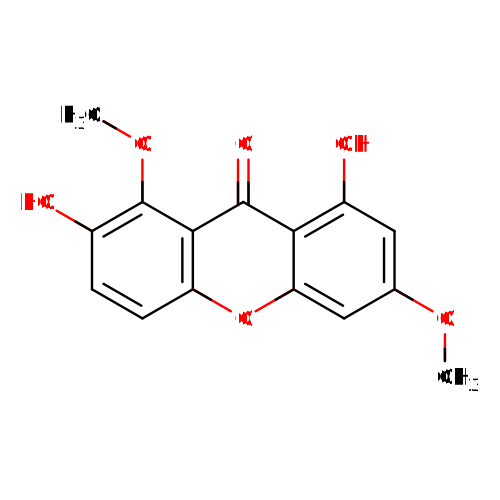
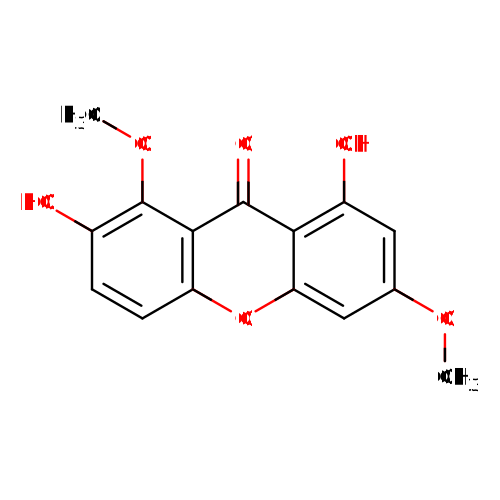
| Common Name | 1,7-Dihydroxy-3,8-dimethoxyxantone |
|---|
| Description | Gentiacaulein belongs to the class of organic compounds known as xanthones. These are polycyclic aromatic compounds containing a xanthene moiety conjugated to a ketone group at carbon 9. Xanthene is a tricyclic compound made up of two benzene rings linearly fused to each other through a pyran ring. 1,7-Dihydroxy-3,8-dimethoxyxantone is found in Gentiana acaulis, Gentiana barbata, Gentiana bavarica, Gentiana brachyphylla, Gentiana ciliata, Gentiana detonsa, Gentiana favrati, Gentiana karelinii, Gentiana kochiana , Gentiana nivalis, Gentiana rostanii, Gentiana schleicheri, Gentiana utriculosa, Gentiana verna, Gentianopsis lanceolata, Gentianopsis paludosa, Haploclathra leiantha, Haploclathra paniculata, Swertia dilatata, Swertia gracilescens, Swertia nervosa, Swertia perennis, Swertia punicea, Swertia racemosa and Swertia speciosa. 1,7-Dihydroxy-3,8-dimethoxyxantone was first documented in 2003 (PMID: 14531031). Gentiacaulein is an extremely weak basic (essentially neutral) compound (based on its pKa) (PMID: 14558348) (PMID: 15646999) (PMID: 25194343). |
|---|
| Structure | COC1=CC(O)=C2C(=O)C3=C(OC)C(O)=CC=C3OC2=C1 InChI=1S/C15H12O6/c1-19-7-5-9(17)12-11(6-7)21-10-4-3-8(16)15(20-2)13(10)14(12)18/h3-6,16-17H,1-2H3 |
|---|
| Synonyms | | Value | Source |
|---|
| 2,8-Dihydroxy-1,6-dimethoxyxanthone | ChEBI |
|
|---|
| Chemical Formula | C15H12O6 |
|---|
| Average Mass | 288.2550 Da |
|---|
| Monoisotopic Mass | 288.06339 Da |
|---|
| IUPAC Name | 2,8-dihydroxy-1,6-dimethoxy-9H-xanthen-9-one |
|---|
| Traditional Name | gentiacaulein |
|---|
| CAS Registry Number | Not Available |
|---|
| SMILES | COC1=CC(O)=C2C(=O)C3=C(OC)C(O)=CC=C3OC2=C1 |
|---|
| InChI Identifier | InChI=1S/C15H12O6/c1-19-7-5-9(17)12-11(6-7)21-10-4-3-8(16)15(20-2)13(10)14(12)18/h3-6,16-17H,1-2H3 |
|---|
| InChI Key | WYOSCUWDVFHQFY-UHFFFAOYSA-N |
|---|
| Experimental Spectra |
|---|
|
| Not Available | | Predicted Spectra |
|---|
|
| | Spectrum Type | Description | Depositor ID | Depositor Organization | Depositor | Deposition Date | View |
|---|
| 1D NMR | 13C NMR Spectrum (1D, 25 MHz, D2O, predicted) | Wishart Lab | Wishart Lab | David Wishart | 2021-06-20 | View Spectrum | | 1D NMR | 1H NMR Spectrum (1D, 100 MHz, D2O, predicted) | Wishart Lab | Wishart Lab | David Wishart | 2021-06-20 | View Spectrum | | 1D NMR | 13C NMR Spectrum (1D, 252 MHz, D2O, predicted) | Wishart Lab | Wishart Lab | David Wishart | 2021-06-20 | View Spectrum | | 1D NMR | 1H NMR Spectrum (1D, 1000 MHz, D2O, predicted) | Wishart Lab | Wishart Lab | David Wishart | 2021-06-20 | View Spectrum | | 1D NMR | 13C NMR Spectrum (1D, 50 MHz, D2O, predicted) | Wishart Lab | Wishart Lab | David Wishart | 2021-06-20 | View Spectrum | | 1D NMR | 1H NMR Spectrum (1D, 200 MHz, D2O, predicted) | Wishart Lab | Wishart Lab | David Wishart | 2021-06-20 | View Spectrum | | 1D NMR | 13C NMR Spectrum (1D, 75 MHz, D2O, predicted) | Wishart Lab | Wishart Lab | David Wishart | 2021-06-20 | View Spectrum | | 1D NMR | 1H NMR Spectrum (1D, 300 MHz, D2O, predicted) | Wishart Lab | Wishart Lab | David Wishart | 2021-06-20 | View Spectrum | | 1D NMR | 13C NMR Spectrum (1D, 101 MHz, D2O, predicted) | Wishart Lab | Wishart Lab | David Wishart | 2021-06-20 | View Spectrum | | 1D NMR | 1H NMR Spectrum (1D, 400 MHz, D2O, predicted) | Wishart Lab | Wishart Lab | David Wishart | 2021-06-20 | View Spectrum | | 1D NMR | 13C NMR Spectrum (1D, 126 MHz, D2O, predicted) | Wishart Lab | Wishart Lab | David Wishart | 2021-06-20 | View Spectrum | | 1D NMR | 1H NMR Spectrum (1D, 500 MHz, D2O, predicted) | Wishart Lab | Wishart Lab | David Wishart | 2021-06-20 | View Spectrum | | 1D NMR | 13C NMR Spectrum (1D, 151 MHz, D2O, predicted) | Wishart Lab | Wishart Lab | David Wishart | 2021-06-20 | View Spectrum | | 1D NMR | 1H NMR Spectrum (1D, 600 MHz, D2O, predicted) | Wishart Lab | Wishart Lab | David Wishart | 2021-06-20 | View Spectrum | | 1D NMR | 13C NMR Spectrum (1D, 176 MHz, D2O, predicted) | Wishart Lab | Wishart Lab | David Wishart | 2021-06-20 | View Spectrum | | 1D NMR | 1H NMR Spectrum (1D, 700 MHz, D2O, predicted) | Wishart Lab | Wishart Lab | David Wishart | 2021-06-20 | View Spectrum | | 1D NMR | 13C NMR Spectrum (1D, 201 MHz, D2O, predicted) | Wishart Lab | Wishart Lab | David Wishart | 2021-06-20 | View Spectrum | | 1D NMR | 1H NMR Spectrum (1D, 800 MHz, D2O, predicted) | Wishart Lab | Wishart Lab | David Wishart | 2021-06-20 | View Spectrum | | 1D NMR | 13C NMR Spectrum (1D, 226 MHz, D2O, predicted) | Wishart Lab | Wishart Lab | David Wishart | 2021-06-20 | View Spectrum | | 1D NMR | 1H NMR Spectrum (1D, 900 MHz, D2O, predicted) | Wishart Lab | Wishart Lab | David Wishart | 2021-06-20 | View Spectrum |
| | Chemical Shift Submissions |
|---|
|
| Not Available | | Species |
|---|
| Species of Origin | |
|---|
| Chemical Taxonomy |
|---|
| Description | Belongs to the class of organic compounds known as xanthones. These are polycyclic aromatic compounds containing a xanthene moiety conjugated to a ketone group at carbon 9. Xanthene is a tricyclic compound made up of two benzene rings linearly fused to each other through a pyran ring. |
|---|
| Kingdom | Organic compounds |
|---|
| Super Class | Organoheterocyclic compounds |
|---|
| Class | Benzopyrans |
|---|
| Sub Class | 1-benzopyrans |
|---|
| Direct Parent | Xanthones |
|---|
| Alternative Parents | |
|---|
| Substituents | - Xanthone
- Chromone
- Anisole
- 1-hydroxy-4-unsubstituted benzenoid
- 1-hydroxy-2-unsubstituted benzenoid
- Alkyl aryl ether
- Pyranone
- Pyran
- Benzenoid
- Heteroaromatic compound
- Vinylogous ester
- Vinylogous acid
- Ether
- Oxacycle
- Organic oxygen compound
- Organooxygen compound
- Hydrocarbon derivative
- Organic oxide
- Aromatic heteropolycyclic compound
|
|---|
| Molecular Framework | Aromatic heteropolycyclic compounds |
|---|
| External Descriptors | |
|---|
| Physical Properties |
|---|
| State | Not Available |
|---|
| Experimental Properties | | Property | Value | Reference |
|---|
| Melting Point | Not Available | Not Available | | Boiling Point | Not Available | Not Available | | Water Solubility | Not Available | Not Available | | LogP | Not Available | Not Available |
|
|---|
| Predicted Properties | |
|---|
| General References | - Chericoni S, Testai L, Calderone V, Flamini G, Nieri P, Morelli I, Martinotti E: The xanthones gentiacaulein and gentiakochianin are responsible for the vasodilator action of the roots of Gentiana kochiana. Planta Med. 2003 Aug;69(8):770-2. doi: 10.1055/s-2003-42784. [PubMed:14531031 ]
- Nikolaev SM, Sambueva ZG, Tsyrenzhapov AV, Nikolaeva GG, Tankhaeva LM, Glyzin VI, Dargaeva TD: [Comparative choleretic properties of natural xanthone compounds from Gentianopsis barbata]. Eksp Klin Farmakol. 2003 Jul-Aug;66(4):29-31. [PubMed:14558348 ]
- Hirakawa K, Yoshida M, Nagatsu A, Mizukami H, Rana V, Rawat MS, Oikawa S, Kawanishi S: Chemopreventive action of xanthone derivatives on photosensitized DNA damage. Photochem Photobiol. 2005 Mar-Apr;81(2):314-9. doi: 10.1562/2004-07-29-RA-252. [PubMed:15646999 ]
- Dar AA, Sangwan PL, Khan I, Gupta N, Qaudri A, Tasduq SA, Kitchlu S, Kumar A, Koul S: Simultaneous quantification of eight bioactive secondary metabolites from Codonopsis ovata by validated high performance thin layer chromatography and their antioxidant profile. J Pharm Biomed Anal. 2014 Nov;100:300-308. doi: 10.1016/j.jpba.2014.07.034. Epub 2014 Aug 7. [PubMed:25194343 ]
|
|---|