| Record Information |
|---|
| Version | 2.0 |
|---|
| Created at | 2022-04-27 22:54:34 UTC |
|---|
| Updated at | 2022-04-27 22:54:34 UTC |
|---|
| NP-MRD ID | NP0051608 |
|---|
| Secondary Accession Numbers | None |
|---|
| Natural Product Identification |
|---|
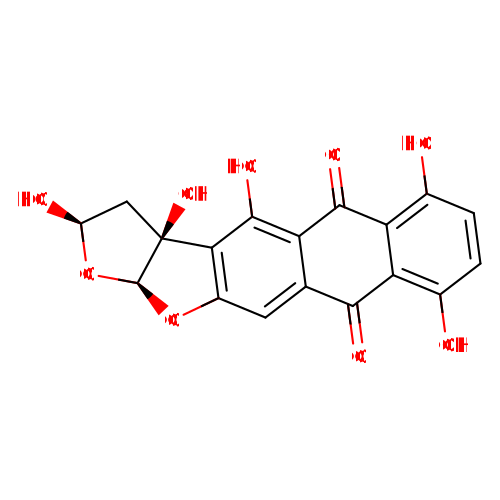
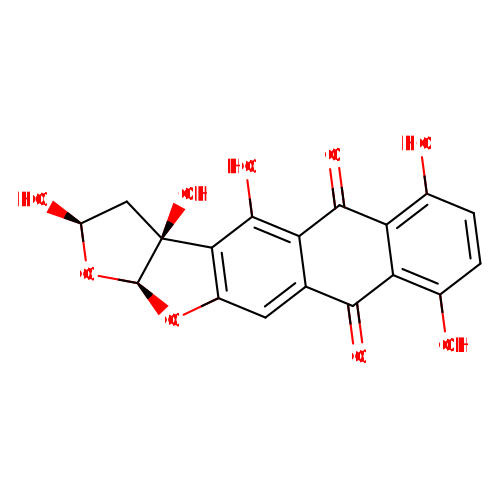
| Common Name | Dothistromin |
|---|
| Description | Dothistromin belongs to the class of organic compounds known as anthraquinones. These are organic compounds containing either anthracene-9,10-quinone, 1,4-anthraquinone, or 1,2-anthraquinone. Dothistromin is found in Cercospora spp., Dothistroma pini and Pinus radiata. Dothistromin was first documented in 2019 (PMID: 31590374). Based on a literature review a small amount of articles have been published on Dothistromin (PMID: 35448744) (PMID: 35241965) (PMID: 34616379) (PMID: 31053329). |
|---|
| Structure | O[C@H]1C[C@]2(O)[C@H](O1)OC1=CC3=C(C(O)=C21)C(=O)C1=C(O)C=CC(O)=C1C3=O InChI=1S/C18H12O9/c19-6-1-2-7(20)12-11(6)14(22)5-3-8-13(16(24)10(5)15(12)23)18(25)4-9(21)27-17(18)26-8/h1-3,9,17,19-21,24-25H,4H2/t9-,17+,18-/m1/s1 |
|---|
| Synonyms | Not Available |
|---|
| Chemical Formula | C18H12O9 |
|---|
| Average Mass | 372.2850 Da |
|---|
| Monoisotopic Mass | 372.04813 Da |
|---|
| IUPAC Name | (4R,6R,8S)-2,4,6,15,18-pentahydroxy-7,9-dioxapentacyclo[10.8.0.0^{3,10}.0^{4,8}.0^{14,19}]icosa-1(12),2,10,14,16,18-hexaene-13,20-dione |
|---|
| Traditional Name | (4R,6R,8S)-2,4,6,15,18-pentahydroxy-7,9-dioxapentacyclo[10.8.0.0^{3,10}.0^{4,8}.0^{14,19}]icosa-1(12),2,10,14,16,18-hexaene-13,20-dione |
|---|
| CAS Registry Number | Not Available |
|---|
| SMILES | O[C@H]1C[C@]2(O)[C@H](O1)OC1=CC3=C(C(O)=C21)C(=O)C1=C(O)C=CC(O)=C1C3=O |
|---|
| InChI Identifier | InChI=1S/C18H12O9/c19-6-1-2-7(20)12-11(6)14(22)5-3-8-13(16(24)10(5)15(12)23)18(25)4-9(21)27-17(18)26-8/h1-3,9,17,19-21,24-25H,4H2/t9-,17+,18-/m1/s1 |
|---|
| InChI Key | FBPGRTYADYGYRG-AHBCHLHISA-N |
|---|
| Experimental Spectra |
|---|
|
| Not Available | | Predicted Spectra |
|---|
|
| | Spectrum Type | Description | Depositor ID | Depositor Organization | Depositor | Deposition Date | View |
|---|
| 1D NMR | 13C NMR Spectrum (1D, 25 MHz, D2O, predicted) | Wishart Lab | Wishart Lab | David Wishart | 2021-06-20 | View Spectrum | | 1D NMR | 1H NMR Spectrum (1D, 100 MHz, D2O, predicted) | Wishart Lab | Wishart Lab | David Wishart | 2021-06-20 | View Spectrum | | 1D NMR | 13C NMR Spectrum (1D, 252 MHz, D2O, predicted) | Wishart Lab | Wishart Lab | David Wishart | 2021-06-20 | View Spectrum | | 1D NMR | 1H NMR Spectrum (1D, 1000 MHz, D2O, predicted) | Wishart Lab | Wishart Lab | David Wishart | 2021-06-20 | View Spectrum | | 1D NMR | 13C NMR Spectrum (1D, 50 MHz, D2O, predicted) | Wishart Lab | Wishart Lab | David Wishart | 2021-06-20 | View Spectrum | | 1D NMR | 1H NMR Spectrum (1D, 200 MHz, D2O, predicted) | Wishart Lab | Wishart Lab | David Wishart | 2021-06-20 | View Spectrum | | 1D NMR | 13C NMR Spectrum (1D, 75 MHz, D2O, predicted) | Wishart Lab | Wishart Lab | David Wishart | 2021-06-20 | View Spectrum | | 1D NMR | 1H NMR Spectrum (1D, 300 MHz, D2O, predicted) | Wishart Lab | Wishart Lab | David Wishart | 2021-06-20 | View Spectrum | | 1D NMR | 13C NMR Spectrum (1D, 101 MHz, D2O, predicted) | Wishart Lab | Wishart Lab | David Wishart | 2021-06-20 | View Spectrum | | 1D NMR | 1H NMR Spectrum (1D, 400 MHz, D2O, predicted) | Wishart Lab | Wishart Lab | David Wishart | 2021-06-20 | View Spectrum | | 1D NMR | 13C NMR Spectrum (1D, 126 MHz, D2O, predicted) | Wishart Lab | Wishart Lab | David Wishart | 2021-06-20 | View Spectrum | | 1D NMR | 1H NMR Spectrum (1D, 500 MHz, D2O, predicted) | Wishart Lab | Wishart Lab | David Wishart | 2021-06-20 | View Spectrum | | 1D NMR | 13C NMR Spectrum (1D, 151 MHz, D2O, predicted) | Wishart Lab | Wishart Lab | David Wishart | 2021-06-20 | View Spectrum | | 1D NMR | 1H NMR Spectrum (1D, 600 MHz, D2O, predicted) | Wishart Lab | Wishart Lab | David Wishart | 2021-06-20 | View Spectrum | | 1D NMR | 13C NMR Spectrum (1D, 176 MHz, D2O, predicted) | Wishart Lab | Wishart Lab | David Wishart | 2021-06-20 | View Spectrum | | 1D NMR | 1H NMR Spectrum (1D, 700 MHz, D2O, predicted) | Wishart Lab | Wishart Lab | David Wishart | 2021-06-20 | View Spectrum | | 1D NMR | 13C NMR Spectrum (1D, 201 MHz, D2O, predicted) | Wishart Lab | Wishart Lab | David Wishart | 2021-06-20 | View Spectrum | | 1D NMR | 1H NMR Spectrum (1D, 800 MHz, D2O, predicted) | Wishart Lab | Wishart Lab | David Wishart | 2021-06-20 | View Spectrum | | 1D NMR | 13C NMR Spectrum (1D, 226 MHz, D2O, predicted) | Wishart Lab | Wishart Lab | David Wishart | 2021-06-20 | View Spectrum | | 1D NMR | 1H NMR Spectrum (1D, 900 MHz, D2O, predicted) | Wishart Lab | Wishart Lab | David Wishart | 2021-06-20 | View Spectrum |
| | Chemical Shift Submissions |
|---|
|
| Not Available | | Species |
|---|
| Species of Origin | |
|---|
| Chemical Taxonomy |
|---|
| Description | Belongs to the class of organic compounds known as anthraquinones. These are organic compounds containing either anthracene-9,10-quinone, 1,4-anthraquinone, or 1,2-anthraquinone. |
|---|
| Kingdom | Organic compounds |
|---|
| Super Class | Benzenoids |
|---|
| Class | Anthracenes |
|---|
| Sub Class | Anthraquinones |
|---|
| Direct Parent | Anthraquinones |
|---|
| Alternative Parents | |
|---|
| Substituents | - 9,10-anthraquinone
- Anthraquinone
- Naphthofuran
- Coumaran
- Aryl ketone
- 1-hydroxy-4-unsubstituted benzenoid
- 1-hydroxy-2-unsubstituted benzenoid
- Tertiary alcohol
- Tetrahydrofuran
- Vinylogous acid
- Hemiacetal
- Ketone
- Polyol
- Acetal
- Oxacycle
- Organoheterocyclic compound
- Organooxygen compound
- Hydrocarbon derivative
- Alcohol
- Organic oxide
- Organic oxygen compound
- Aromatic heteropolycyclic compound
|
|---|
| Molecular Framework | Aromatic heteropolycyclic compounds |
|---|
| External Descriptors | |
|---|
| Physical Properties |
|---|
| State | Not Available |
|---|
| Experimental Properties | | Property | Value | Reference |
|---|
| Melting Point | Not Available | Not Available | | Boiling Point | Not Available | Not Available | | Water Solubility | Not Available | Not Available | | LogP | Not Available | Not Available |
|
|---|
| Predicted Properties | |
|---|
| General References | - McCarthy HM, Tarallo M, Mesarich CH, McDougal RL, Bradshaw RE: Targeted Gene Mutations in the Forest Pathogen Dothistroma septosporum Using CRISPR/Cas9. Plants (Basel). 2022 Apr 8;11(8). pii: plants11081016. doi: 10.3390/plants11081016. [PubMed:35448744 ]
- Shahid F, Alghamdi YS, Mashraqi M, Khurshid M, Ashfaq UA: Proteome based mapping and molecular docking revealed DnaA as a potential drug target against Shigella sonnei. Saudi J Biol Sci. 2022 Feb;29(2):1147-1159. doi: 10.1016/j.sjbs.2021.09.051. Epub 2021 Oct 1. [PubMed:35241965 ]
- Huang K, Tang J, Zou Y, Sun X, Lan J, Wang W, Xu P, Wu X, Ma R, Wang Q, Wang Z, Liu J: Whole Genome Sequence of Alternaria alternata, the Causal Agent of Black Spot of Kiwifruit. Front Microbiol. 2021 Sep 20;12:713462. doi: 10.3389/fmicb.2021.713462. eCollection 2021. [PubMed:34616379 ]
- Bradshaw RE, Ormond S, Dupont PY, Chettri P, Ozturk IK, McDougal RL, Bulman LS, Cox MP: Reduced Virulence of an Introduced Forest Pathogen over 50 Years. Microorganisms. 2019 Oct 5;7(10). pii: microorganisms7100420. doi: 10.3390/microorganisms7100420. [PubMed:31590374 ]
- Ozturk IK, Dupont PY, Chettri P, McDougal R, Bohl OJ, Cox RJ, Bradshaw RE: Evolutionary relics dominate the small number of secondary metabolism genes in the hemibiotrophic fungus Dothistroma septosporum. Fungal Biol. 2019 May;123(5):397-407. doi: 10.1016/j.funbio.2019.02.006. Epub 2019 Feb 27. [PubMed:31053329 ]
|
|---|