| Record Information |
|---|
| Version | 2.0 |
|---|
| Created at | 2022-04-27 22:49:32 UTC |
|---|
| Updated at | 2022-04-27 22:49:32 UTC |
|---|
| NP-MRD ID | NP0051471 |
|---|
| Secondary Accession Numbers | None |
|---|
| Natural Product Identification |
|---|
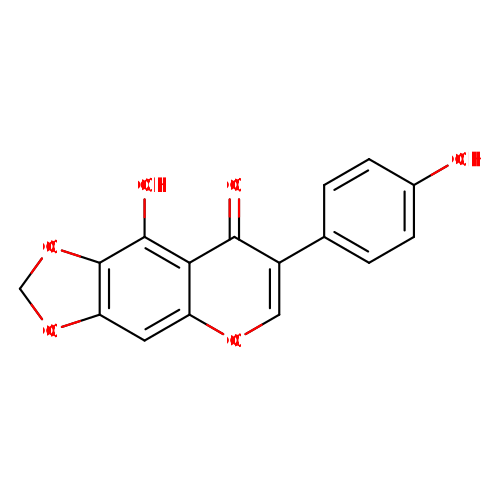
| Common Name | 5,4'-Dihydroxy-6,7-methylenedioxyisoflavone |
|---|
| Description | Irilone, also known as irolone, belongs to the class of organic compounds known as isoflavones. These are polycyclic compounds containing a 2-isoflavene skeleton which bears a ketone group at the C4 carbon atom. Thus, irilone is considered to be a flavonoid lipid molecule. Irilone is a very hydrophobic molecule, practically insoluble (in water), and relatively neutral. Outside of the human body, Irilone has been detected, but not quantified in, herbs and spices and tea. This could make irilone a potential biomarker for the consumption of these foods. 5,4'-Dihydroxy-6,7-methylenedioxyisoflavone is found in Iris domestica, Iris germanica , Iris leptophylla, Iris nigricans, Iris pseudopumila, Iris sofarana, Iris soforana, Lophira lanceolata, Medicago truncatula, Ochna calodendron and Trifolium pratense . 5,4'-Dihydroxy-6,7-methylenedioxyisoflavone was first documented in 2003 (PMID: 12567273). A hydroxyisoflavone that is 6,7-methylenedioxyisoflavone substituted by hydroxy groups at positions 5 and 4' (PMID: 19003948) (PMID: 20349151) (PMID: 21495101) (PMID: 22388969). |
|---|
| Structure | OC1=CC=C(C=C1)C1=COC2=CC3=C(OCO3)C(O)=C2C1=O InChI=1S/C16H10O6/c17-9-3-1-8(2-4-9)10-6-20-11-5-12-16(22-7-21-12)15(19)13(11)14(10)18/h1-6,17,19H,7H2 |
|---|
| Synonyms | | Value | Source |
|---|
| 5,4'-Dihydroxy-6,7-methylenedioxyisoflavone | ChEBI | | 9-Hydroxy-7-(4-hydroxyphenyl)-8H-1,3-dioxolo[4,5-g]-1-benzopyran-8-one | ChEBI | | Irolone | ChEBI | | 9-Hydroxy-7-(4-hydroxyphenyl)-8H-1,3-dioxolo[4,5-g][1]benzopyran-8-one, 9ci | HMDB |
|
|---|
| Chemical Formula | C16H10O6 |
|---|
| Average Mass | 298.2470 Da |
|---|
| Monoisotopic Mass | 298.04774 Da |
|---|
| IUPAC Name | 9-hydroxy-7-(4-hydroxyphenyl)-2H,8H-[1,3]dioxolo[4,5-g]chromen-8-one |
|---|
| Traditional Name | irilone |
|---|
| CAS Registry Number | Not Available |
|---|
| SMILES | OC1=CC=C(C=C1)C1=COC2=CC3=C(OCO3)C(O)=C2C1=O |
|---|
| InChI Identifier | InChI=1S/C16H10O6/c17-9-3-1-8(2-4-9)10-6-20-11-5-12-16(22-7-21-12)15(19)13(11)14(10)18/h1-6,17,19H,7H2 |
|---|
| InChI Key | NUGRQNBDTZWXTP-UHFFFAOYSA-N |
|---|
| Experimental Spectra |
|---|
|
| Not Available | | Predicted Spectra |
|---|
|
| | Spectrum Type | Description | Depositor ID | Depositor Organization | Depositor | Deposition Date | View |
|---|
| 1D NMR | 13C NMR Spectrum (1D, 25 MHz, D2O, predicted) | Wishart Lab | Wishart Lab | David Wishart | 2021-06-20 | View Spectrum | | 1D NMR | 1H NMR Spectrum (1D, 100 MHz, D2O, predicted) | Wishart Lab | Wishart Lab | David Wishart | 2021-06-20 | View Spectrum | | 1D NMR | 13C NMR Spectrum (1D, 252 MHz, D2O, predicted) | Wishart Lab | Wishart Lab | David Wishart | 2021-06-20 | View Spectrum | | 1D NMR | 1H NMR Spectrum (1D, 1000 MHz, D2O, predicted) | Wishart Lab | Wishart Lab | David Wishart | 2021-06-20 | View Spectrum | | 1D NMR | 13C NMR Spectrum (1D, 50 MHz, D2O, predicted) | Wishart Lab | Wishart Lab | David Wishart | 2021-06-20 | View Spectrum | | 1D NMR | 1H NMR Spectrum (1D, 200 MHz, D2O, predicted) | Wishart Lab | Wishart Lab | David Wishart | 2021-06-20 | View Spectrum | | 1D NMR | 13C NMR Spectrum (1D, 75 MHz, D2O, predicted) | Wishart Lab | Wishart Lab | David Wishart | 2021-06-20 | View Spectrum | | 1D NMR | 1H NMR Spectrum (1D, 300 MHz, D2O, predicted) | Wishart Lab | Wishart Lab | David Wishart | 2021-06-20 | View Spectrum | | 1D NMR | 13C NMR Spectrum (1D, 101 MHz, D2O, predicted) | Wishart Lab | Wishart Lab | David Wishart | 2021-06-20 | View Spectrum | | 1D NMR | 1H NMR Spectrum (1D, 400 MHz, D2O, predicted) | Wishart Lab | Wishart Lab | David Wishart | 2021-06-20 | View Spectrum | | 1D NMR | 13C NMR Spectrum (1D, 126 MHz, D2O, predicted) | Wishart Lab | Wishart Lab | David Wishart | 2021-06-20 | View Spectrum | | 1D NMR | 1H NMR Spectrum (1D, 500 MHz, D2O, predicted) | Wishart Lab | Wishart Lab | David Wishart | 2021-06-20 | View Spectrum | | 1D NMR | 13C NMR Spectrum (1D, 151 MHz, D2O, predicted) | Wishart Lab | Wishart Lab | David Wishart | 2021-06-20 | View Spectrum | | 1D NMR | 1H NMR Spectrum (1D, 600 MHz, D2O, predicted) | Wishart Lab | Wishart Lab | David Wishart | 2021-06-20 | View Spectrum | | 1D NMR | 13C NMR Spectrum (1D, 176 MHz, D2O, predicted) | Wishart Lab | Wishart Lab | David Wishart | 2021-06-20 | View Spectrum | | 1D NMR | 1H NMR Spectrum (1D, 700 MHz, D2O, predicted) | Wishart Lab | Wishart Lab | David Wishart | 2021-06-20 | View Spectrum | | 1D NMR | 13C NMR Spectrum (1D, 201 MHz, D2O, predicted) | Wishart Lab | Wishart Lab | David Wishart | 2021-06-20 | View Spectrum | | 1D NMR | 1H NMR Spectrum (1D, 800 MHz, D2O, predicted) | Wishart Lab | Wishart Lab | David Wishart | 2021-06-20 | View Spectrum | | 1D NMR | 13C NMR Spectrum (1D, 226 MHz, D2O, predicted) | Wishart Lab | Wishart Lab | David Wishart | 2021-06-20 | View Spectrum | | 1D NMR | 1H NMR Spectrum (1D, 900 MHz, D2O, predicted) | Wishart Lab | Wishart Lab | David Wishart | 2021-06-20 | View Spectrum |
| | Chemical Shift Submissions |
|---|
|
| Not Available | | Species |
|---|
| Species of Origin | |
|---|
| Chemical Taxonomy |
|---|
| Description | Belongs to the class of organic compounds known as isoflavones. These are polycyclic compounds containing a 2-isoflavene skeleton which bears a ketone group at the C4 carbon atom. |
|---|
| Kingdom | Organic compounds |
|---|
| Super Class | Phenylpropanoids and polyketides |
|---|
| Class | Isoflavonoids |
|---|
| Sub Class | Isoflav-2-enes |
|---|
| Direct Parent | Isoflavones |
|---|
| Alternative Parents | |
|---|
| Substituents | - Isoflavone
- Hydroxyisoflavonoid
- Chromone
- Benzopyran
- 1-benzopyran
- Benzodioxole
- 1-hydroxy-4-unsubstituted benzenoid
- 1-hydroxy-2-unsubstituted benzenoid
- Phenol
- Pyranone
- Monocyclic benzene moiety
- Benzenoid
- Pyran
- Heteroaromatic compound
- Vinylogous acid
- Organoheterocyclic compound
- Oxacycle
- Acetal
- Organooxygen compound
- Organic oxide
- Hydrocarbon derivative
- Organic oxygen compound
- Aromatic heteropolycyclic compound
|
|---|
| Molecular Framework | Aromatic heteropolycyclic compounds |
|---|
| External Descriptors | |
|---|
| Physical Properties |
|---|
| State | Not Available |
|---|
| Experimental Properties | | Property | Value | Reference |
|---|
| Melting Point | Not Available | Not Available | | Boiling Point | Not Available | Not Available | | Water Solubility | Not Available | Not Available | | LogP | Not Available | Not Available |
|
|---|
| Predicted Properties | |
|---|
| General References | - Wollenweber E, Stevens JF, Klimo K, Knauft J, Frank N, Gerhauser C: Cancer chemopreventive in vitro activities of isoflavones isolated from Iris germanica. Planta Med. 2003 Jan;69(1):15-20. doi: 10.1055/s-2003-37030. [PubMed:12567273 ]
- Nazir N, Koul S, Qurishi MA, Taneja SC, Ahmad SF, Khan B, Bani S, Qazi GN: Immunomodulatory activity of isoflavones isolated from Iris germanica (Iridaceae) on T-lymphocytes and cytokines. Phytother Res. 2009 Mar;23(3):428-33. doi: 10.1002/ptr.2683. [PubMed:19003948 ]
- Wang GR, Tang WZ, Yao QQ, Zhong H, Liu YJ: New flavonoids with 2BS cell proliferation promoting effect from the seeds of Trigonella foenum-graecum L. J Nat Med. 2010 Jul;64(3):358-61. doi: 10.1007/s11418-010-0407-8. Epub 2010 Mar 27. [PubMed:20349151 ]
- Mansoor TA, Ramalho RM, Luo X, Ramalhete C, Rodrigues CM, Ferreira MJ: Isoflavones as apoptosis inducers in human hepatoma HuH-7 cells. Phytother Res. 2011 Dec;25(12):1819-24. doi: 10.1002/ptr.3498. Epub 2011 Apr 14. [PubMed:21495101 ]
- Ibrahim SR, Mohamed GA, Al-Musayeib NM: New constituents from the rhizomes of Egyptian Iris germanica L. Molecules. 2012 Mar 2;17(3):2587-98. doi: 10.3390/molecules17032587. [PubMed:22388969 ]
|
|---|