| Record Information |
|---|
| Version | 2.0 |
|---|
| Created at | 2022-04-27 22:48:30 UTC |
|---|
| Updated at | 2022-04-27 22:48:30 UTC |
|---|
| NP-MRD ID | NP0051443 |
|---|
| Secondary Accession Numbers | None |
|---|
| Natural Product Identification |
|---|
| Common Name | Dicoumarol |
|---|
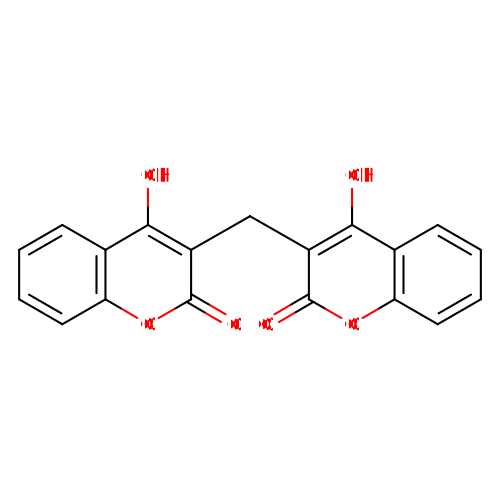
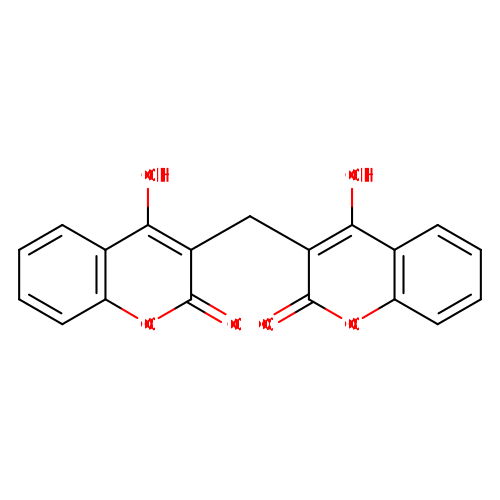
| Description | Dicumarol, also known as dicoumarin, belongs to the class of organic compounds known as 4-hydroxycoumarins. These are coumarins that contain one or more hydroxyl groups attached to C4-position the coumarin skeleton. Dicumarol is a drug which is used for decreasing blood clotting. Often used along with heparin for treatment of deep vein thrombosis. Dicumarol is an extremely weak basic (essentially neutral) compound (based on its pKa). In humans, dicumarol is involved in dicumarol action pathway. Dicumarol is a bitter tasting compound. Outside of the human body, Dicumarol has been detected, but not quantified in, herbs and spices and pulses. This could make dicumarol a potential biomarker for the consumption of these foods. Dicumarol is a potentially toxic compound. Dicoumarol is found in Anthoxanthum spp., Melilotus alba, Melilotus spp. and Viola arvensis. Dicoumarol was first documented in 2003 (PMID: 12880296). A hydroxycoumarin that is methane in which two hydrogens have each been substituted by a 4-hydroxycoumarin-3-yl group (PMID: 14500388) (PMID: 15511084) (PMID: 15639223) (PMID: 16700548). |
|---|
| Structure | OC1=C(CC2=C(O)C3=C(OC2=O)C=CC=C3)C(=O)OC2=C1C=CC=C2 InChI=1S/C19H12O6/c20-16-10-5-1-3-7-14(10)24-18(22)12(16)9-13-17(21)11-6-2-4-8-15(11)25-19(13)23/h1-8,20-21H,9H2 |
|---|
| Synonyms | | Value | Source |
|---|
| 3,3'-Methylen-bis(4-hydroxy-cumarin) | ChEBI | | 3,3'-Methylene-bis(4-hydroxycoumarine) | ChEBI | | 3,3'-Methylenebis(4-hydroxy-1,2-benzopyrone) | ChEBI | | 3,3'-Methylenebis(4-hydroxy-2H-1-benzopyran-2-one) | ChEBI | | 3,3'-Methylenebis(4-hydroxycoumarin) | ChEBI | | Bis(4-hydroxycoumarin-3-yl)methane | ChEBI | | Bis-3,3'-(4-hydroxycoumarinyl)methane | ChEBI | | Bis-hydroxycoumarin | ChEBI | | Di-(4-hydroxy-3-coumarinyl)methane | ChEBI | | Dicoumarolum | ChEBI | | Dicoumarol | Kegg | | Bishydroxycoumarin | HMDB | | Dicoumarin | HMDB |
|
|---|
| Chemical Formula | C19H12O6 |
|---|
| Average Mass | 336.2950 Da |
|---|
| Monoisotopic Mass | 336.06339 Da |
|---|
| IUPAC Name | 4-hydroxy-3-[(4-hydroxy-2-oxo-2H-chromen-3-yl)methyl]-2H-chromen-2-one |
|---|
| Traditional Name | dicoumarol |
|---|
| CAS Registry Number | Not Available |
|---|
| SMILES | OC1=C(CC2=C(O)C3=C(OC2=O)C=CC=C3)C(=O)OC2=C1C=CC=C2 |
|---|
| InChI Identifier | InChI=1S/C19H12O6/c20-16-10-5-1-3-7-14(10)24-18(22)12(16)9-13-17(21)11-6-2-4-8-15(11)25-19(13)23/h1-8,20-21H,9H2 |
|---|
| InChI Key | DOBMPNYZJYQDGZ-UHFFFAOYSA-N |
|---|
| Experimental Spectra |
|---|
|
| Not Available | | Predicted Spectra |
|---|
|
| | Spectrum Type | Description | Depositor ID | Depositor Organization | Depositor | Deposition Date | View |
|---|
| 1D NMR | 13C NMR Spectrum (1D, 25 MHz, D2O, predicted) | Wishart Lab | Wishart Lab | David Wishart | 2021-06-20 | View Spectrum | | 1D NMR | 1H NMR Spectrum (1D, 100 MHz, D2O, predicted) | Wishart Lab | Wishart Lab | David Wishart | 2021-06-20 | View Spectrum | | 1D NMR | 13C NMR Spectrum (1D, 252 MHz, D2O, predicted) | Wishart Lab | Wishart Lab | David Wishart | 2021-06-20 | View Spectrum | | 1D NMR | 1H NMR Spectrum (1D, 1000 MHz, D2O, predicted) | Wishart Lab | Wishart Lab | David Wishart | 2021-06-20 | View Spectrum | | 1D NMR | 13C NMR Spectrum (1D, 50 MHz, D2O, predicted) | Wishart Lab | Wishart Lab | David Wishart | 2021-06-20 | View Spectrum | | 1D NMR | 1H NMR Spectrum (1D, 200 MHz, D2O, predicted) | Wishart Lab | Wishart Lab | David Wishart | 2021-06-20 | View Spectrum | | 1D NMR | 13C NMR Spectrum (1D, 75 MHz, D2O, predicted) | Wishart Lab | Wishart Lab | David Wishart | 2021-06-20 | View Spectrum | | 1D NMR | 1H NMR Spectrum (1D, 300 MHz, D2O, predicted) | Wishart Lab | Wishart Lab | David Wishart | 2021-06-20 | View Spectrum | | 1D NMR | 13C NMR Spectrum (1D, 101 MHz, D2O, predicted) | Wishart Lab | Wishart Lab | David Wishart | 2021-06-20 | View Spectrum | | 1D NMR | 1H NMR Spectrum (1D, 400 MHz, D2O, predicted) | Wishart Lab | Wishart Lab | David Wishart | 2021-06-20 | View Spectrum | | 1D NMR | 13C NMR Spectrum (1D, 126 MHz, D2O, predicted) | Wishart Lab | Wishart Lab | David Wishart | 2021-06-20 | View Spectrum | | 1D NMR | 1H NMR Spectrum (1D, 500 MHz, D2O, predicted) | Wishart Lab | Wishart Lab | David Wishart | 2021-06-20 | View Spectrum | | 1D NMR | 13C NMR Spectrum (1D, 151 MHz, D2O, predicted) | Wishart Lab | Wishart Lab | David Wishart | 2021-06-20 | View Spectrum | | 1D NMR | 1H NMR Spectrum (1D, 600 MHz, D2O, predicted) | Wishart Lab | Wishart Lab | David Wishart | 2021-06-20 | View Spectrum | | 1D NMR | 13C NMR Spectrum (1D, 176 MHz, D2O, predicted) | Wishart Lab | Wishart Lab | David Wishart | 2021-06-20 | View Spectrum | | 1D NMR | 1H NMR Spectrum (1D, 700 MHz, D2O, predicted) | Wishart Lab | Wishart Lab | David Wishart | 2021-06-20 | View Spectrum | | 1D NMR | 13C NMR Spectrum (1D, 201 MHz, D2O, predicted) | Wishart Lab | Wishart Lab | David Wishart | 2021-06-20 | View Spectrum | | 1D NMR | 1H NMR Spectrum (1D, 800 MHz, D2O, predicted) | Wishart Lab | Wishart Lab | David Wishart | 2021-06-20 | View Spectrum | | 1D NMR | 13C NMR Spectrum (1D, 226 MHz, D2O, predicted) | Wishart Lab | Wishart Lab | David Wishart | 2021-06-20 | View Spectrum | | 1D NMR | 1H NMR Spectrum (1D, 900 MHz, D2O, predicted) | Wishart Lab | Wishart Lab | David Wishart | 2021-06-20 | View Spectrum |
| | Chemical Shift Submissions |
|---|
|
| Not Available | | Species |
|---|
| Species of Origin | | Species Name | Source | Reference |
|---|
| Anthoxanthum spp. | Plant | | | Melilotus alba | Plant | | | Melilotus spp. | Plant | | | Viola arvensis | LOTUS Database | |
|
|---|
| Chemical Taxonomy |
|---|
| Description | Belongs to the class of organic compounds known as 4-hydroxycoumarins. These are coumarins that contain one or more hydroxyl groups attached to C4-position the coumarin skeleton. |
|---|
| Kingdom | Organic compounds |
|---|
| Super Class | Phenylpropanoids and polyketides |
|---|
| Class | Coumarins and derivatives |
|---|
| Sub Class | Hydroxycoumarins |
|---|
| Direct Parent | 4-hydroxycoumarins |
|---|
| Alternative Parents | |
|---|
| Substituents | - 4-hydroxycoumarin
- Benzopyran
- 1-benzopyran
- Pyranone
- Pyran
- Benzenoid
- Heteroaromatic compound
- Vinylogous acid
- Lactone
- Oxacycle
- Organoheterocyclic compound
- Organic oxygen compound
- Hydrocarbon derivative
- Organooxygen compound
- Organic oxide
- Aromatic heteropolycyclic compound
|
|---|
| Molecular Framework | Aromatic heteropolycyclic compounds |
|---|
| External Descriptors | |
|---|
| Physical Properties |
|---|
| State | Not Available |
|---|
| Experimental Properties | | Property | Value | Reference |
|---|
| Melting Point | Not Available | Not Available | | Boiling Point | Not Available | Not Available | | Water Solubility | Not Available | Not Available | | LogP | Not Available | Not Available |
|
|---|
| Predicted Properties | |
|---|
| General References | - Thanos CG, Liu Z, Reineke J, Edwards E, Mathiowitz E: Improving relative bioavailability of dicumarol by reducing particle size and adding the adhesive poly(fumaric-co-sebacic) anhydride. Pharm Res. 2003 Jul;20(7):1093-100. doi: 10.1023/a:1024474609667. [PubMed:12880296 ]
- Cullen JJ, Hinkhouse MM, Grady M, Gaut AW, Liu J, Zhang YP, Weydert CJ, Domann FE, Oberley LW: Dicumarol inhibition of NADPH:quinone oxidoreductase induces growth inhibition of pancreatic cancer via a superoxide-mediated mechanism. Cancer Res. 2003 Sep 1;63(17):5513-20. [PubMed:14500388 ]
- Mironov AA, Colanzi A, Polishchuk RS, Beznoussenko GV, Mironov AA Jr, Fusella A, Di Tullio G, Silletta MG, Corda D, De Matteis MA, Luini A: Dicumarol, an inhibitor of ADP-ribosylation of CtBP3/BARS, fragments golgi non-compact tubular zones and inhibits intra-golgi transport. Eur J Cell Biol. 2004 Jul;83(6):263-79. doi: 10.1078/0171-9335-00377. [PubMed:15511084 ]
- Abdelmohsen K, Stuhlmann D, Daubrawa F, Klotz LO: Dicumarol is a potent reversible inhibitor of gap junctional intercellular communication. Arch Biochem Biophys. 2005 Feb 15;434(2):241-7. doi: 10.1016/j.abb.2004.11.002. [PubMed:15639223 ]
- Asher G, Dym O, Tsvetkov P, Adler J, Shaul Y: The crystal structure of NAD(P)H quinone oxidoreductase 1 in complex with its potent inhibitor dicoumarol. Biochemistry. 2006 May 23;45(20):6372-8. doi: 10.1021/bi0600087. [PubMed:16700548 ]
|
|---|