| Record Information |
|---|
| Version | 2.0 |
|---|
| Created at | 2022-04-27 22:33:45 UTC |
|---|
| Updated at | 2022-04-27 22:33:45 UTC |
|---|
| NP-MRD ID | NP0051150 |
|---|
| Secondary Accession Numbers | None |
|---|
| Natural Product Identification |
|---|
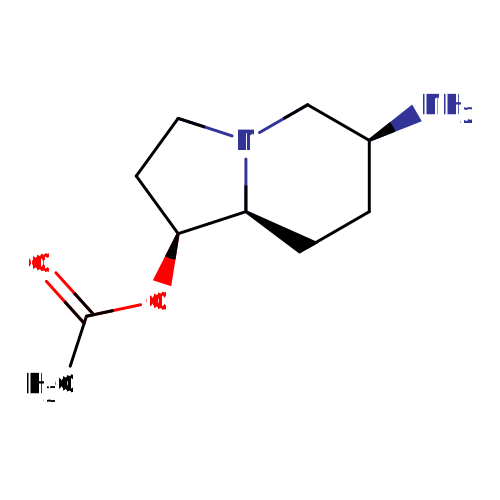
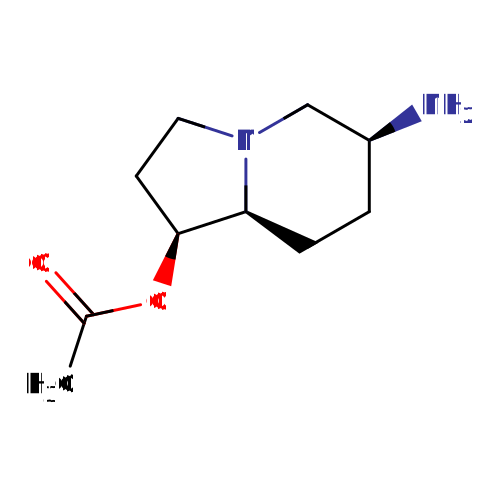
| Common Name | Slaframine |
|---|
| Description | Slaframine belongs to the class of organic compounds known as indolizidines. These are polycyclic compounds containing an indolizidine, which is a bicyclic heterocycle containing a saturated six-member ring fused to a saturated five-member ring, one of the bridging atoms being nitrogen. Slaframine is found in Rhizoctonia leguminicola and Trifolium repens . Slaframine was first documented in 2002 (PMID: 12521266). Based on a literature review a significant number of articles have been published on Slaframine (PMID: 26777309) (PMID: 30830325) (PMID: 28932984) (PMID: 26858953) (PMID: 25585493) (PMID: 14620842). |
|---|
| Structure | CC(=O)O[C@H]1CCN2C[C@@H](N)CC[C@@H]12 InChI=1S/C10H18N2O2/c1-7(13)14-10-4-5-12-6-8(11)2-3-9(10)12/h8-10H,2-6,11H2,1H3/t8-,9-,10-/m0/s1 |
|---|
| Synonyms | | Value | Source |
|---|
| (1S,6S,8AS)-1-acetoxy-6-aminooctahydroindolizine | MeSH | | Slaframine citrate salt (1:2) | MeSH |
|
|---|
| Chemical Formula | C10H18N2O2 |
|---|
| Average Mass | 198.2660 Da |
|---|
| Monoisotopic Mass | 198.13683 Da |
|---|
| IUPAC Name | (1S,6S,8aS)-6-amino-octahydroindolizin-1-yl acetate |
|---|
| Traditional Name | slaframine |
|---|
| CAS Registry Number | Not Available |
|---|
| SMILES | CC(=O)O[C@H]1CCN2C[C@@H](N)CC[C@@H]12 |
|---|
| InChI Identifier | InChI=1S/C10H18N2O2/c1-7(13)14-10-4-5-12-6-8(11)2-3-9(10)12/h8-10H,2-6,11H2,1H3/t8-,9-,10-/m0/s1 |
|---|
| InChI Key | YYIUHLPAZILPSG-GUBZILKMSA-N |
|---|
| Experimental Spectra |
|---|
|
| Not Available | | Predicted Spectra |
|---|
|
| | Spectrum Type | Description | Depositor ID | Depositor Organization | Depositor | Deposition Date | View |
|---|
| 1D NMR | 13C NMR Spectrum (1D, 25 MHz, D2O, predicted) | Wishart Lab | Wishart Lab | David Wishart | 2021-06-20 | View Spectrum | | 1D NMR | 1H NMR Spectrum (1D, 100 MHz, D2O, predicted) | Wishart Lab | Wishart Lab | David Wishart | 2021-06-20 | View Spectrum | | 1D NMR | 13C NMR Spectrum (1D, 252 MHz, D2O, predicted) | Wishart Lab | Wishart Lab | David Wishart | 2021-06-20 | View Spectrum | | 1D NMR | 1H NMR Spectrum (1D, 1000 MHz, D2O, predicted) | Wishart Lab | Wishart Lab | David Wishart | 2021-06-20 | View Spectrum | | 1D NMR | 13C NMR Spectrum (1D, 50 MHz, D2O, predicted) | Wishart Lab | Wishart Lab | David Wishart | 2021-06-20 | View Spectrum | | 1D NMR | 1H NMR Spectrum (1D, 200 MHz, D2O, predicted) | Wishart Lab | Wishart Lab | David Wishart | 2021-06-20 | View Spectrum | | 1D NMR | 13C NMR Spectrum (1D, 75 MHz, D2O, predicted) | Wishart Lab | Wishart Lab | David Wishart | 2021-06-20 | View Spectrum | | 1D NMR | 1H NMR Spectrum (1D, 300 MHz, D2O, predicted) | Wishart Lab | Wishart Lab | David Wishart | 2021-06-20 | View Spectrum | | 1D NMR | 13C NMR Spectrum (1D, 101 MHz, D2O, predicted) | Wishart Lab | Wishart Lab | David Wishart | 2021-06-20 | View Spectrum | | 1D NMR | 1H NMR Spectrum (1D, 400 MHz, D2O, predicted) | Wishart Lab | Wishart Lab | David Wishart | 2021-06-20 | View Spectrum | | 1D NMR | 13C NMR Spectrum (1D, 126 MHz, D2O, predicted) | Wishart Lab | Wishart Lab | David Wishart | 2021-06-20 | View Spectrum | | 1D NMR | 1H NMR Spectrum (1D, 500 MHz, D2O, predicted) | Wishart Lab | Wishart Lab | David Wishart | 2021-06-20 | View Spectrum | | 1D NMR | 13C NMR Spectrum (1D, 151 MHz, D2O, predicted) | Wishart Lab | Wishart Lab | David Wishart | 2021-06-20 | View Spectrum | | 1D NMR | 1H NMR Spectrum (1D, 600 MHz, D2O, predicted) | Wishart Lab | Wishart Lab | David Wishart | 2021-06-20 | View Spectrum | | 1D NMR | 13C NMR Spectrum (1D, 176 MHz, D2O, predicted) | Wishart Lab | Wishart Lab | David Wishart | 2021-06-20 | View Spectrum | | 1D NMR | 1H NMR Spectrum (1D, 700 MHz, D2O, predicted) | Wishart Lab | Wishart Lab | David Wishart | 2021-06-20 | View Spectrum | | 1D NMR | 13C NMR Spectrum (1D, 201 MHz, D2O, predicted) | Wishart Lab | Wishart Lab | David Wishart | 2021-06-20 | View Spectrum | | 1D NMR | 1H NMR Spectrum (1D, 800 MHz, D2O, predicted) | Wishart Lab | Wishart Lab | David Wishart | 2021-06-20 | View Spectrum | | 1D NMR | 13C NMR Spectrum (1D, 226 MHz, D2O, predicted) | Wishart Lab | Wishart Lab | David Wishart | 2021-06-20 | View Spectrum | | 1D NMR | 1H NMR Spectrum (1D, 900 MHz, D2O, predicted) | Wishart Lab | Wishart Lab | David Wishart | 2021-06-20 | View Spectrum |
| | Chemical Shift Submissions |
|---|
|
| Not Available | | Species |
|---|
| Species of Origin | |
|---|
| Chemical Taxonomy |
|---|
| Description | Belongs to the class of organic compounds known as indolizidines. These are polycyclic compounds containing an indolizidine, which is a bicyclic heterocycle containing a saturated six-member ring fused to a saturated five-member ring, one of the bridging atoms being nitrogen. |
|---|
| Kingdom | Organic compounds |
|---|
| Super Class | Organoheterocyclic compounds |
|---|
| Class | Indolizidines |
|---|
| Sub Class | Not Available |
|---|
| Direct Parent | Indolizidines |
|---|
| Alternative Parents | |
|---|
| Substituents | - Indolizidine
- 3-aminopiperidine
- Piperidine
- N-alkylpyrrolidine
- Pyrrolidine
- Amino acid or derivatives
- Carboxylic acid ester
- Tertiary amine
- Tertiary aliphatic amine
- Monocarboxylic acid or derivatives
- Carboxylic acid derivative
- Azacycle
- Organic oxide
- Primary amine
- Organopnictogen compound
- Organooxygen compound
- Organonitrogen compound
- Primary aliphatic amine
- Organic oxygen compound
- Amine
- Carbonyl group
- Organic nitrogen compound
- Hydrocarbon derivative
- Aliphatic heteropolycyclic compound
|
|---|
| Molecular Framework | Aliphatic heteropolycyclic compounds |
|---|
| External Descriptors | Not Available |
|---|
| Physical Properties |
|---|
| State | Not Available |
|---|
| Experimental Properties | | Property | Value | Reference |
|---|
| Melting Point | Not Available | Not Available | | Boiling Point | Not Available | Not Available | | Water Solubility | Not Available | Not Available | | LogP | Not Available | Not Available |
|
|---|
| Predicted Properties | |
|---|
| General References | - Michael JP: Simple Indolizidine and Quinolizidine Alkaloids. Alkaloids Chem Biol. 2016;75:1-498. doi: 10.1016/bs.alkal.2014.12.001. Epub 2015 Mar 30. [PubMed:26777309 ]
- Jousse C, Dalle C, Canet I, Lagree M, Traikia M, Lyan B, Mendes C, Sancelme M, Amato P, Delort AM: Metabolomic study of the response to cold shock in a strain of Pseudomonas syringae isolated from cloud water. Metabolomics. 2017 Dec 4;14(1):11. doi: 10.1007/s11306-017-1295-7. [PubMed:30830325 ]
- Alhawatema MS, Gebril S, Cook D, Creamer R: RNAi-mediated down-regulation of a melanin polyketide synthase (pks1) gene in the fungus Slafractonia leguminicola. World J Microbiol Biotechnol. 2017 Sep 20;33(10):179. doi: 10.1007/s11274-017-2346-y. [PubMed:28932984 ]
- Kagan IA: Blackpatch of Clover, Cause of Slobbers Syndrome: A Review of the Disease and the Pathogen, Rhizoctonia leguminicola. Front Vet Sci. 2016 Jan 27;3:3. doi: 10.3389/fvets.2016.00003. eCollection 2016. [PubMed:26858953 ]
- Alhawatema MS, Sanogo S, Baucom DL, Creamer R: A search for the phylogenetic relationship of the ascomycete Rhizoctonia leguminicola using genetic analysis. Mycopathologia. 2015 Jun;179(5-6):381-9. doi: 10.1007/s11046-015-9860-y. Epub 2015 Jan 14. [PubMed:25585493 ]
- Michael JP: Indolizidine and quinolizidine alkaloids. Nat Prod Rep. 2003 Oct;20(5):458-75. doi: 10.1039/b208137g. [PubMed:14620842 ]
- Riet-Correa F, Rivero R, Odriozola E, Adrien Mde L, Medeiros RM, Schild AL: Mycotoxicoses of ruminants and horses. J Vet Diagn Invest. 2013 Nov;25(6):692-708. doi: 10.1177/1040638713504572. Epub 2013 Oct 3. [PubMed:24091682 ]
- Cossy J: Selective methodologies for the synthesis of biologically active piperidinic compounds. Chem Rec. 2005;5(2):70-80. doi: 10.1002/tcr.20035. [PubMed:15825169 ]
- Naranjo L, Martin de Valmaseda E, Casqueiro J, Ullan RV, Lamas-Maceiras M, Banuelos O, Martin JF: Inactivation of the lys7 gene, encoding saccharopine reductase in Penicillium chrysogenum, leads to accumulation of the secondary metabolite precursors piperideine-6-carboxylic acid and pipecolic acid from alpha-aminoadipic acid. Appl Environ Microbiol. 2004 Feb;70(2):1031-9. doi: 10.1128/AEM.70.2.1031-1039.2004. [PubMed:14766586 ]
- Michael JP: Indolizidine and quinolizidine alkaloids. Nat Prod Rep. 2002 Dec;19(6):719-41. doi: 10.1039/b104969k. [PubMed:12521266 ]
|
|---|