| Record Information |
|---|
| Version | 2.0 |
|---|
| Created at | 2022-04-27 22:33:31 UTC |
|---|
| Updated at | 2022-04-27 22:33:31 UTC |
|---|
| NP-MRD ID | NP0051144 |
|---|
| Secondary Accession Numbers | None |
|---|
| Natural Product Identification |
|---|
| Common Name | Piperlongumine |
|---|
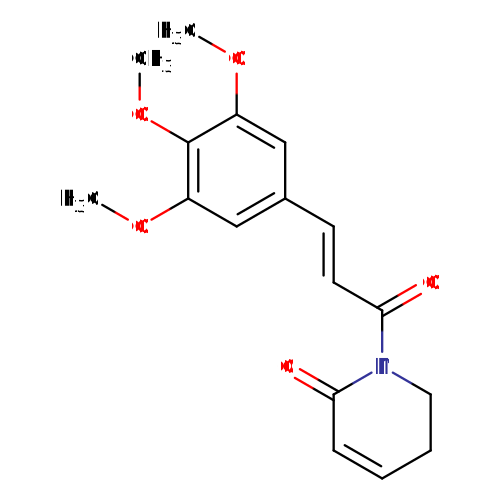
| Description | Piplartine, also known as piperlongumine, belongs to the class of organic compounds known as cinnamic acids and derivatives. These are organic aromatic compounds containing a benzene and a carboxylic acid group (or a derivative thereof) forming 3-phenylprop-2-enoic acid. Piplartine is an extremely weak basic (essentially neutral) compound (based on its pKa). Its anticancer effects may be due to silencing the GSTP1 gene. Outside of the human body, Piplartine has been detected, but not quantified in, herbs and spices. This could make piplartine a potential biomarker for the consumption of these foods. Some piperlongumine derivatives were potent anti-inflammatory agents. In in vitro experiments, it selectively kills some types cancer cells over normal cells. Piperlongumine inhibits the migration of breast cancer cells (MDA-MB-231), an approach for discovering antimetastatic agents. Piperlongumine may have anti-cancer properties. Piperlongumine (PL) is a natural product constituent of the fruit of the Long pepper (Piper longum), a pepper plant found in southern India and southeast Asia. One study in a xenograft mouse model of cancer showed that piperlongumine inhibits the growth of malignant breast tumors and their associated metastases. Although this study has been retracted. Wang et al., Evaluated piperlongumine as a novel senolytic agent. Piperlongumine is found in Piper arborescens, Piper cenocladum, Piper longum , Piper macropiper, Piper puberulum, Piper retrofractum, Piper retrofractum Vahl. , Piper sarmentosum, Piper sulvaticum, Piper swartzianum, Piper sylvaticum , Piper tuberculatum and Piper tuberculatum Jacq. . Piperlongumine was first documented in 2008 (PMID: 18813819). The synthesis typically involved Schotten-Baumann reaction between the acid chloride of 3,4,5-trimethoxycinnamic acid with the corresponding amines. |
|---|
| Structure | COC1=CC(\C=C\C(=O)N2CCC=CC2=O)=CC(OC)=C1OC InChI=1S/C17H19NO5/c1-21-13-10-12(11-14(22-2)17(13)23-3)7-8-16(20)18-9-5-4-6-15(18)19/h4,6-8,10-11H,5,9H2,1-3H3/b8-7+ |
|---|
| Synonyms | | Value | Source |
|---|
| Piperlongumine | Kegg | | 5,6-Dihydro-1-(3,4,5-trimethoxycinnamoyl)-2(1H)-pyridinone | HMDB | | 5,6-Dihydro-1-[1-oxo-3-(3,4,5-trimethoxyphenyl)-2-propenyl]-2(1H)-pyridinone, 9ci | HMDB | | N-(3,4,5-Trimethoxycinnamoyl)-D3-piperidin-2-one | HMDB | | Piperlonguminine | HMDB |
|
|---|
| Chemical Formula | C17H19NO5 |
|---|
| Average Mass | 317.3365 Da |
|---|
| Monoisotopic Mass | 317.12632 Da |
|---|
| IUPAC Name | 1-[(2E)-3-(3,4,5-trimethoxyphenyl)prop-2-enoyl]-1,2,5,6-tetrahydropyridin-2-one |
|---|
| Traditional Name | piperlongumine |
|---|
| CAS Registry Number | Not Available |
|---|
| SMILES | COC1=CC(\C=C\C(=O)N2CCC=CC2=O)=CC(OC)=C1OC |
|---|
| InChI Identifier | InChI=1S/C17H19NO5/c1-21-13-10-12(11-14(22-2)17(13)23-3)7-8-16(20)18-9-5-4-6-15(18)19/h4,6-8,10-11H,5,9H2,1-3H3/b8-7+ |
|---|
| InChI Key | VABYUUZNAVQNPG-BQYQJAHWSA-N |
|---|
| Experimental Spectra |
|---|
|
| Not Available | | Predicted Spectra |
|---|
|
| | Spectrum Type | Description | Depositor ID | Depositor Organization | Depositor | Deposition Date | View |
|---|
| 1D NMR | 13C NMR Spectrum (1D, 25 MHz, D2O, predicted) | Wishart Lab | Wishart Lab | David Wishart | 2021-06-20 | View Spectrum | | 1D NMR | 1H NMR Spectrum (1D, 100 MHz, D2O, predicted) | Wishart Lab | Wishart Lab | David Wishart | 2021-06-20 | View Spectrum | | 1D NMR | 13C NMR Spectrum (1D, 252 MHz, D2O, predicted) | Wishart Lab | Wishart Lab | David Wishart | 2021-06-20 | View Spectrum | | 1D NMR | 1H NMR Spectrum (1D, 1000 MHz, D2O, predicted) | Wishart Lab | Wishart Lab | David Wishart | 2021-06-20 | View Spectrum | | 1D NMR | 13C NMR Spectrum (1D, 50 MHz, D2O, predicted) | Wishart Lab | Wishart Lab | David Wishart | 2021-06-20 | View Spectrum | | 1D NMR | 1H NMR Spectrum (1D, 200 MHz, D2O, predicted) | Wishart Lab | Wishart Lab | David Wishart | 2021-06-20 | View Spectrum | | 1D NMR | 13C NMR Spectrum (1D, 75 MHz, D2O, predicted) | Wishart Lab | Wishart Lab | David Wishart | 2021-06-20 | View Spectrum | | 1D NMR | 1H NMR Spectrum (1D, 300 MHz, D2O, predicted) | Wishart Lab | Wishart Lab | David Wishart | 2021-06-20 | View Spectrum | | 1D NMR | 13C NMR Spectrum (1D, 101 MHz, D2O, predicted) | Wishart Lab | Wishart Lab | David Wishart | 2021-06-20 | View Spectrum | | 1D NMR | 1H NMR Spectrum (1D, 400 MHz, D2O, predicted) | Wishart Lab | Wishart Lab | David Wishart | 2021-06-20 | View Spectrum | | 1D NMR | 13C NMR Spectrum (1D, 126 MHz, D2O, predicted) | Wishart Lab | Wishart Lab | David Wishart | 2021-06-20 | View Spectrum | | 1D NMR | 1H NMR Spectrum (1D, 500 MHz, D2O, predicted) | Wishart Lab | Wishart Lab | David Wishart | 2021-06-20 | View Spectrum | | 1D NMR | 13C NMR Spectrum (1D, 151 MHz, D2O, predicted) | Wishart Lab | Wishart Lab | David Wishart | 2021-06-20 | View Spectrum | | 1D NMR | 1H NMR Spectrum (1D, 600 MHz, D2O, predicted) | Wishart Lab | Wishart Lab | David Wishart | 2021-06-20 | View Spectrum | | 1D NMR | 13C NMR Spectrum (1D, 176 MHz, D2O, predicted) | Wishart Lab | Wishart Lab | David Wishart | 2021-06-20 | View Spectrum | | 1D NMR | 1H NMR Spectrum (1D, 700 MHz, D2O, predicted) | Wishart Lab | Wishart Lab | David Wishart | 2021-06-20 | View Spectrum | | 1D NMR | 13C NMR Spectrum (1D, 201 MHz, D2O, predicted) | Wishart Lab | Wishart Lab | David Wishart | 2021-06-20 | View Spectrum | | 1D NMR | 1H NMR Spectrum (1D, 800 MHz, D2O, predicted) | Wishart Lab | Wishart Lab | David Wishart | 2021-06-20 | View Spectrum | | 1D NMR | 13C NMR Spectrum (1D, 226 MHz, D2O, predicted) | Wishart Lab | Wishart Lab | David Wishart | 2021-06-20 | View Spectrum | | 1D NMR | 1H NMR Spectrum (1D, 900 MHz, D2O, predicted) | Wishart Lab | Wishart Lab | David Wishart | 2021-06-20 | View Spectrum |
| | Chemical Shift Submissions |
|---|
|
| Not Available | | Species |
|---|
| Species of Origin | |
|---|
| Chemical Taxonomy |
|---|
| Description | Belongs to the class of organic compounds known as cinnamic acids and derivatives. These are organic aromatic compounds containing a benzene and a carboxylic acid group (or a derivative thereof) forming 3-phenylprop-2-enoic acid. |
|---|
| Kingdom | Organic compounds |
|---|
| Super Class | Phenylpropanoids and polyketides |
|---|
| Class | Cinnamic acids and derivatives |
|---|
| Sub Class | Not Available |
|---|
| Direct Parent | Cinnamic acids and derivatives |
|---|
| Alternative Parents | |
|---|
| Substituents | - Cinnamic acid or derivatives
- Phenoxy compound
- Anisole
- Methoxybenzene
- Styrene
- Phenol ether
- Alkyl aryl ether
- Monocyclic benzene moiety
- Hydropyridine
- Benzenoid
- Carboxylic acid imide, n-substituted
- Carboxylic acid imide
- Dicarboximide
- Carboxylic acid derivative
- Azacycle
- Ether
- Organoheterocyclic compound
- Organic oxygen compound
- Hydrocarbon derivative
- Organic oxide
- Organic nitrogen compound
- Carbonyl group
- Organopnictogen compound
- Organooxygen compound
- Organonitrogen compound
- Aromatic heteromonocyclic compound
|
|---|
| Molecular Framework | Aromatic heteromonocyclic compounds |
|---|
| External Descriptors | |
|---|
| Physical Properties |
|---|
| State | Not Available |
|---|
| Experimental Properties | | Property | Value | Reference |
|---|
| Melting Point | Not Available | Not Available | | Boiling Point | Not Available | Not Available | | Water Solubility | Not Available | Not Available | | LogP | Not Available | Not Available |
|
|---|
| Predicted Properties | |
|---|