| Record Information |
|---|
| Version | 2.0 |
|---|
| Created at | 2022-04-27 22:20:04 UTC |
|---|
| Updated at | 2022-04-27 22:20:05 UTC |
|---|
| NP-MRD ID | NP0050880 |
|---|
| Secondary Accession Numbers | None |
|---|
| Natural Product Identification |
|---|
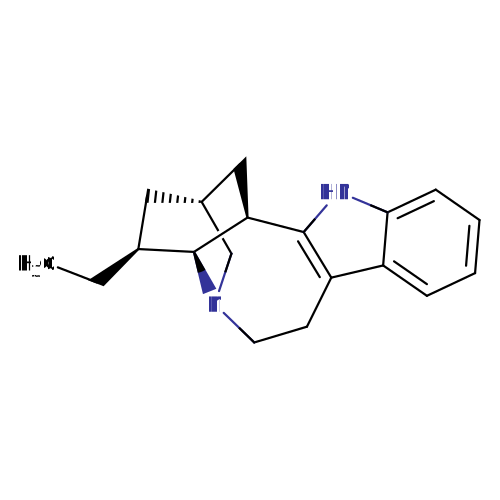
| Common Name | Ibogamine |
|---|
| Description | Ibogamine belongs to the class of organic compounds known as ibogan-type alkaloids. These are indole alkaloids with a structure based on the ibogamine skeleton or a derivative thereof. Ibogamine is a pentacyclic heterocyclic compound consisting of an indole fused to an azepane-containing tricyclic moiety ring. Iboga alkaloids arise from the cyclization of a secodine-type precursor through the formation of a 16,21 bond. Ibogamine is a secondary metabolite. Secondary metabolites are metabolically or physiologically non-essential metabolites that may serve a role as defense or signalling molecules. In some cases they are simply molecules that arise from the incomplete metabolism of other secondary metabolites. Ibogamine is found in Catharanthus roseus , Tabernaemontana divaricata, Ervatamia divaricata Gouyahua, Tabernaemontana calcarea, Tabernaemontana citrifolia, Tabernaemontana markgrafiana and Tabernanthe iboga . Ibogamine was first documented in 2018 (PMID: 30030374). Based on a literature review a small amount of articles have been published on ibogamine (PMID: 33321518) (PMID: 31095891) (PMID: 30618175) (PMID: 30599414). |
|---|
| Structure | CC[C@H]1C[C@@H]2C[C@@H]3[C@H]1N(C2)CCC1=C3NC2=CC=CC=C12 InChI=1S/C19H24N2/c1-2-13-9-12-10-16-18-15(7-8-21(11-12)19(13)16)14-5-3-4-6-17(14)20-18/h3-6,12-13,16,19-20H,2,7-11H2,1H3/t12-,13+,16+,19+/m1/s1 |
|---|
| Synonyms | | Value | Source |
|---|
| (-)-Ibogamine | ChEBI |
|
|---|
| Chemical Formula | C19H24N2 |
|---|
| Average Mass | 280.4150 Da |
|---|
| Monoisotopic Mass | 280.19395 Da |
|---|
| IUPAC Name | (1R,15R,17S,18S)-17-ethyl-3,13-diazapentacyclo[13.3.1.0^{2,10}.0^{4,9}.0^{13,18}]nonadeca-2(10),4,6,8-tetraene |
|---|
| Traditional Name | (1R,15R,17S,18S)-17-ethyl-3,13-diazapentacyclo[13.3.1.0^{2,10}.0^{4,9}.0^{13,18}]nonadeca-2(10),4,6,8-tetraene |
|---|
| CAS Registry Number | Not Available |
|---|
| SMILES | CC[C@H]1C[C@@H]2C[C@@H]3[C@H]1N(C2)CCC1=C3NC2=CC=CC=C12 |
|---|
| InChI Identifier | InChI=1S/C19H24N2/c1-2-13-9-12-10-16-18-15(7-8-21(11-12)19(13)16)14-5-3-4-6-17(14)20-18/h3-6,12-13,16,19-20H,2,7-11H2,1H3/t12-,13+,16+,19+/m1/s1 |
|---|
| InChI Key | LRLCVRYKAFDXKU-YGOSVGOTSA-N |
|---|
| Experimental Spectra |
|---|
|
| Not Available | | Predicted Spectra |
|---|
|
| | Spectrum Type | Description | Depositor ID | Depositor Organization | Depositor | Deposition Date | View |
|---|
| 1D NMR | 13C NMR Spectrum (1D, 25 MHz, D2O, predicted) | Wishart Lab | Wishart Lab | David Wishart | 2021-06-20 | View Spectrum | | 1D NMR | 1H NMR Spectrum (1D, 100 MHz, D2O, predicted) | Wishart Lab | Wishart Lab | David Wishart | 2021-06-20 | View Spectrum | | 1D NMR | 13C NMR Spectrum (1D, 252 MHz, D2O, predicted) | Wishart Lab | Wishart Lab | David Wishart | 2021-06-20 | View Spectrum | | 1D NMR | 1H NMR Spectrum (1D, 1000 MHz, D2O, predicted) | Wishart Lab | Wishart Lab | David Wishart | 2021-06-20 | View Spectrum | | 1D NMR | 13C NMR Spectrum (1D, 50 MHz, D2O, predicted) | Wishart Lab | Wishart Lab | David Wishart | 2021-06-20 | View Spectrum | | 1D NMR | 1H NMR Spectrum (1D, 200 MHz, D2O, predicted) | Wishart Lab | Wishart Lab | David Wishart | 2021-06-20 | View Spectrum | | 1D NMR | 13C NMR Spectrum (1D, 75 MHz, D2O, predicted) | Wishart Lab | Wishart Lab | David Wishart | 2021-06-20 | View Spectrum | | 1D NMR | 1H NMR Spectrum (1D, 300 MHz, D2O, predicted) | Wishart Lab | Wishart Lab | David Wishart | 2021-06-20 | View Spectrum | | 1D NMR | 13C NMR Spectrum (1D, 101 MHz, D2O, predicted) | Wishart Lab | Wishart Lab | David Wishart | 2021-06-20 | View Spectrum | | 1D NMR | 1H NMR Spectrum (1D, 400 MHz, D2O, predicted) | Wishart Lab | Wishart Lab | David Wishart | 2021-06-20 | View Spectrum | | 1D NMR | 13C NMR Spectrum (1D, 126 MHz, D2O, predicted) | Wishart Lab | Wishart Lab | David Wishart | 2021-06-20 | View Spectrum | | 1D NMR | 1H NMR Spectrum (1D, 500 MHz, D2O, predicted) | Wishart Lab | Wishart Lab | David Wishart | 2021-06-20 | View Spectrum | | 1D NMR | 13C NMR Spectrum (1D, 151 MHz, D2O, predicted) | Wishart Lab | Wishart Lab | David Wishart | 2021-06-20 | View Spectrum | | 1D NMR | 1H NMR Spectrum (1D, 600 MHz, D2O, predicted) | Wishart Lab | Wishart Lab | David Wishart | 2021-06-20 | View Spectrum | | 1D NMR | 13C NMR Spectrum (1D, 176 MHz, D2O, predicted) | Wishart Lab | Wishart Lab | David Wishart | 2021-06-20 | View Spectrum | | 1D NMR | 1H NMR Spectrum (1D, 700 MHz, D2O, predicted) | Wishart Lab | Wishart Lab | David Wishart | 2021-06-20 | View Spectrum | | 1D NMR | 13C NMR Spectrum (1D, 201 MHz, D2O, predicted) | Wishart Lab | Wishart Lab | David Wishart | 2021-06-20 | View Spectrum | | 1D NMR | 1H NMR Spectrum (1D, 800 MHz, D2O, predicted) | Wishart Lab | Wishart Lab | David Wishart | 2021-06-20 | View Spectrum | | 1D NMR | 13C NMR Spectrum (1D, 226 MHz, D2O, predicted) | Wishart Lab | Wishart Lab | David Wishart | 2021-06-20 | View Spectrum | | 1D NMR | 1H NMR Spectrum (1D, 900 MHz, D2O, predicted) | Wishart Lab | Wishart Lab | David Wishart | 2021-06-20 | View Spectrum |
| | Chemical Shift Submissions |
|---|
|
| Not Available | | Species |
|---|
| Species of Origin | |
|---|
| Chemical Taxonomy |
|---|
| Description | Belongs to the class of organic compounds known as ibogan-type alkaloids. These are indole alkaloids with a structure based on the ibogamine skeleton or a derivative thereof. Ibogamine is a pentacyclic heterocyclic compound consisting of an indole fused to an azepane-containing tricyclic moiety ring. Iboga alkaloids arise from the cyclization of a secodine-type precursor through the formation of a 16,21 bond. |
|---|
| Kingdom | Organic compounds |
|---|
| Super Class | Alkaloids and derivatives |
|---|
| Class | Ibogan-type alkaloids |
|---|
| Sub Class | Not Available |
|---|
| Direct Parent | Ibogan-type alkaloids |
|---|
| Alternative Parents | |
|---|
| Substituents | - Ibogan skeleton
- Catharanthine skeleton
- Pyrroloazepine
- 3-alkylindole
- Indole
- Indole or derivatives
- Azepine
- Aralkylamine
- Piperidine
- Benzenoid
- Pyrrole
- Heteroaromatic compound
- Tertiary aliphatic amine
- Tertiary amine
- Azacycle
- Organoheterocyclic compound
- Organonitrogen compound
- Hydrocarbon derivative
- Organopnictogen compound
- Organic nitrogen compound
- Amine
- Aromatic heteropolycyclic compound
|
|---|
| Molecular Framework | Aromatic heteropolycyclic compounds |
|---|
| External Descriptors | |
|---|
| Physical Properties |
|---|
| State | Not Available |
|---|
| Experimental Properties | | Property | Value | Reference |
|---|
| Melting Point | Not Available | Not Available | | Boiling Point | Not Available | Not Available | | Water Solubility | Not Available | Not Available | | LogP | Not Available | Not Available |
|
|---|
| Predicted Properties | |
|---|
| General References | - Farrow SC, Kamileen MO, Meades J, Ameyaw B, Xiao Y, O'Connor SE: Cytochrome P450 and O-methyltransferase catalyze the final steps in the biosynthesis of the anti-addictive alkaloid ibogaine from Tabernanthe iboga. J Biol Chem. 2018 Sep 7;293(36):13821-13833. doi: 10.1074/jbc.RA118.004060. Epub 2018 Jul 20. [PubMed:30030374 ]
- Musquiari B, Crevelin EJ, Bertoni BW, Franca SC, Pereira AMS, Castello ACD, Castillo-Ordonez WO, Giuliatti S, Lopes AA: Precursor-directed Biosynthesis in Tabernaemontana catharinensis as a New Avenue for Alzheimer's Disease-modifying Agents. Planta Med. 2021 Feb;87(1-02):136-147. doi: 10.1055/a-1315-2282. Epub 2020 Dec 15. [PubMed:33321518 ]
- Krengel F, Mijangos MV, Reyes-Lezama M, Reyes-Chilpa R: Extraction and Conversion Studies of the Antiaddictive Alkaloids Coronaridine, Ibogamine, Voacangine, and Ibogaine from Two Mexican Tabernaemontana Species (Apocynaceae). Chem Biodivers. 2019 Jul;16(7):e1900175. doi: 10.1002/cbdv.201900175. Epub 2019 Jun 13. [PubMed:31095891 ]
- Krengel F, Chevalier Q, Dickinson J, Herrera Santoyo J, Reyes Chilpa R: Metabolite Profiling of Anti-Addictive Alkaloids from Four Mexican Tabernaemontana Species and the Entheogenic African Shrub Tabernanthe iboga (Apocynaceae). Chem Biodivers. 2019 Apr;16(4):e1800506. doi: 10.1002/cbdv.201800506. Epub 2019 Mar 12. [PubMed:30618175 ]
- Rosales PF, Marinho FF, Gower A, Chiarello M, Canci B, Roesch-Ely M, Paula FR, Moura S: Bio-guided search of active indole alkaloids from Tabernaemontana catharinensis: Antitumour activity, toxicity in silico and molecular modelling studies. Bioorg Chem. 2019 Apr;85:66-74. doi: 10.1016/j.bioorg.2018.12.016. Epub 2018 Dec 15. [PubMed:30599414 ]
|
|---|