| Record Information |
|---|
| Version | 2.0 |
|---|
| Created at | 2022-04-27 22:20:00 UTC |
|---|
| Updated at | 2022-04-27 22:20:00 UTC |
|---|
| NP-MRD ID | NP0050878 |
|---|
| Secondary Accession Numbers | None |
|---|
| Natural Product Identification |
|---|
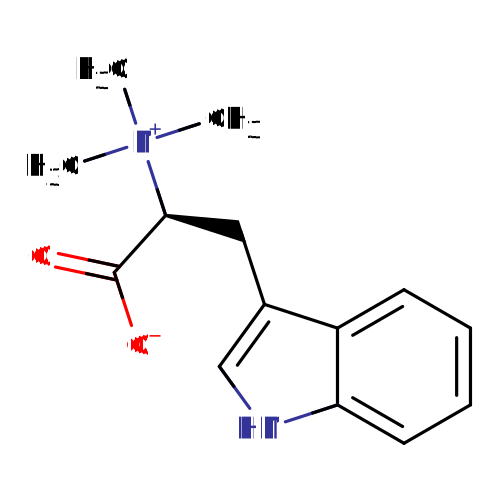
| Common Name | Hypaphorine |
|---|
| Description | Lenticin, also known as glyyunnanenine or L-hypaphorine, belongs to the class of organic compounds known as l-alpha-amino acids. These are alpha amino acids which have the L-configuration of the alpha-carbon atom. In plants it is an agonist of the plant hormone indole acetic acid. It is known to be a sleep-inducing compound (PMID: 18571406 ). It can also be detected in blood after an individual has consumed lentils and may therefore serve as a food biomarker. Lenticin is a moderately acidic compound (based on its pKa). Lenticin or hypaphorine is a compound found in lentil extracts. Hypaphorine is found in Abrus precatorius , Caragana sinica, Desmodium gangeticum , Erythrina hypaphorus, Erythrina senegalensis , Erythrina stricta, Erythrina suberosa, Erythrina subumbrans, Erythrina sudumbrans, Erythrina verna, Glycyrrhiza yunnanensis, Hedysarum polybotrys, Maquira coriacea, Pisolithus arhizus and Pterocarpus officinalis . Hypaphorine was first documented in 2000 (PMID: 10659705). Lenticin is an indole alkaloid that is essentially an N-methylated form of tryptophan (PMID: 11089686) (PMID: 11676477) (PMID: 12056802) (PMID: 12236599). |
|---|
| Structure | C[N+](C)(C)[C@@H](CC1=CNC2=CC=CC=C12)C([O-])=O InChI=1S/C14H18N2O2/c1-16(2,3)13(14(17)18)8-10-9-15-12-7-5-4-6-11(10)12/h4-7,9,13,15H,8H2,1-3H3/t13-/m0/s1 |
|---|
| Synonyms | | Value | Source |
|---|
| (+)-Hypaphorine | ChEBI | | Glyyunnanenine | ChEBI | | L-Hypaphorine | ChEBI | | L-Tryptophan betaine | ChEBI | | N,N,N-Trimethyltryptophan betaine | ChEBI | | Tryptophan betaine | ChEBI | | Lenticin nitrate | HMDB | | Hypaforin | HMDB | | Lenticin | ChEBI |
|
|---|
| Chemical Formula | C14H18N2O2 |
|---|
| Average Mass | 246.3049 Da |
|---|
| Monoisotopic Mass | 246.13683 Da |
|---|
| IUPAC Name | (2S)-3-(1H-indol-3-yl)-2-(trimethylazaniumyl)propanoate |
|---|
| Traditional Name | hypaphorine |
|---|
| CAS Registry Number | Not Available |
|---|
| SMILES | C[N+](C)(C)[C@@H](CC1=CNC2=CC=CC=C12)C([O-])=O |
|---|
| InChI Identifier | InChI=1S/C14H18N2O2/c1-16(2,3)13(14(17)18)8-10-9-15-12-7-5-4-6-11(10)12/h4-7,9,13,15H,8H2,1-3H3/t13-/m0/s1 |
|---|
| InChI Key | AOHCBEAZXHZMOR-ZDUSSCGKSA-N |
|---|
| Experimental Spectra |
|---|
|
| Not Available | | Predicted Spectra |
|---|
|
| | Spectrum Type | Description | Depositor ID | Depositor Organization | Depositor | Deposition Date | View |
|---|
| 1D NMR | 13C NMR Spectrum (1D, 25 MHz, D2O, predicted) | Wishart Lab | Wishart Lab | David Wishart | 2021-06-20 | View Spectrum | | 1D NMR | 1H NMR Spectrum (1D, 100 MHz, D2O, predicted) | Wishart Lab | Wishart Lab | David Wishart | 2021-06-20 | View Spectrum | | 1D NMR | 13C NMR Spectrum (1D, 252 MHz, D2O, predicted) | Wishart Lab | Wishart Lab | David Wishart | 2021-06-20 | View Spectrum | | 1D NMR | 1H NMR Spectrum (1D, 1000 MHz, D2O, predicted) | Wishart Lab | Wishart Lab | David Wishart | 2021-06-20 | View Spectrum | | 1D NMR | 13C NMR Spectrum (1D, 50 MHz, D2O, predicted) | Wishart Lab | Wishart Lab | David Wishart | 2021-06-20 | View Spectrum | | 1D NMR | 1H NMR Spectrum (1D, 200 MHz, D2O, predicted) | Wishart Lab | Wishart Lab | David Wishart | 2021-06-20 | View Spectrum | | 1D NMR | 13C NMR Spectrum (1D, 75 MHz, D2O, predicted) | Wishart Lab | Wishart Lab | David Wishart | 2021-06-20 | View Spectrum | | 1D NMR | 1H NMR Spectrum (1D, 300 MHz, D2O, predicted) | Wishart Lab | Wishart Lab | David Wishart | 2021-06-20 | View Spectrum | | 1D NMR | 13C NMR Spectrum (1D, 101 MHz, D2O, predicted) | Wishart Lab | Wishart Lab | David Wishart | 2021-06-20 | View Spectrum | | 1D NMR | 1H NMR Spectrum (1D, 400 MHz, D2O, predicted) | Wishart Lab | Wishart Lab | David Wishart | 2021-06-20 | View Spectrum | | 1D NMR | 13C NMR Spectrum (1D, 126 MHz, D2O, predicted) | Wishart Lab | Wishart Lab | David Wishart | 2021-06-20 | View Spectrum | | 1D NMR | 1H NMR Spectrum (1D, 500 MHz, D2O, predicted) | Wishart Lab | Wishart Lab | David Wishart | 2021-06-20 | View Spectrum | | 1D NMR | 13C NMR Spectrum (1D, 151 MHz, D2O, predicted) | Wishart Lab | Wishart Lab | David Wishart | 2021-06-20 | View Spectrum | | 1D NMR | 1H NMR Spectrum (1D, 600 MHz, D2O, predicted) | Wishart Lab | Wishart Lab | David Wishart | 2021-06-20 | View Spectrum | | 1D NMR | 13C NMR Spectrum (1D, 176 MHz, D2O, predicted) | Wishart Lab | Wishart Lab | David Wishart | 2021-06-20 | View Spectrum | | 1D NMR | 1H NMR Spectrum (1D, 700 MHz, D2O, predicted) | Wishart Lab | Wishart Lab | David Wishart | 2021-06-20 | View Spectrum | | 1D NMR | 13C NMR Spectrum (1D, 201 MHz, D2O, predicted) | Wishart Lab | Wishart Lab | David Wishart | 2021-06-20 | View Spectrum | | 1D NMR | 1H NMR Spectrum (1D, 800 MHz, D2O, predicted) | Wishart Lab | Wishart Lab | David Wishart | 2021-06-20 | View Spectrum | | 1D NMR | 13C NMR Spectrum (1D, 226 MHz, D2O, predicted) | Wishart Lab | Wishart Lab | David Wishart | 2021-06-20 | View Spectrum | | 1D NMR | 1H NMR Spectrum (1D, 900 MHz, D2O, predicted) | Wishart Lab | Wishart Lab | David Wishart | 2021-06-20 | View Spectrum |
| | Chemical Shift Submissions |
|---|
|
| Not Available | | Species |
|---|
| Species of Origin | |
|---|
| Chemical Taxonomy |
|---|
| Description | Belongs to the class of organic compounds known as l-alpha-amino acids. These are alpha amino acids which have the L-configuration of the alpha-carbon atom. |
|---|
| Kingdom | Organic compounds |
|---|
| Super Class | Organic acids and derivatives |
|---|
| Class | Carboxylic acids and derivatives |
|---|
| Sub Class | Amino acids, peptides, and analogues |
|---|
| Direct Parent | L-alpha-amino acids |
|---|
| Alternative Parents | |
|---|
| Substituents | - 3-alkylindole
- L-alpha-amino acid
- Indole
- Indole or derivatives
- Aralkylamine
- Substituted pyrrole
- Benzenoid
- Tetraalkylammonium salt
- Pyrrole
- Heteroaromatic compound
- Quaternary ammonium salt
- Carboxylic acid salt
- Carboxylic acid
- Monocarboxylic acid or derivatives
- Azacycle
- Organoheterocyclic compound
- Organic oxygen compound
- Organooxygen compound
- Organonitrogen compound
- Organic oxide
- Amine
- Organopnictogen compound
- Carbonyl group
- Hydrocarbon derivative
- Organic nitrogen compound
- Organic salt
- Aromatic heteropolycyclic compound
|
|---|
| Molecular Framework | Aromatic heteropolycyclic compounds |
|---|
| External Descriptors | |
|---|
| Physical Properties |
|---|
| State | Not Available |
|---|
| Experimental Properties | | Property | Value | Reference |
|---|
| Melting Point | Not Available | Not Available | | Boiling Point | Not Available | Not Available | | Water Solubility | Not Available | Not Available | | LogP | Not Available | Not Available |
|
|---|
| Predicted Properties | |
|---|
| General References | - Ditengou FA, Lapeyrie F: Hypaphorine from the ectomycorrhizal fungus Pisolithus tinctorius counteracts activities of indole-3-acetic acid and ethylene but not synthetic auxins in eucalypt seedlings. Mol Plant Microbe Interact. 2000 Feb;13(2):151-8. doi: 10.1094/MPMI.2000.13.2.151. [PubMed:10659705 ]
- Ditengou FA, Beguiristain T, Lapeyrie F: Root hair elongation is inhibited by hypaphorine, the indole alkaloid from the ectomycorrhizal fungus Pisolithus tinctorius, and restored by indole-3-acetic acid. Planta. 2000 Oct;211(5):722-8. doi: 10.1007/s004250000342. [PubMed:11089686 ]
- Kawano T, Kawano N, Hosoya H, Lapeyrie F: Fungal auxin antagonist hypaphorine competitively inhibits indole-3-acetic acid-dependent superoxide generation by horseradish peroxidase. Biochem Biophys Res Commun. 2001 Nov 2;288(3):546-51. doi: 10.1006/bbrc.2001.5800. [PubMed:11676477 ]
- Kawano T, Kawano N, Lapeyrie F: A fungal auxin antagonist, hypaphorine prevents the indole-3-acetic acid-dependent irreversible inactivation of horseradish peroxidase: inhibition of Compound III-mediated formation of P-670. Biochem Biophys Res Commun. 2002 Jun 14;294(3):553-9. doi: 10.1016/S0006-291X(02)00513-2. [PubMed:12056802 ]
- Reboutier D, Bianchi M, Brault M, Roux C, Dauphin A, Rona JP, Legue V, Lapeyrie F, Bouteau F: The indolic compound hypaphorine produced by ectomycorrhizal fungus interferes with auxin action and evokes early responses in nonhost Arabidopsis thaliana. Mol Plant Microbe Interact. 2002 Sep;15(9):932-8. doi: 10.1094/MPMI.2002.15.9.932. [PubMed:12236599 ]
|
|---|