| Record Information |
|---|
| Version | 2.0 |
|---|
| Created at | 2022-04-27 22:19:48 UTC |
|---|
| Updated at | 2022-04-27 22:19:48 UTC |
|---|
| NP-MRD ID | NP0050874 |
|---|
| Secondary Accession Numbers | None |
|---|
| Natural Product Identification |
|---|
| Common Name | Harmaline |
|---|
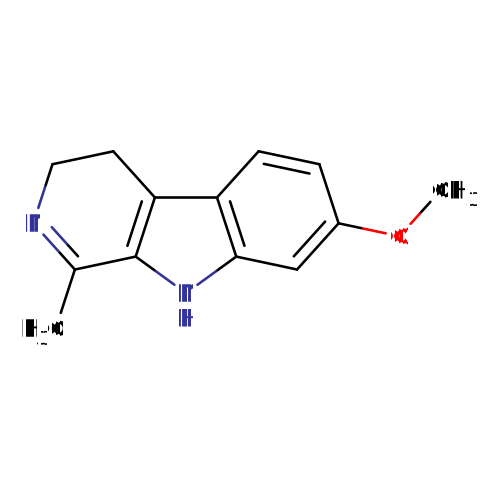
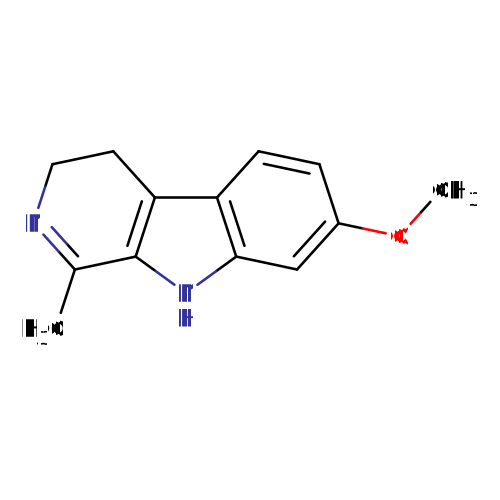
| Description | Harmaline, also known as dihydroharmine or harmidine, belongs to the class of organic compounds known as harmala alkaloids. Harmala alkaloids are compounds with a structure based on harmaline, harmine, harmalol, harman or a derivative of those parents. These parents are beta-carbolines, consisting of a pyrimidine fused to the pyrrole moiety of an indole to form a pyrido[3,4-b]indole. Harmaline is a very strong basic compound (based on its pKa). Outside of the human body, Harmaline has been detected, but not quantified in, fruits and herbs and spices. This could make harmaline a potential biomarker for the consumption of these foods. Harmaline is found in Banisteria caapi, Banisteriopsis caapi, Banisteriopsis caapi(Spr. Ex Briesb.), Daphnia pulex, Elaeagnus angustifolia , Oxalis tuberosa Molina , Passiflora incarnata , Passiflora pilosicorona, Peganum harmala , Perganum harmala, Psychotria viridis and Tribulus terrestris L. . Harmaline was first documented in 1977 (PMID: 918633). A harmala alkaloid in which the harman skeleton is methoxy-substituted at C-7 and has been reduced across the 3,4 bond. |
|---|
| Structure | COC1=CC2=C(C=C1)C1=C(N2)C(C)=NCC1 InChI=1S/C13H14N2O/c1-8-13-11(5-6-14-8)10-4-3-9(16-2)7-12(10)15-13/h3-4,7,15H,5-6H2,1-2H3 |
|---|
| Synonyms | | Value | Source |
|---|
| 3,4-Dihydroharmine | ChEBI | | 7-Methoxy-1-methyl-4,9-dihydro-3H-beta-carboline | ChEBI | | Armalin | ChEBI | | Dihydroharmine | ChEBI | | Harmalin | ChEBI | | Harmalol methyl ether | ChEBI | | Harmidine | ChEBI | | O-Methylharmalol | ChEBI | | 7-Methoxy-1-methyl-4,9-dihydro-3H-b-carboline | Generator | | 7-Methoxy-1-methyl-4,9-dihydro-3H-β-carboline | Generator | | 1-Methyl-7-methoxy-3, 4-dihydro-beta -carboline | HMDB | | 1-Methyl-7-methoxy-3,4-dihydro- beta-carboline | HMDB | | 1-Methyl-7-methoxy-3,4-dihydro-beta -carboline | HMDB | | 1-Methyl-7-methoxy-3,4-dihydro-beta-carboline | HMDB | | 3, 4-Dihydroharmine | HMDB | | 3,4-Dihydro-7-methoxy-1-methyl-9-pyrid(3,4-b)indole | HMDB | | 3,4-Dihydro-7-methoxy-1-methyl-9-pyrido(3,4-b)indole | HMDB | | 3,4-Dihydro-7-methoxy-1-methyl-9-pyrid[3,4-b]indole | HMDB | | 3,4-Dihydro-7-methoxy-1-methyl-b-carboline | HMDB | | 4,9-Dihydro-7-methoxy-1-methyl-3H-pyrido(3,4-b)indole | HMDB | | 4,9-Dihydro-7-methoxy-1-methyl-3H-pyrido[3,4-b]indole | HMDB | | Dihydro-harmine | HMDB |
|
|---|
| Chemical Formula | C13H14N2O |
|---|
| Average Mass | 214.2631 Da |
|---|
| Monoisotopic Mass | 214.11061 Da |
|---|
| IUPAC Name | 7-methoxy-1-methyl-3H,4H,9H-pyrido[3,4-b]indole |
|---|
| Traditional Name | harmaline |
|---|
| CAS Registry Number | Not Available |
|---|
| SMILES | COC1=CC2=C(C=C1)C1=C(N2)C(C)=NCC1 |
|---|
| InChI Identifier | InChI=1S/C13H14N2O/c1-8-13-11(5-6-14-8)10-4-3-9(16-2)7-12(10)15-13/h3-4,7,15H,5-6H2,1-2H3 |
|---|
| InChI Key | RERZNCLIYCABFS-UHFFFAOYSA-N |
|---|
| Experimental Spectra |
|---|
|
| Not Available | | Predicted Spectra |
|---|
|
| | Spectrum Type | Description | Depositor ID | Depositor Organization | Depositor | Deposition Date | View |
|---|
| 1D NMR | 13C NMR Spectrum (1D, 25 MHz, D2O, predicted) | Wishart Lab | Wishart Lab | David Wishart | 2021-06-20 | View Spectrum | | 1D NMR | 1H NMR Spectrum (1D, 100 MHz, D2O, predicted) | Wishart Lab | Wishart Lab | David Wishart | 2021-06-20 | View Spectrum | | 1D NMR | 13C NMR Spectrum (1D, 252 MHz, D2O, predicted) | Wishart Lab | Wishart Lab | David Wishart | 2021-06-20 | View Spectrum | | 1D NMR | 1H NMR Spectrum (1D, 1000 MHz, D2O, predicted) | Wishart Lab | Wishart Lab | David Wishart | 2021-06-20 | View Spectrum | | 1D NMR | 13C NMR Spectrum (1D, 50 MHz, D2O, predicted) | Wishart Lab | Wishart Lab | David Wishart | 2021-06-20 | View Spectrum | | 1D NMR | 1H NMR Spectrum (1D, 200 MHz, D2O, predicted) | Wishart Lab | Wishart Lab | David Wishart | 2021-06-20 | View Spectrum | | 1D NMR | 13C NMR Spectrum (1D, 75 MHz, D2O, predicted) | Wishart Lab | Wishart Lab | David Wishart | 2021-06-20 | View Spectrum | | 1D NMR | 1H NMR Spectrum (1D, 300 MHz, D2O, predicted) | Wishart Lab | Wishart Lab | David Wishart | 2021-06-20 | View Spectrum | | 1D NMR | 13C NMR Spectrum (1D, 101 MHz, D2O, predicted) | Wishart Lab | Wishart Lab | David Wishart | 2021-06-20 | View Spectrum | | 1D NMR | 1H NMR Spectrum (1D, 400 MHz, D2O, predicted) | Wishart Lab | Wishart Lab | David Wishart | 2021-06-20 | View Spectrum | | 1D NMR | 13C NMR Spectrum (1D, 126 MHz, D2O, predicted) | Wishart Lab | Wishart Lab | David Wishart | 2021-06-20 | View Spectrum | | 1D NMR | 1H NMR Spectrum (1D, 500 MHz, D2O, predicted) | Wishart Lab | Wishart Lab | David Wishart | 2021-06-20 | View Spectrum | | 1D NMR | 13C NMR Spectrum (1D, 151 MHz, D2O, predicted) | Wishart Lab | Wishart Lab | David Wishart | 2021-06-20 | View Spectrum | | 1D NMR | 1H NMR Spectrum (1D, 600 MHz, D2O, predicted) | Wishart Lab | Wishart Lab | David Wishart | 2021-06-20 | View Spectrum | | 1D NMR | 13C NMR Spectrum (1D, 176 MHz, D2O, predicted) | Wishart Lab | Wishart Lab | David Wishart | 2021-06-20 | View Spectrum | | 1D NMR | 1H NMR Spectrum (1D, 700 MHz, D2O, predicted) | Wishart Lab | Wishart Lab | David Wishart | 2021-06-20 | View Spectrum | | 1D NMR | 13C NMR Spectrum (1D, 201 MHz, D2O, predicted) | Wishart Lab | Wishart Lab | David Wishart | 2021-06-20 | View Spectrum | | 1D NMR | 1H NMR Spectrum (1D, 800 MHz, D2O, predicted) | Wishart Lab | Wishart Lab | David Wishart | 2021-06-20 | View Spectrum | | 1D NMR | 13C NMR Spectrum (1D, 226 MHz, D2O, predicted) | Wishart Lab | Wishart Lab | David Wishart | 2021-06-20 | View Spectrum | | 1D NMR | 1H NMR Spectrum (1D, 900 MHz, D2O, predicted) | Wishart Lab | Wishart Lab | David Wishart | 2021-06-20 | View Spectrum |
| | Chemical Shift Submissions |
|---|
|
| Not Available | | Species |
|---|
| Species of Origin | |
|---|
| Chemical Taxonomy |
|---|
| Description | Belongs to the class of organic compounds known as harmala alkaloids. Harmala alkaloids are compounds with a structure based on harmaline, harmine, harmalol, harman or a derivative of those parents. These parents are beta-carbolines, consisting of a pyrimidine fused to the pyrrole moiety of an indole to form a pyrido[3,4-b]indole. |
|---|
| Kingdom | Organic compounds |
|---|
| Super Class | Alkaloids and derivatives |
|---|
| Class | Harmala alkaloids |
|---|
| Sub Class | Not Available |
|---|
| Direct Parent | Harmala alkaloids |
|---|
| Alternative Parents | |
|---|
| Substituents | - Harmaline
- Harman
- Beta-carboline
- Pyridoindole
- 3-alkylindole
- Indole or derivatives
- Indole
- Anisole
- Alkyl aryl ether
- Benzenoid
- Heteroaromatic compound
- Pyrrole
- Ketimine
- Azacycle
- Organoheterocyclic compound
- Organic 1,3-dipolar compound
- Propargyl-type 1,3-dipolar organic compound
- Ether
- Organopnictogen compound
- Imine
- Organic oxygen compound
- Organic nitrogen compound
- Organonitrogen compound
- Organooxygen compound
- Hydrocarbon derivative
- Aromatic heteropolycyclic compound
|
|---|
| Molecular Framework | Aromatic heteropolycyclic compounds |
|---|
| External Descriptors | |
|---|
| Physical Properties |
|---|
| State | Not Available |
|---|
| Experimental Properties | | Property | Value | Reference |
|---|
| Melting Point | Not Available | Not Available | | Boiling Point | Not Available | Not Available | | Water Solubility | Not Available | Not Available | | LogP | Not Available | Not Available |
|
|---|
| Predicted Properties | |
|---|