| Record Information |
|---|
| Version | 2.0 |
|---|
| Created at | 2022-04-27 22:04:53 UTC |
|---|
| Updated at | 2022-04-27 22:04:53 UTC |
|---|
| NP-MRD ID | NP0050744 |
|---|
| Secondary Accession Numbers | None |
|---|
| Natural Product Identification |
|---|
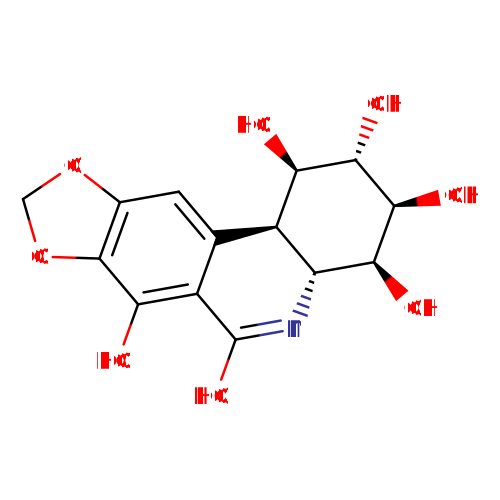
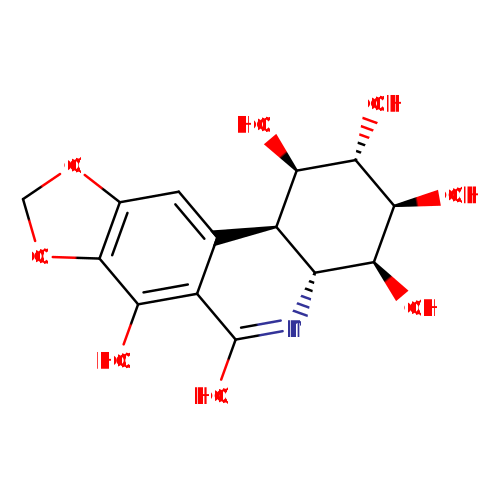
| Common Name | (+)-Pancratistatin |
|---|
| Description | Pancratistatin belongs to the class of organic compounds known as phenanthridine- and phenanthridone-type amaryllidaceae alkaloids. These are amaryllidaceae alkaloids compounds based on the phenanthridine or the phenanthridone skeleton. Phenanthridone-type alkaloids have the highest oxygenated C ring in all Amaryllidaceae alkaloids, and they always show an amide group in ring B. On the contrary, alkaloids of the phenanthridine type often show completely aromatic ring system, occasionally with a methylation quaternary nitrogen atom. (+)-Pancratistatin is found in Brachystola magna, Delphinium denudatum, Delphinium denudatum Wall. , Hymenocallis expansa, Hymenocallis litroralis, Hymenocallis littorale, Hymenocallis littoralis , Hymenocallis sonorensis, Hymenocallis speciosa, Pancratium maritimum, Habranthus brachyandrus, Zephyranthes carinata and Zephyranthes grandiflora . (+)-Pancratistatin was first documented in 2019 (PMID: 31542397). Based on a literature review a small amount of articles have been published on Pancratistatin (PMID: 35357593) (PMID: 35214809) (PMID: 33820903) (PMID: 31823643). |
|---|
| Structure | O[C@@H]1[C@@H](O)[C@H](O)[C@H]2[C@@H](NC(=O)C3=C2C=C2OCOC2=C3O)[C@@H]1O InChI=1S/C14H15NO8/c16-8-5-3-1-4-13(23-2-22-4)9(17)6(3)14(21)15-7(5)10(18)12(20)11(8)19/h1,5,7-8,10-12,16-20H,2H2,(H,15,21)/t5-,7-,8-,10+,11+,12+/m1/s1 |
|---|
| Synonyms | Not Available |
|---|
| Chemical Formula | C14H15NO8 |
|---|
| Average Mass | 325.2730 Da |
|---|
| Monoisotopic Mass | 325.07977 Da |
|---|
| IUPAC Name | (2R,3R,4S,5S,6S,7R)-3,4,5,6,11-pentahydroxy-13,15-dioxa-8-azatetracyclo[8.7.0.0^{2,7}.0^{12,16}]heptadeca-1(10),11,16-trien-9-one |
|---|
| Traditional Name | (2R,3R,4S,5S,6S,7R)-3,4,5,6,11-pentahydroxy-13,15-dioxa-8-azatetracyclo[8.7.0.0^{2,7}.0^{12,16}]heptadeca-1(10),11,16-trien-9-one |
|---|
| CAS Registry Number | Not Available |
|---|
| SMILES | O[C@@H]1[C@@H](O)[C@H](O)[C@H]2[C@@H](NC(=O)C3=C2C=C2OCOC2=C3O)[C@@H]1O |
|---|
| InChI Identifier | InChI=1S/C14H15NO8/c16-8-5-3-1-4-13(23-2-22-4)9(17)6(3)14(21)15-7(5)10(18)12(20)11(8)19/h1,5,7-8,10-12,16-20H,2H2,(H,15,21)/t5-,7-,8-,10+,11+,12+/m1/s1 |
|---|
| InChI Key | VREZDOWOLGNDPW-ALTGWBOUSA-N |
|---|
| Experimental Spectra |
|---|
|
| Not Available | | Predicted Spectra |
|---|
|
| Not Available | | Chemical Shift Submissions |
|---|
|
| Not Available | | Species |
|---|
| Species of Origin | |
|---|
| Chemical Taxonomy |
|---|
| Description | Belongs to the class of organic compounds known as phenanthridine- and phenanthridone-type amaryllidaceae alkaloids. These are amaryllidaceae alkaloids compounds based on the phenanthridine or the phenanthridone skeleton. Phenanthridone-type alkaloids have the highest oxygenated C ring in all Amaryllidaceae alkaloids, and they always show an amide group in ring B. On the contrary, alkaloids of the phenanthridine type often show completely aromatic ring system, occasionally with a methylation quaternary nitrogen atom. |
|---|
| Kingdom | Organic compounds |
|---|
| Super Class | Alkaloids and derivatives |
|---|
| Class | Amaryllidaceae alkaloids |
|---|
| Sub Class | Phenanthridine- and phenanthridone-type amaryllidaceae alkaloids |
|---|
| Direct Parent | Phenanthridine- and phenanthridone-type amaryllidaceae alkaloids |
|---|
| Alternative Parents | |
|---|
| Substituents | - Phenanthridone-type amaryllidaceae alkaloid
- Benzoquinoline
- Phenanthridine
- Isoquinolone
- Quinoline
- Tetrahydroisoquinoline
- Benzodioxole
- 1-hydroxy-4-unsubstituted benzenoid
- Cyclitol or derivatives
- Benzenoid
- Vinylogous acid
- Cyclic alcohol
- Secondary carboxylic acid amide
- Secondary alcohol
- Carboxamide group
- Lactam
- Oxacycle
- Azacycle
- Organoheterocyclic compound
- Acetal
- Polyol
- Carboxylic acid derivative
- Organic oxide
- Organonitrogen compound
- Organooxygen compound
- Organic oxygen compound
- Organic nitrogen compound
- Alcohol
- Organopnictogen compound
- Hydrocarbon derivative
- Aromatic heteropolycyclic compound
|
|---|
| Molecular Framework | Aromatic heteropolycyclic compounds |
|---|
| External Descriptors | |
|---|
| Physical Properties |
|---|
| State | Not Available |
|---|
| Experimental Properties | | Property | Value | Reference |
|---|
| Melting Point | Not Available | Not Available | | Boiling Point | Not Available | Not Available | | Water Solubility | Not Available | Not Available | | LogP | Not Available | Not Available |
|
|---|
| Predicted Properties | |
|---|
| General References | - Rammohan A, Khasanov AF, Kopchuk DS, Gunasekar D, Zyryanov GV, Chupakhin ON: Assessment on facile Diels-Alder approach of alpha-pyrone and terpenoquinone for the expedient synthesis of various natural scaffolds. Nat Prod Bioprospect. 2022 Mar 31;12(1):12. doi: 10.1007/s13659-022-00333-4. [PubMed:35357593 ]
- Youssef DTA, Shaala LA, Altyar AE: Cytotoxic Phenylpropanoid Derivatives and Alkaloids from the Flowers of Pancratium maritimum L. Plants (Basel). 2022 Feb 9;11(4). pii: plants11040476. doi: 10.3390/plants11040476. [PubMed:35214809 ]
- Xiong Y, Xiong YJ, Liu DY, Shen RR: Retracted: Pancratistatin Inhibits the Growth of Colorectal Cancer Cells by Inducing Apoptosis, Autophagy, and G2/M Cell Cycle Arrest. Med Sci Monit. 2021 Mar 25;27:e932346. doi: 10.12659/MSM.932346. [PubMed:33820903 ]
- Liang X, Zhang L, Li F, Luan S, He C, Yin L, Yin Z, Zou Y, Yue G, Li L, Song X, Lv C, Zhang W, Jing B: Autophagy-regulating N-heterocycles derivatives as potential anticancer agents. Future Med Chem. 2020 Feb;12(3):223-242. doi: 10.4155/fmc-2019-0294. Epub 2019 Dec 11. [PubMed:31823643 ]
- Dutta P, Sahu RK, Dey T, Lahkar MD, Manna P, Kalita J: Beneficial role of insect-derived bioactive components against inflammation and its associated complications (colitis and arthritis) and cancer. Chem Biol Interact. 2019 Nov 1;313:108824. doi: 10.1016/j.cbi.2019.108824. Epub 2019 Sep 19. [PubMed:31542397 ]
|
|---|