| Record Information |
|---|
| Version | 2.0 |
|---|
| Created at | 2022-04-27 22:03:50 UTC |
|---|
| Updated at | 2022-04-27 22:03:50 UTC |
|---|
| NP-MRD ID | NP0050730 |
|---|
| Secondary Accession Numbers | None |
|---|
| Natural Product Identification |
|---|
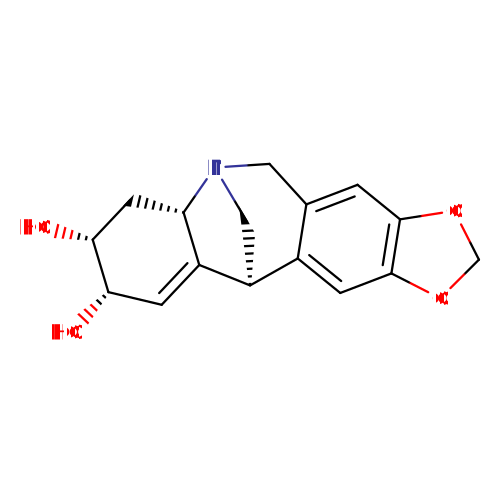
| Common Name | Brunsvigine |
|---|
| Description | Brunsvigine, also known as 3alpha-pancracine, belongs to the class of organic compounds known as alkaloids and derivatives. These are naturally occurring chemical compounds that contain mostly basic nitrogen atoms. This group also includes some related compounds with neutral and even weakly acidic properties. Also some synthetic compounds of similar structure are attributed to alkaloids. In addition to carbon, hydrogen and nitrogen, alkaloids may also contain oxygen, sulfur and more rarely other elements such as chlorine, bromine, and phosphorus. Brunsvigine is found in Brunsvigia cooperi. Brunsvigine was first documented in 2007 (PMID: 17672470). Based on a literature review a small amount of articles have been published on Brunsvigine (PMID: 33170051) (PMID: 18781802). |
|---|
| Structure | O[C@@H]1C[C@@H]2N3C[C@H](C2=C[C@@H]1O)C1=C(C3)C=C2OCOC2=C1 InChI=1S/C16H17NO4/c18-13-2-10-11-6-17(12(10)4-14(13)19)5-8-1-15-16(3-9(8)11)21-7-20-15/h1-3,11-14,18-19H,4-7H2/t11-,12-,13-,14+/m0/s1 |
|---|
| Synonyms | | Value | Source |
|---|
| (-)-Brunsvigine | Kegg | | 3alpha-Pancracine | Kegg | | 3a-Pancracine | Generator | | 3Α-pancracine | Generator |
|
|---|
| Chemical Formula | C16H17NO4 |
|---|
| Average Mass | 287.3150 Da |
|---|
| Monoisotopic Mass | 287.11576 Da |
|---|
| IUPAC Name | (1S,13S,15R,16S)-5,7-dioxa-12-azapentacyclo[10.6.1.0^{2,10}.0^{4,8}.0^{13,18}]nonadeca-2(10),3,8,17-tetraene-15,16-diol |
|---|
| Traditional Name | (1S,13S,15R,16S)-5,7-dioxa-12-azapentacyclo[10.6.1.0^{2,10}.0^{4,8}.0^{13,18}]nonadeca-2(10),3,8,17-tetraene-15,16-diol |
|---|
| CAS Registry Number | Not Available |
|---|
| SMILES | O[C@@H]1C[C@@H]2N3C[C@H](C2=C[C@@H]1O)C1=C(C3)C=C2OCOC2=C1 |
|---|
| InChI Identifier | InChI=1S/C16H17NO4/c18-13-2-10-11-6-17(12(10)4-14(13)19)5-8-1-15-16(3-9(8)11)21-7-20-15/h1-3,11-14,18-19H,4-7H2/t11-,12-,13-,14+/m0/s1 |
|---|
| InChI Key | JKZMYBLUKAMPKM-XDQVBPFNSA-N |
|---|
| Experimental Spectra |
|---|
|
| Not Available | | Predicted Spectra |
|---|
|
| Not Available | | Chemical Shift Submissions |
|---|
|
| Not Available | | Species |
|---|
| Species of Origin | | Species Name | Source | Reference |
|---|
| Brunsvigia cooperi | Plant | |
|
|---|
| Chemical Taxonomy |
|---|
| Description | Belongs to the class of organic compounds known as alkaloids and derivatives. These are naturally occurring chemical compounds that contain mostly basic nitrogen atoms. This group also includes some related compounds with neutral and even weakly acidic properties. Also some synthetic compounds of similar structure are attributed to alkaloids. In addition to carbon, hydrogen and nitrogen, alkaloids may also contain oxygen, sulfur and more rarely other elements such as chlorine, bromine, and phosphorus. |
|---|
| Kingdom | Organic compounds |
|---|
| Super Class | Alkaloids and derivatives |
|---|
| Class | Not Available |
|---|
| Sub Class | Not Available |
|---|
| Direct Parent | Alkaloids and derivatives |
|---|
| Alternative Parents | |
|---|
| Substituents | - Pancranine-skeleton
- Benzazepine
- Tetrahydroisoquinoline
- Benzodioxole
- Indole or derivatives
- Alkaloid or derivatives
- Aralkylamine
- Azepine
- Benzenoid
- N-alkylpyrrolidine
- Pyrrolidine
- Tertiary aliphatic amine
- Tertiary amine
- Secondary alcohol
- 1,2-diol
- Oxacycle
- Organoheterocyclic compound
- Azacycle
- Acetal
- Hydrocarbon derivative
- Organonitrogen compound
- Organic oxygen compound
- Organooxygen compound
- Amine
- Organic nitrogen compound
- Organopnictogen compound
- Alcohol
- Aromatic heteropolycyclic compound
|
|---|
| Molecular Framework | Aromatic heteropolycyclic compounds |
|---|
| External Descriptors | |
|---|
| Physical Properties |
|---|
| State | Not Available |
|---|
| Experimental Properties | | Property | Value | Reference |
|---|
| Melting Point | Not Available | Not Available | | Boiling Point | Not Available | Not Available | | Water Solubility | Not Available | Not Available | | LogP | Not Available | Not Available |
|
|---|
| Predicted Properties | |
|---|
| General References | - Hoang THX, Ho DV, Van Phan K, Le QV, Raal A, Nguyen HT: Effects of Hippeastrum reticulatum on memory, spatial learning and object recognition in a scopolamine-induced animal model of Alzheimer's disease. Pharm Biol. 2020 Dec;58(1):1098-1104. doi: 10.1080/13880209.2020.1841810. [PubMed:33170051 ]
- Hong AW, Cheng TH, Raghukumar V, Sha CK: An expedient route to Montanine-type Amaryllidaceae alkaloids: total syntheses of (-)-brunsvigine and (-)-manthine. J Org Chem. 2008 Oct 3;73(19):7580-5. doi: 10.1021/jo801089y. Epub 2008 Sep 10. [PubMed:18781802 ]
- Banwell MG, Kokas OJ, Willis AC: Chemoenzymatic approaches to the montanine alkaloids: a total synthesis of (+)-brunsvigine. Org Lett. 2007 Aug 30;9(18):3503-6. doi: 10.1021/ol071344y. Epub 2007 Aug 2. [PubMed:17672470 ]
|
|---|