| Record Information |
|---|
| Version | 2.0 |
|---|
| Created at | 2022-04-27 22:03:15 UTC |
|---|
| Updated at | 2022-04-27 22:03:15 UTC |
|---|
| NP-MRD ID | NP0050715 |
|---|
| Secondary Accession Numbers | None |
|---|
| Natural Product Identification |
|---|
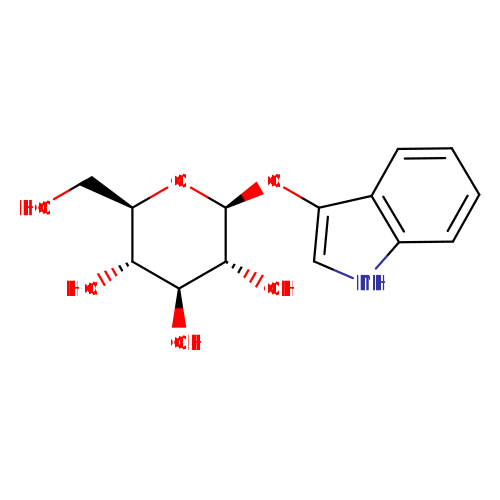
| Common Name | Indican glucoside |
|---|
| Description | Indican, also known as indican, plant or uroxanthin, belongs to the class of organic compounds known as o-glycosyl compounds. These are glycoside in which a sugar group is bonded through one carbon to another group via a O-glycosidic bond. Indican is an extremely weak basic (essentially neutral) compound (based on its pKa). Indican is a colourless organic compound, soluble in water, naturally occurring in Indigofera plants. Indican interferes with many commercial procedures for measuring total bilirubin which can be a problem for renal failure patients where blood indican levels are raised. Tryptophan is first converted to indole (excreted in faeces), then to indican by bacteria in the gut. The enzyme "indoxyl esterase" has been found in humans and is involved in another pathway of chemical reactions involving indoxyl. A reaction, similar to the above-mentioned is seen in the normal population, who excrete small amounts of the chemical in their urine. Indican glucoside is found in Calanthe discolor, Celosia argentea, Indigofera spp. , Indigofera suffruticosa, Indigofera tinctoria , Isatis indigotica , Polygonum perfoliatum, Polygonum tinctorium, Polygonum tinctorum and Strobilanthes cusia. Indican glucoside was first documented in 1975 (PMID: 1199990). Common and significant reactions involving indican are as follows:Indican is a glycoside. |
|---|
| Structure | OC[C@H]1O[C@@H](OC2=CNC3=C2C=CC=C3)[C@H](O)[C@@H](O)[C@@H]1O InChI=1S/C14H17NO6/c16-6-10-11(17)12(18)13(19)14(21-10)20-9-5-15-8-4-2-1-3-7(8)9/h1-5,10-19H,6H2/t10-,11-,12+,13-,14-/m1/s1 |
|---|
| Synonyms | | Value | Source |
|---|
| Indican, plant | ChEBI | | 1H-indol-3-yl beta-Glucopyranoside | HMDB | | 1H-indol-3-yl Β-D-glucopyranoside | HMDB | | Indoxyl-β-D-glucoside | HMDB | | 1H-indol-3-yl beta-D-Glucopyranoside | HMDB | | Indoxyl-beta-D-glucoside | HMDB | | 3-(Glucosyloxy)indole | HMDB | | Uroxanthin | HMDB |
|
|---|
| Chemical Formula | C14H17NO6 |
|---|
| Average Mass | 295.2910 Da |
|---|
| Monoisotopic Mass | 295.10559 Da |
|---|
| IUPAC Name | (2R,3S,4S,5R)-2-(hydroxymethyl)-6-(1H-indol-3-yloxy)oxane-3,4,5-triol |
|---|
| Traditional Name | (2R,3S,4S,5R)-2-(hydroxymethyl)-6-(1H-indol-3-yloxy)oxane-3,4,5-triol |
|---|
| CAS Registry Number | Not Available |
|---|
| SMILES | OC[C@H]1O[C@@H](OC2=CNC3=C2C=CC=C3)[C@H](O)[C@@H](O)[C@@H]1O |
|---|
| InChI Identifier | InChI=1S/C14H17NO6/c16-6-10-11(17)12(18)13(19)14(21-10)20-9-5-15-8-4-2-1-3-7(8)9/h1-5,10-19H,6H2/t10-,11-,12+,13-,14-/m1/s1 |
|---|
| InChI Key | XVARCVCWNFACQC-RKQHYHRCSA-N |
|---|
| Experimental Spectra |
|---|
|
| Not Available | | Predicted Spectra |
|---|
|
| Not Available | | Chemical Shift Submissions |
|---|
|
| Not Available | | Species |
|---|
| Species of Origin | |
|---|
| Chemical Taxonomy |
|---|
| Description | Belongs to the class of organic compounds known as o-glycosyl compounds. These are glycoside in which a sugar group is bonded through one carbon to another group via a O-glycosidic bond. |
|---|
| Kingdom | Organic compounds |
|---|
| Super Class | Organic oxygen compounds |
|---|
| Class | Organooxygen compounds |
|---|
| Sub Class | Carbohydrates and carbohydrate conjugates |
|---|
| Direct Parent | O-glycosyl compounds |
|---|
| Alternative Parents | |
|---|
| Substituents | - Hexose monosaccharide
- O-glycosyl compound
- Indole
- Indole or derivatives
- Monosaccharide
- Oxane
- Benzenoid
- Substituted pyrrole
- Heteroaromatic compound
- Pyrrole
- Secondary alcohol
- Acetal
- Oxacycle
- Azacycle
- Organoheterocyclic compound
- Polyol
- Alcohol
- Hydrocarbon derivative
- Organonitrogen compound
- Organic nitrogen compound
- Organopnictogen compound
- Primary alcohol
- Aromatic heteropolycyclic compound
|
|---|
| Molecular Framework | Aromatic heteropolycyclic compounds |
|---|
| External Descriptors | |
|---|
| Physical Properties |
|---|
| State | Not Available |
|---|
| Experimental Properties | | Property | Value | Reference |
|---|
| Melting Point | Not Available | Not Available | | Boiling Point | Not Available | Not Available | | Water Solubility | Not Available | Not Available | | LogP | Not Available | Not Available |
|
|---|
| Predicted Properties | |
|---|