| Record Information |
|---|
| Version | 2.0 |
|---|
| Created at | 2022-04-27 22:02:15 UTC |
|---|
| Updated at | 2022-04-27 22:02:15 UTC |
|---|
| NP-MRD ID | NP0050695 |
|---|
| Secondary Accession Numbers | None |
|---|
| Natural Product Identification |
|---|
| Common Name | Psilocin |
|---|
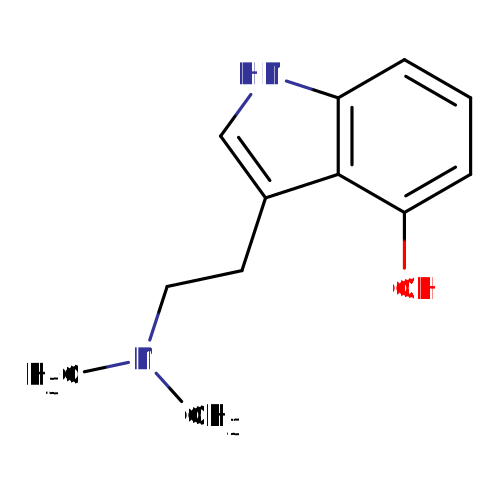
| Description | Psilocin, also known as 4-OH-DMT or psilotsin, belongs to the class of organic compounds known as tryptamines and derivatives. Tryptamines and derivatives are compounds containing the tryptamine backbone, which is structurally characterized by an indole ring substituted at the 3-position by an ethanamine. Psilocin is a very strong basic compound (based on its pKa). Psilocin is found in Deconica montana, Gymnopilus purpuratus, Panaeolus cambodginiensis, Phaeolepiota aurea, Psilocybe arcana, Psilocybe azurescens, Psilocybe baeocystis, Psilocybe bohemica, Psilocybe caerulescens, Psilocybe cyanescens, Psilocybe mexicana, Psilocybe samuiensis, Psilocybe semilaceata, Psilocybe semilanceata and Psilocybe subcubensis. Psilocin was first documented in 2011 (PMID: 21148021). Psilocin is a potentially toxic compound (PMID: 21820980) (PMID: 22138681) (PMID: 23183899) (PMID: 23851905). |
|---|
| Structure | CN(C)CCC1=CNC2=C1C(O)=CC=C2 InChI=1S/C12H16N2O/c1-14(2)7-6-9-8-13-10-4-3-5-11(15)12(9)10/h3-5,8,13,15H,6-7H2,1-2H3 |
|---|
| Synonyms | | Value | Source |
|---|
| 3-(2-(Dimethylamino)ethyl)indol-4-ol | ChEBI | | 4-Hydroxy-N,N-dimethyltryptamine | ChEBI | | 4-OH-DMT | ChEBI | | N,N-Dimethyl-4-hydroxytryptamine | ChEBI | | Psilocine | ChEBI | | Psilotsin | ChEBI | | 3-[2-(Dimethylamino)ethyl]-1H-indol-4-ol | HMDB | | 3-[2-(Dimethylamino)ethyl]-indol-4-ol | HMDB | | Psilocin tartrate (1:1) | HMDB | | Psilocin hydrochloride | HMDB | | (3-(2-Dimethylamino)ethyl)indol-4-ol | HMDB |
|
|---|
| Chemical Formula | C12H16N2O |
|---|
| Average Mass | 204.2682 Da |
|---|
| Monoisotopic Mass | 204.12626 Da |
|---|
| IUPAC Name | 3-[2-(dimethylamino)ethyl]-1H-indol-4-ol |
|---|
| Traditional Name | psilocin |
|---|
| CAS Registry Number | Not Available |
|---|
| SMILES | CN(C)CCC1=CNC2=C1C(O)=CC=C2 |
|---|
| InChI Identifier | InChI=1S/C12H16N2O/c1-14(2)7-6-9-8-13-10-4-3-5-11(15)12(9)10/h3-5,8,13,15H,6-7H2,1-2H3 |
|---|
| InChI Key | SPCIYGNTAMCTRO-UHFFFAOYSA-N |
|---|
| Experimental Spectra |
|---|
|
| Not Available | | Predicted Spectra |
|---|
|
| Not Available | | Chemical Shift Submissions |
|---|
|
| Not Available | | Species |
|---|
| Species of Origin | |
|---|
| Chemical Taxonomy |
|---|
| Description | Belongs to the class of organic compounds known as tryptamines and derivatives. Tryptamines and derivatives are compounds containing the tryptamine backbone, which is structurally characterized by an indole ring substituted at the 3-position by an ethanamine. |
|---|
| Kingdom | Organic compounds |
|---|
| Super Class | Organoheterocyclic compounds |
|---|
| Class | Indoles and derivatives |
|---|
| Sub Class | Tryptamines and derivatives |
|---|
| Direct Parent | Tryptamines and derivatives |
|---|
| Alternative Parents | |
|---|
| Substituents | - Tryptamine
- Hydroxyindole
- 3-alkylindole
- Indole
- Alkaloid or derivatives
- 1-hydroxy-4-unsubstituted benzenoid
- 1-hydroxy-2-unsubstituted benzenoid
- Aralkylamine
- Substituted pyrrole
- Benzenoid
- Pyrrole
- Heteroaromatic compound
- Tertiary aliphatic amine
- Tertiary amine
- Azacycle
- Hydrocarbon derivative
- Organopnictogen compound
- Organic oxygen compound
- Amine
- Organooxygen compound
- Organonitrogen compound
- Organic nitrogen compound
- Aromatic heteropolycyclic compound
|
|---|
| Molecular Framework | Aromatic heteropolycyclic compounds |
|---|
| External Descriptors | |
|---|
| Physical Properties |
|---|
| State | Not Available |
|---|
| Experimental Properties | | Property | Value | Reference |
|---|
| Melting Point | Not Available | Not Available | | Boiling Point | Not Available | Not Available | | Water Solubility | Not Available | Not Available | | LogP | Not Available | Not Available |
|
|---|
| Predicted Properties | |
|---|
| General References | - Halberstadt AL, Koedood L, Powell SB, Geyer MA: Differential contributions of serotonin receptors to the behavioral effects of indoleamine hallucinogens in mice. J Psychopharmacol. 2011 Nov;25(11):1548-61. doi: 10.1177/0269881110388326. Epub 2010 Dec 8. [PubMed:21148021 ]
- Chen J, Li M, Yan X, Wu E, Zhu H, Lee KJ, Chu VM, Zhan L, Lee W, Kang JS: Determining the pharmacokinetics of psilocin in rat plasma using ultra-performance liquid chromatography coupled with a photodiode array detector after orally administering an extract of Gymnopilus spectabilis. J Chromatogr B Analyt Technol Biomed Life Sci. 2011 Sep 1;879(25):2669-72. doi: 10.1016/j.jchromb.2011.07.003. Epub 2011 Jul 18. [PubMed:21820980 ]
- Martin R, Schurenkamp J, Pfeiffer H, Kohler H: A validated method for quantitation of psilocin in plasma by LC-MS/MS and study of stability. Int J Legal Med. 2012 Nov;126(6):845-9. doi: 10.1007/s00414-011-0652-8. Epub 2011 Dec 3. [PubMed:22138681 ]
- Martin R, Schurenkamp J, Gasse A, Pfeiffer H, Kohler H: Determination of psilocin, bufotenine, LSD and its metabolites in serum, plasma and urine by SPE-LC-MS/MS. Int J Legal Med. 2013 May;127(3):593-601. doi: 10.1007/s00414-012-0796-1. Epub 2012 Nov 27. [PubMed:23183899 ]
- Stebelska K: Fungal hallucinogens psilocin, ibotenic acid, and muscimol: analytical methods and biologic activities. Ther Drug Monit. 2013 Aug;35(4):420-42. doi: 10.1097/FTD.0b013e31828741a5. [PubMed:23851905 ]
|
|---|