| Record Information |
|---|
| Version | 2.0 |
|---|
| Created at | 2022-04-27 22:01:33 UTC |
|---|
| Updated at | 2022-04-27 22:01:34 UTC |
|---|
| NP-MRD ID | NP0050673 |
|---|
| Secondary Accession Numbers | None |
|---|
| Natural Product Identification |
|---|
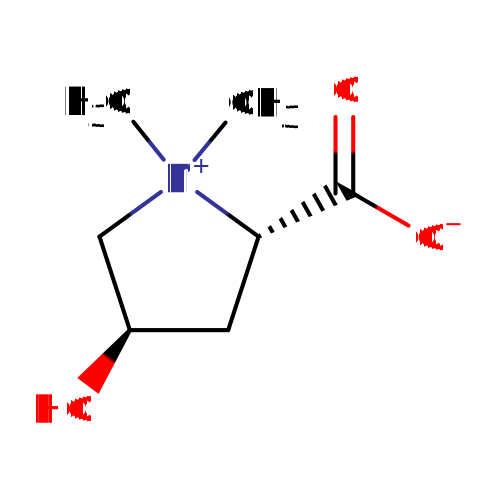
| Common Name | (-)-Betonicine |
|---|
| Description | Betonicine, also known as achillein, belongs to the class of organic compounds known as proline and derivatives. Proline and derivatives are compounds containing proline or a derivative thereof resulting from reaction of proline at the amino group or the carboxy group, or from the replacement of any hydrogen of glycine by a heteroatom. Betonicine is an extremely weak basic (essentially neutral) compound (based on its pKa). Outside of the human body, Betonicine has been detected, but not quantified in, herbs and spices and pulses. This could make betonicine a potential biomarker for the consumption of these foods. (-)-Betonicine is found in Achillea millefolium , Betonica officinalis , Combretum micranthum , Marrubium vulgare and Stachys sylvatica. (-)-Betonicine was first documented in 2011 (PMID: 21838291). An amino-acid betaine that is trans-4-hydroxy-L-proline zwitterion in which both of the hydrogens attached to the nitrogen have been replaced by methyl groups (PMID: 25012968) (PMID: 24056934). |
|---|
| Structure | C[N+]1(C)C[C@H](O)C[C@H]1C([O-])=O InChI=1S/C7H13NO3/c1-8(2)4-5(9)3-6(8)7(10)11/h5-6,9H,3-4H2,1-2H3/t5-,6+/m1/s1 |
|---|
| Synonyms | | Value | Source |
|---|
| (-)-Betonicine | ChEBI | | (2S-trans)-2-Carboxylato-4-hydroxy-1,1-dimethylpyrrolidinium | ChEBI | | 4-Hydroxystachydrine | ChEBI | | trans-4-Hydroxy-L-proline betaine | Kegg | | 4-Hydroxy-1,1-dimethylpyrrolidinium-2-carboxylate | HMDB | | 4-Hydroxy-stachydrine | HMDB | | 4-Hydroxyproline betaine | HMDB | | Achillein | HMDB | | 4-Hydroxy-L-prolinebetaine | HMDB | | Achilleine | HMDB | | Betonicin | HMDB | | trans-4-Hydroxyproline betaine | HMDB | | Betonicine | ChEBI |
|
|---|
| Chemical Formula | C7H13NO3 |
|---|
| Average Mass | 159.1830 Da |
|---|
| Monoisotopic Mass | 159.08954 Da |
|---|
| IUPAC Name | (2S,4R)-4-hydroxy-1,1-dimethylpyrrolidin-1-ium-2-carboxylate |
|---|
| Traditional Name | (-)-betonicine |
|---|
| CAS Registry Number | Not Available |
|---|
| SMILES | C[N+]1(C)C[C@H](O)C[C@H]1C([O-])=O |
|---|
| InChI Identifier | InChI=1S/C7H13NO3/c1-8(2)4-5(9)3-6(8)7(10)11/h5-6,9H,3-4H2,1-2H3/t5-,6+/m1/s1 |
|---|
| InChI Key | MUNWAHDYFVYIKH-RITPCOANSA-N |
|---|
| Experimental Spectra |
|---|
|
| Not Available | | Predicted Spectra |
|---|
|
| Not Available | | Chemical Shift Submissions |
|---|
|
| Not Available | | Species |
|---|
| Species of Origin | |
|---|
| Chemical Taxonomy |
|---|
| Description | Belongs to the class of organic compounds known as proline and derivatives. Proline and derivatives are compounds containing proline or a derivative thereof resulting from reaction of proline at the amino group or the carboxy group, or from the replacement of any hydrogen of glycine by a heteroatom. |
|---|
| Kingdom | Organic compounds |
|---|
| Super Class | Organic acids and derivatives |
|---|
| Class | Carboxylic acids and derivatives |
|---|
| Sub Class | Amino acids, peptides, and analogues |
|---|
| Direct Parent | Proline and derivatives |
|---|
| Alternative Parents | |
|---|
| Substituents | - Proline or derivatives
- Alpha-amino acid
- L-alpha-amino acid
- Pyrrolidine carboxylic acid
- Pyrrolidine carboxylic acid or derivatives
- N-alkylpyrrolidine
- Tetraalkylammonium salt
- Pyrrolidine
- Quaternary ammonium salt
- 1,2-aminoalcohol
- Carboxylic acid salt
- Secondary alcohol
- Carboxylic acid
- Monocarboxylic acid or derivatives
- Azacycle
- Organoheterocyclic compound
- Organic oxide
- Organooxygen compound
- Organonitrogen compound
- Alcohol
- Organic nitrogen compound
- Organopnictogen compound
- Carbonyl group
- Amine
- Hydrocarbon derivative
- Organic oxygen compound
- Organic salt
- Aliphatic heteromonocyclic compound
|
|---|
| Molecular Framework | Aliphatic heteromonocyclic compounds |
|---|
| External Descriptors | |
|---|
| Physical Properties |
|---|
| State | Not Available |
|---|
| Experimental Properties | | Property | Value | Reference |
|---|
| Melting Point | Not Available | Not Available | | Boiling Point | Not Available | Not Available | | Water Solubility | Not Available | Not Available | | LogP | Not Available | Not Available |
|
|---|
| Predicted Properties | |
|---|
| General References | - Bashir A, Hoffmann T, Kempf B, Xie X, Smits SHJ, Bremer E: Plant-derived compatible solutes proline betaine and betonicine confer enhanced osmotic and temperature stress tolerance to Bacillus subtilis. Microbiology (Reading). 2014 Oct;160(Pt 10):2283-2294. doi: 10.1099/mic.0.079665-0. Epub 2014 Jul 10. [PubMed:25012968 ]
- Zhao S, Kumar R, Sakai A, Vetting MW, Wood BM, Brown S, Bonanno JB, Hillerich BS, Seidel RD, Babbitt PC, Almo SC, Sweedler JV, Gerlt JA, Cronan JE, Jacobson MP: Discovery of new enzymes and metabolic pathways by using structure and genome context. Nature. 2013 Oct 31;502(7473):698-702. doi: 10.1038/nature12576. Epub 2013 Sep 22. [PubMed:24056934 ]
- Servillo L, Giovane A, Balestrieri ML, Bata-Csere A, Cautela D, Castaldo D: Betaines in fruits of Citrus genus plants. J Agric Food Chem. 2011 Sep 14;59(17):9410-6. doi: 10.1021/jf2014815. Epub 2011 Aug 12. [PubMed:21838291 ]
|
|---|