| Record Information |
|---|
| Version | 2.0 |
|---|
| Created at | 2022-04-27 21:59:40 UTC |
|---|
| Updated at | 2022-04-27 21:59:40 UTC |
|---|
| NP-MRD ID | NP0050631 |
|---|
| Secondary Accession Numbers | None |
|---|
| Natural Product Identification |
|---|
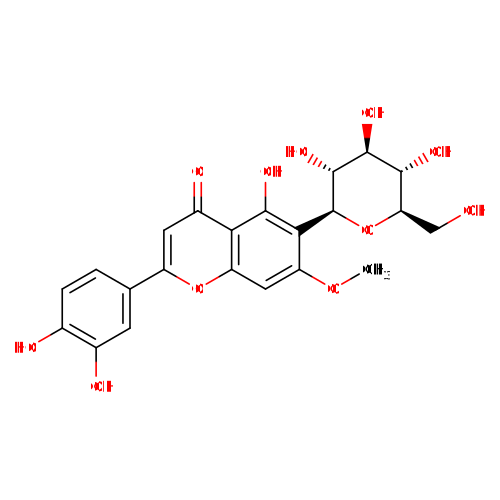
| Common Name | 6-beta-D-glucopyranosyl-3',4',5-trihydroxy-7-methoxyflavone |
|---|
| Description | Swertiajaponin belongs to the class of organic compounds known as flavonoid c-glycosides. Flavonoid C-glycosides are compounds containing a carbohydrate moiety which is C-glycosidically linked to the 2-phenylchromen-4-one flavonoid backbone. Thus, swertiajaponin is considered to be a flavonoid. 6-beta-D-glucopyranosyl-3',4',5-trihydroxy-7-methoxyflavone is found in Arrhenatherum elatius, Achillea leptophylla, Achillea spp., Alliaria petiolata, Cephalaria leucantha, Cephalaria uralensis, Cymbopogon citratus , Carex fraseriana, Deschampsia antarctica, Echinodorus grandiflorus, Gentiana germanica, Gentiana ramosa, Gnetum gnemon , Iris germanica , Iris lactea, Iris nertshinskia, Iris ramosa, Iris sanguinea, Justicia pectoralis, Knautia montana, Leiothrix flavescens, Lophatherum gracile, Passiflora biflora, Passiflora sexflora, Phragmites australis, Pterocephalus plumosus, Saccharum officinarum, Swertia japonica , Swertia mileensis, Swertia pseudochinensis and Tragopogon spp.. 6-beta-D-glucopyranosyl-3',4',5-trihydroxy-7-methoxyflavone was first documented in 2018 (PMID: 29478533). Based on a literature review a small amount of articles have been published on Swertiajaponin (PMID: 33928007) (PMID: 32859126) (PMID: 31779076) (PMID: 30391397). |
|---|
| Structure | COC1=C([C@@H]2O[C@H](CO)[C@@H](O)[C@H](O)[C@H]2O)C(O)=C2C(=O)C=C(OC2=C1)C1=CC=C(O)C(O)=C1 InChI=1S/C22H22O11/c1-31-13-6-14-16(11(26)5-12(32-14)8-2-3-9(24)10(25)4-8)19(28)17(13)22-21(30)20(29)18(27)15(7-23)33-22/h2-6,15,18,20-25,27-30H,7H2,1H3/t15-,18-,20+,21-,22+/m1/s1 |
|---|
| Synonyms | Not Available |
|---|
| Chemical Formula | C22H22O11 |
|---|
| Average Mass | 462.4070 Da |
|---|
| Monoisotopic Mass | 462.11621 Da |
|---|
| IUPAC Name | 2-(3,4-dihydroxyphenyl)-5-hydroxy-7-methoxy-6-[(2S,3R,4R,5S,6R)-3,4,5-trihydroxy-6-(hydroxymethyl)oxan-2-yl]-4H-chromen-4-one |
|---|
| Traditional Name | swertiajaponin |
|---|
| CAS Registry Number | Not Available |
|---|
| SMILES | COC1=C([C@@H]2O[C@H](CO)[C@@H](O)[C@H](O)[C@H]2O)C(O)=C2C(=O)C=C(OC2=C1)C1=CC=C(O)C(O)=C1 |
|---|
| InChI Identifier | InChI=1S/C22H22O11/c1-31-13-6-14-16(11(26)5-12(32-14)8-2-3-9(24)10(25)4-8)19(28)17(13)22-21(30)20(29)18(27)15(7-23)33-22/h2-6,15,18,20-25,27-30H,7H2,1H3/t15-,18-,20+,21-,22+/m1/s1 |
|---|
| InChI Key | DLVLXOYLQKCAME-DGHBBABESA-N |
|---|
| Experimental Spectra |
|---|
|
| Not Available | | Predicted Spectra |
|---|
|
| Not Available | | Chemical Shift Submissions |
|---|
|
| Not Available | | Species |
|---|
| Species of Origin | |
|---|
| Chemical Taxonomy |
|---|
| Description | Belongs to the class of organic compounds known as flavonoid c-glycosides. Flavonoid C-glycosides are compounds containing a carbohydrate moiety which is C-glycosidically linked to the 2-phenylchromen-4-one flavonoid backbone. |
|---|
| Kingdom | Organic compounds |
|---|
| Super Class | Phenylpropanoids and polyketides |
|---|
| Class | Flavonoids |
|---|
| Sub Class | Flavonoid glycosides |
|---|
| Direct Parent | Flavonoid C-glycosides |
|---|
| Alternative Parents | |
|---|
| Substituents | - Flavonoid c-glycoside
- 7-methoxyflavonoid-skeleton
- Hydroxyflavonoid
- Flavone
- 5-hydroxyflavonoid
- 4'-hydroxyflavonoid
- 3'-hydroxyflavonoid
- Phenolic glycoside
- Hexose monosaccharide
- C-glycosyl compound
- Chromone
- Glycosyl compound
- Benzopyran
- 1-benzopyran
- Anisole
- Catechol
- Alkyl aryl ether
- Pyranone
- 1-hydroxy-2-unsubstituted benzenoid
- Phenol
- 1-hydroxy-4-unsubstituted benzenoid
- Monocyclic benzene moiety
- Benzenoid
- Pyran
- Oxane
- Monosaccharide
- Vinylogous acid
- Heteroaromatic compound
- Secondary alcohol
- Ether
- Dialkyl ether
- Organoheterocyclic compound
- Oxacycle
- Polyol
- Hydrocarbon derivative
- Organic oxide
- Organic oxygen compound
- Primary alcohol
- Organooxygen compound
- Alcohol
- Aromatic heteropolycyclic compound
|
|---|
| Molecular Framework | Aromatic heteropolycyclic compounds |
|---|
| External Descriptors | |
|---|
| Physical Properties |
|---|
| State | Not Available |
|---|
| Experimental Properties | | Property | Value | Reference |
|---|
| Melting Point | Not Available | Not Available | | Boiling Point | Not Available | Not Available | | Water Solubility | Not Available | Not Available | | LogP | Not Available | Not Available |
|
|---|
| Predicted Properties | |
|---|
| General References | - Dwivedi PSR, Khanal P, Gaonkar VP, Rasal VP, Patil BM: Identification of PTP1B regulators from Cymbopogon citratus and its enrichment analysis for diabetes mellitus. In Silico Pharmacol. 2021 Apr 11;9(1):30. doi: 10.1007/s40203-021-00088-9. eCollection 2021. [PubMed:33928007 ]
- Chrzaszcz M, Miazga-Karska M, Klimek K, Granica S, Tchorzewska D, Ginalska G, Szewczyk K: Extracts from Cephalaria Uralensis (Murray) Roem. & Schult. and Cephalaria Gigantea (Ledeb.) Bobrov as Potential Agents for Treatment of Acne Vulgaris: Chemical Characterization and In Vitro Biological Evaluation. Antioxidants (Basel). 2020 Aug 26;9(9). pii: antiox9090796. doi: 10.3390/antiox9090796. [PubMed:32859126 ]
- Tchoumtchoua J, Mathiron D, Pontarin N, Gagneul D, van Bohemen AI, Otogo N'nang E, Mesnard F, Petit E, Fontaine JX, Molinie R, Quero A: Phenolic Profiling of Flax Highlights Contrasting Patterns in Winter and Spring Varieties. Molecules. 2019 Nov 26;24(23). pii: molecules24234303. doi: 10.3390/molecules24234303. [PubMed:31779076 ]
- Chen LF, Zhong YL, Luo D, Liu Z, Tang W, Cheng W, Xiong S, Li YL, Li MM: Antiviral activity of ethanol extract of Lophatherum gracile against respiratory syncytial virus infection. J Ethnopharmacol. 2019 Oct 5;242:111575. doi: 10.1016/j.jep.2018.10.036. Epub 2018 Nov 1. [PubMed:30391397 ]
- Moon KM, Lee B, Cho WK, Lee BS, Kim CY, Ma JY: Swertiajaponin as an anti-browning and antioxidant flavonoid. Food Chem. 2018 Jun 30;252:207-214. doi: 10.1016/j.foodchem.2018.01.053. Epub 2018 Jan 6. [PubMed:29478533 ]
|
|---|