| Record Information |
|---|
| Version | 2.0 |
|---|
| Created at | 2022-04-27 21:59:33 UTC |
|---|
| Updated at | 2022-04-27 21:59:33 UTC |
|---|
| NP-MRD ID | NP0050627 |
|---|
| Secondary Accession Numbers | None |
|---|
| Natural Product Identification |
|---|
| Common Name | Robustaflavone |
|---|
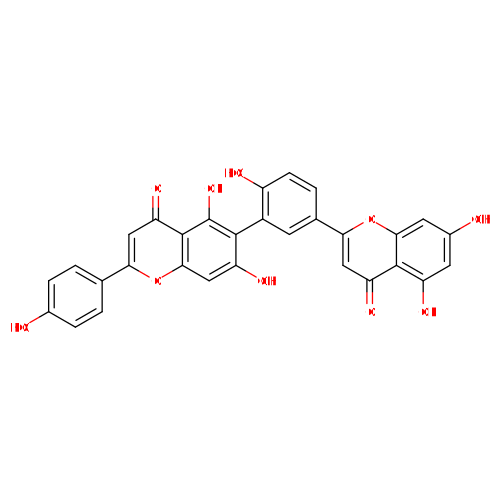
| Description | Robustaflavone, also known as 3',6''-biapigenin, belongs to the class of organic compounds known as biflavonoids and polyflavonoids. These are organic compounds containing at least two flavan/flavone units. These units are usually linked through CC or C-O-C bonds. Some examples include C2-O-C3, C2-O-C4, C3'-C3''', and C6-C8''. Thus, robustaflavone is considered to be a flavonoid lipid molecule. A biflavonoid that is obtained by oxidative coupling of two molecules of apigenin resulting in a bond between positions C-3 of the hydroxyphenyl ring and C-6 of the chromene ring. Robustaflavone is found in Agathis robusta, Araucaria spp., Callitropsis nootkatensis, Cunninghamia lanceolata Hook.f. , Garcinia brevipedicellata, Garcinia multiflora, Juniperus bermudiana, Juniperus spp., Podocarpus imbricatus, Rhus spp., Rhus succedanea , Selaginella delicatula, Selaginella denticulata, Selaginella labordei, Selaginella lepidophylla, Selaginella selaginoides, Selaginella sinensis, Selaginella tamariscina, Selaginella willdenowii and Toxicodendron succedaneum. Robustaflavone was first documented in 1998 (PMID: 9806485). Robustaflavone is a very hydrophobic molecule, practically insoluble (in water), and relatively neutral (PMID: 10843573) (PMID: 19280159). |
|---|
| Structure | OC1=CC=C(C=C1)C1=CC(=O)C2=C(O)C(=C(O)C=C2O1)C1=CC(=CC=C1O)C1=CC(=O)C2=C(O)C=C(O)C=C2O1 InChI=1S/C30H18O10/c31-15-4-1-13(2-5-15)23-11-22(37)29-26(39-23)12-20(35)27(30(29)38)17-7-14(3-6-18(17)33)24-10-21(36)28-19(34)8-16(32)9-25(28)40-24/h1-12,31-35,38H |
|---|
| Synonyms | | Value | Source |
|---|
| 3',6''-Biapigenin | ChEBI | | 6-(5-(5,7-Dihydroxy-4-oxo-4H-1-benzopyran-2-yl)-2-hydroxyphenyl)-5,7-dihydroxy-2-(4-hydroxyphenyl)-4H-1-benzopyran-4-one | ChEBI |
|
|---|
| Chemical Formula | C30H18O10 |
|---|
| Average Mass | 538.4640 Da |
|---|
| Monoisotopic Mass | 538.09000 Da |
|---|
| IUPAC Name | 6-[5-(5,7-dihydroxy-4-oxo-4H-chromen-2-yl)-2-hydroxyphenyl]-5,7-dihydroxy-2-(4-hydroxyphenyl)-4H-chromen-4-one |
|---|
| Traditional Name | robustaflavone |
|---|
| CAS Registry Number | Not Available |
|---|
| SMILES | OC1=CC=C(C=C1)C1=CC(=O)C2=C(O)C(=C(O)C=C2O1)C1=CC(=CC=C1O)C1=CC(=O)C2=C(O)C=C(O)C=C2O1 |
|---|
| InChI Identifier | InChI=1S/C30H18O10/c31-15-4-1-13(2-5-15)23-11-22(37)29-26(39-23)12-20(35)27(30(29)38)17-7-14(3-6-18(17)33)24-10-21(36)28-19(34)8-16(32)9-25(28)40-24/h1-12,31-35,38H |
|---|
| InChI Key | BORWSEZUWHQTOK-UHFFFAOYSA-N |
|---|
| Experimental Spectra |
|---|
|
| Not Available | | Predicted Spectra |
|---|
|
| Not Available | | Chemical Shift Submissions |
|---|
|
| Not Available | | Species |
|---|
| Species of Origin | |
|---|
| Chemical Taxonomy |
|---|
| Description | Belongs to the class of organic compounds known as biflavonoids and polyflavonoids. These are organic compounds containing at least two flavan/flavone units. These units are usually linked through CC or C-O-C bonds. Some examples include C2-O-C3, C2-O-C4, C3'-C3''', and C6-C8''. |
|---|
| Kingdom | Organic compounds |
|---|
| Super Class | Phenylpropanoids and polyketides |
|---|
| Class | Flavonoids |
|---|
| Sub Class | Biflavonoids and polyflavonoids |
|---|
| Direct Parent | Biflavonoids and polyflavonoids |
|---|
| Alternative Parents | |
|---|
| Substituents | - Bi- and polyflavonoid skeleton
- 4'-hydroxyflavonoid
- 5-hydroxyflavonoid
- 7-hydroxyflavonoid
- Flavone
- Hydroxyflavonoid
- Chromone
- Benzopyran
- 1-benzopyran
- 1-hydroxy-4-unsubstituted benzenoid
- 1-hydroxy-2-unsubstituted benzenoid
- Phenol
- Pyranone
- Monocyclic benzene moiety
- Pyran
- Benzenoid
- Heteroaromatic compound
- Vinylogous acid
- Organoheterocyclic compound
- Oxacycle
- Organic oxygen compound
- Organooxygen compound
- Hydrocarbon derivative
- Organic oxide
- Aromatic heteropolycyclic compound
|
|---|
| Molecular Framework | Aromatic heteropolycyclic compounds |
|---|
| External Descriptors | |
|---|
| Physical Properties |
|---|
| State | Not Available |
|---|
| Experimental Properties | | Property | Value | Reference |
|---|
| Melting Point | Not Available | Not Available | | Boiling Point | Not Available | Not Available | | Water Solubility | Not Available | Not Available | | LogP | Not Available | Not Available |
|
|---|
| Predicted Properties | |
|---|
| General References | - Lin LC, Kuo YC, Chou CJ: Cytotoxic biflavonoids from Selaginella delicatula. J Nat Prod. 2000 May;63(5):627-30. doi: 10.1021/np990538m. [PubMed:10843573 ]
- Xu GH, Ryoo IJ, Kim YH, Choo SJ, Yoo ID: Free radical scavenging and antielastase activities of flavonoids from the fruits of Thuja orientalis. Arch Pharm Res. 2009 Feb;32(2):275-82. doi: 10.1007/s12272-009-1233-y. Epub 2009 Mar 13. [PubMed:19280159 ]
- Zembower DE, Lin YM, Flavin MT, Chen FC, Korba BE: Robustaflavone, a potential non-nucleoside anti-hepatitis B agent. Antiviral Res. 1998 Aug;39(2):81-8. doi: 10.1016/s0166-3542(98)00033-3. [PubMed:9806485 ]
|
|---|