| Record Information |
|---|
| Version | 2.0 |
|---|
| Created at | 2022-04-27 21:59:26 UTC |
|---|
| Updated at | 2022-04-27 21:59:26 UTC |
|---|
| NP-MRD ID | NP0050623 |
|---|
| Secondary Accession Numbers | None |
|---|
| Natural Product Identification |
|---|
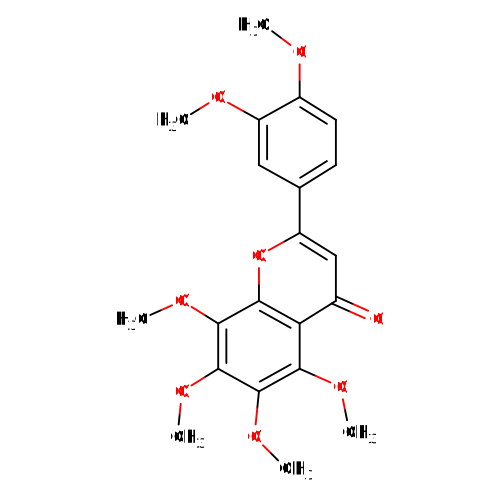
| Common Name | 3',4',5,6,7,8-Hexamethoxyflavone |
|---|
| Description | Nobiletin belongs to the class of organic compounds known as 8-o-methylated flavonoids. These are flavonoids with methoxy groups attached to the C8 atom of the flavonoid backbone. Thus, nobiletin is considered to be a flavonoid lipid molecule. Nobiletin is a very hydrophobic molecule, practically insoluble (in water), and relatively neutral. Nobiletin is a bitter tasting compound. Outside of the human body, Nobiletin is found, on average, in the highest concentration within sweet oranges. Nobiletin has also been detected, but not quantified in, several different foods, such as citrus, grapefruits, lemons, mandarin orange (clementine, tangerine), and sweet bay. This could make nobiletin a potential biomarker for the consumption of these foods. 3',4',5,6,7,8-Hexamethoxyflavone is found in Actinocephalus polyanthus, Ageratina conyzoides, Ageratum conyzoides , Blumea fistulosa, Blumea glomerata, Citrus aurantium , Citrus deliciosa, Citrus depressa, Citrus hassaku , Fortunella japonica , Citrus kinokuni, Citrus mitis, Citrus myrtifolia, Citrus nobilis , Citrus paradisi, Citrus reticulata, Citrus reticulata tangerine , Citrus sinensis, Citrus spp., Citrus tangerina, Citrus tankan, Citrus unshiu, Citrus sinensis , Eupatorium coelestinum, Conoclinium greggii, Eupatorium leucolepis, Eupatorium leucolepsis, Fortunella margarita , Juncus effusus, Laurus nobilis L. , Oxalis pes-caprae, Ozothamnus lycopodioides, Plenodomus tracheiphilus, Tripterygium wilfordii , Viburnum tinus, Viguiera rosei and Xinhui citrus. 3',4',5,6,7,8-Hexamethoxyflavone was first documented in 2003 (PMID: 12787887). A methoxyflavone that is flavone substituted by methoxy groups at positions 5, 6, 7, 8, 3' and 4' respectively (PMID: 25488359) (PMID: 25845666) (PMID: 20670297) (PMID: 15252145). |
|---|
| Structure | COC1=CC=C(C=C1OC)C1=CC(=O)C2=C(O1)C(OC)=C(OC)C(OC)=C2OC InChI=1S/C21H22O8/c1-23-13-8-7-11(9-15(13)24-2)14-10-12(22)16-17(25-3)19(26-4)21(28-6)20(27-5)18(16)29-14/h7-10H,1-6H3 |
|---|
| Synonyms | | Value | Source |
|---|
| 5,6,7,8,3',4'-Hexamethoxyflavone | ChEBI | | Hexamethoxyflavone | ChEBI | | 2-(3,4-Dimethoxyphenyl)-5,6,7,8-tetramethoxy-4H-1-benzopyran-4-one, 9ci | HMDB | | Flavone, 5,6,7,8,3',4'-hexamethoxy | HMDB |
|
|---|
| Chemical Formula | C21H22O8 |
|---|
| Average Mass | 402.3946 Da |
|---|
| Monoisotopic Mass | 402.13147 Da |
|---|
| IUPAC Name | 2-(3,4-dimethoxyphenyl)-5,6,7,8-tetramethoxy-4H-chromen-4-one |
|---|
| Traditional Name | nobiletin |
|---|
| CAS Registry Number | Not Available |
|---|
| SMILES | COC1=CC=C(C=C1OC)C1=CC(=O)C2=C(O1)C(OC)=C(OC)C(OC)=C2OC |
|---|
| InChI Identifier | InChI=1S/C21H22O8/c1-23-13-8-7-11(9-15(13)24-2)14-10-12(22)16-17(25-3)19(26-4)21(28-6)20(27-5)18(16)29-14/h7-10H,1-6H3 |
|---|
| InChI Key | MRIAQLRQZPPODS-UHFFFAOYSA-N |
|---|
| Experimental Spectra |
|---|
|
| Not Available | | Predicted Spectra |
|---|
|
| Not Available | | Chemical Shift Submissions |
|---|
|
| Not Available | | Species |
|---|
| Species of Origin | |
|---|
| Chemical Taxonomy |
|---|
| Description | Belongs to the class of organic compounds known as 8-o-methylated flavonoids. These are flavonoids with methoxy groups attached to the C8 atom of the flavonoid backbone. |
|---|
| Kingdom | Organic compounds |
|---|
| Super Class | Phenylpropanoids and polyketides |
|---|
| Class | Flavonoids |
|---|
| Sub Class | O-methylated flavonoids |
|---|
| Direct Parent | 8-O-methylated flavonoids |
|---|
| Alternative Parents | |
|---|
| Substituents | - 3p-methoxyflavonoid-skeleton
- 4p-methoxyflavonoid-skeleton
- 5-methoxyflavonoid-skeleton
- 6-methoxyflavonoid-skeleton
- 7-methoxyflavonoid-skeleton
- 8-methoxyflavonoid-skeleton
- Flavone
- Chromone
- Benzopyran
- O-dimethoxybenzene
- Dimethoxybenzene
- 1-benzopyran
- Phenoxy compound
- Anisole
- Methoxybenzene
- Phenol ether
- Alkyl aryl ether
- Pyranone
- Monocyclic benzene moiety
- Pyran
- Benzenoid
- Vinylogous ester
- Heteroaromatic compound
- Ether
- Organoheterocyclic compound
- Oxacycle
- Organooxygen compound
- Organic oxide
- Organic oxygen compound
- Hydrocarbon derivative
- Aromatic heteropolycyclic compound
|
|---|
| Molecular Framework | Aromatic heteropolycyclic compounds |
|---|
| External Descriptors | |
|---|
| Physical Properties |
|---|
| State | Not Available |
|---|
| Experimental Properties | | Property | Value | Reference |
|---|
| Melting Point | Not Available | Not Available | | Boiling Point | Not Available | Not Available | | Water Solubility | Not Available | Not Available | | LogP | Not Available | Not Available |
|
|---|
| Predicted Properties | |
|---|
| General References | - Lin N, Sato T, Takayama Y, Mimaki Y, Sashida Y, Yano M, Ito A: Novel anti-inflammatory actions of nobiletin, a citrus polymethoxy flavonoid, on human synovial fibroblasts and mouse macrophages. Biochem Pharmacol. 2003 Jun 15;65(12):2065-71. [PubMed:12787887 ]
- Kim HJ, Yonezawa T, Teruya T, Woo JT, Cha BY: Nobiletin, a polymethoxy flavonoid, reduced endothelin-1 plus SCF-induced pigmentation in human melanocytes. Photochem Photobiol. 2015 Mar-Apr;91(2):379-86. doi: 10.1111/php.12400. Epub 2015 Jan 12. [PubMed:25488359 ]
- Chen J, Chen AY, Huang H, Ye X, Rollyson WD, Perry HE, Brown KC, Rojanasakul Y, Rankin GO, Dasgupta P, Chen YC: The flavonoid nobiletin inhibits tumor growth and angiogenesis of ovarian cancers via the Akt pathway. Int J Oncol. 2015;46(6):2629-38. doi: 10.3892/ijo.2015.2946. Epub 2015 Apr 1. [PubMed:25845666 ]
- Kunimasa K, Ikekita M, Sato M, Ohta T, Yamori Y, Ikeda M, Kuranuki S, Oikawa T: Nobiletin, a citrus polymethoxyflavonoid, suppresses multiple angiogenesis-related endothelial cell functions and angiogenesis in vivo. Cancer Sci. 2010 Nov;101(11):2462-9. doi: 10.1111/j.1349-7006.2010.01668.x. [PubMed:20670297 ]
- Miyata Y, Sato T, Yano M, Ito A: Activation of protein kinase C betaII/epsilon-c-Jun NH2-terminal kinase pathway and inhibition of mitogen-activated protein/extracellular signal-regulated kinase 1/2 phosphorylation in antitumor invasive activity induced by the polymethoxy flavonoid, nobiletin. Mol Cancer Ther. 2004 Jul;3(7):839-47. [PubMed:15252145 ]
|
|---|