| Record Information |
|---|
| Version | 2.0 |
|---|
| Created at | 2022-04-27 21:59:24 UTC |
|---|
| Updated at | 2022-04-27 21:59:24 UTC |
|---|
| NP-MRD ID | NP0050622 |
|---|
| Secondary Accession Numbers | None |
|---|
| Natural Product Identification |
|---|
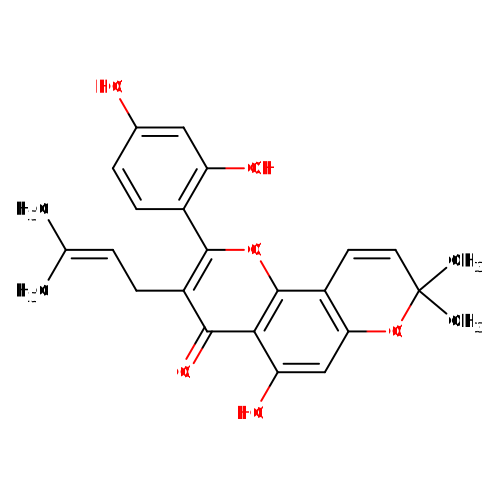
| Common Name | 2-(2,4-Dihydroxyphenyl)-5-hydroxy-8,8-dimethyl-3-(3-methyl-2-butenyl)-4H,8H-benzo[1,2-b:3,4-b']dipyran-4-one |
|---|
| Description | Morusin, also known as mulberrochromene, belongs to the class of organic compounds known as 3-prenylated flavones. These are flavones that features a C5-isoprenoid substituent at the 3-position. Thus, morusin is considered to be a flavonoid lipid molecule. Morusin is a very hydrophobic molecule, practically insoluble (in water), and relatively neutral. An extended flavonoid that is flavone substituted by hydroxy groups at positions 5, 2' and 4', a prenyl group at position 3 and a 2,2-dimethyl pyran group across positions 7 and 8. Outside of the human body, Morusin has been detected, but not quantified in, fruits. 2-(2,4-Dihydroxyphenyl)-5-hydroxy-8,8-dimethyl-3-(3-methyl-2-butenyl)-4H,8H-benzo[1,2-b:3,4-b']dipyran-4-one is found in Artocarpus altilis, Artocarpus fretessi, Artocarpus fretessii, Artocarpus tonkinensis, Morus alba , Morus australis , Morus lhou, Morus mongolica , Morus nigra, Morus spp. and Sorocea bonplandii. 2-(2,4-Dihydroxyphenyl)-5-hydroxy-8,8-dimethyl-3-(3-methyl-2-butenyl)-4H,8H-benzo[1,2-b:3,4-b']dipyran-4-one was first documented in 2000 (PMID: 10817216). This could make morusin a potential biomarker for the consumption of these foods (PMID: 25237377) (PMID: 25476160) (PMID: 25628938) (PMID: 18485277). |
|---|
| Structure | CC(C)=CCC1=C(OC2=C(C(O)=CC3=C2C=CC(C)(C)O3)C1=O)C1=C(O)C=C(O)C=C1 InChI=1S/C25H24O6/c1-13(2)5-7-17-22(29)21-19(28)12-20-16(9-10-25(3,4)31-20)24(21)30-23(17)15-8-6-14(26)11-18(15)27/h5-6,8-12,26-28H,7H2,1-4H3 |
|---|
| Synonyms | | Value | Source |
|---|
| 2-(2,4-Dihydroxyphenyl)-5-hydroxy-8,8-dimethyl-3-(3-methyl-2-butenyl)-4H,8H-benzo[1,2-b:3,4-b']dipyran-4-one | HMDB | | 2-(2,4-Dihydroxyphenyl)-5-hydroxy-8,8-dimethyl-3-(3-methyl-2-butenyl)-4H,8H-benzo[1,2-b:3,4-b']dipyran-4-one, 9ci | HMDB | | Mulberrochromene | HMDB |
|
|---|
| Chemical Formula | C25H24O6 |
|---|
| Average Mass | 420.4545 Da |
|---|
| Monoisotopic Mass | 420.15729 Da |
|---|
| IUPAC Name | 2-(2,4-dihydroxyphenyl)-5-hydroxy-8,8-dimethyl-3-(3-methylbut-2-en-1-yl)-4H,8H-pyrano[2,3-h]chromen-4-one |
|---|
| Traditional Name | morusin |
|---|
| CAS Registry Number | Not Available |
|---|
| SMILES | CC(C)=CCC1=C(OC2=C(C(O)=CC3=C2C=CC(C)(C)O3)C1=O)C1=C(O)C=C(O)C=C1 |
|---|
| InChI Identifier | InChI=1S/C25H24O6/c1-13(2)5-7-17-22(29)21-19(28)12-20-16(9-10-25(3,4)31-20)24(21)30-23(17)15-8-6-14(26)11-18(15)27/h5-6,8-12,26-28H,7H2,1-4H3 |
|---|
| InChI Key | XFFOMNJIDRDDLQ-UHFFFAOYSA-N |
|---|
| Experimental Spectra |
|---|
|
| Not Available | | Predicted Spectra |
|---|
|
| Not Available | | Chemical Shift Submissions |
|---|
|
| Not Available | | Species |
|---|
| Species of Origin | |
|---|
| Chemical Taxonomy |
|---|
| Description | Belongs to the class of organic compounds known as 3-prenylated flavones. These are flavones that features a C5-isoprenoid substituent at the 3-position. |
|---|
| Kingdom | Organic compounds |
|---|
| Super Class | Phenylpropanoids and polyketides |
|---|
| Class | Flavonoids |
|---|
| Sub Class | Flavones |
|---|
| Direct Parent | 3-prenylated flavones |
|---|
| Alternative Parents | |
|---|
| Substituents | - 3-prenylated flavone
- Pyranoflavonoid
- Hydroxyflavonoid
- 4'-hydroxyflavonoid
- 5-hydroxyflavonoid
- Pyranochromene
- 2,2-dimethyl-1-benzopyran
- Chromone
- 1-benzopyran
- Benzopyran
- Resorcinol
- Alkyl aryl ether
- 1-hydroxy-4-unsubstituted benzenoid
- Pyranone
- Phenol
- 1-hydroxy-2-unsubstituted benzenoid
- Monocyclic benzene moiety
- Pyran
- Benzenoid
- Vinylogous acid
- Heteroaromatic compound
- Oxacycle
- Organoheterocyclic compound
- Ether
- Organic oxygen compound
- Organic oxide
- Organooxygen compound
- Hydrocarbon derivative
- Aromatic heteropolycyclic compound
|
|---|
| Molecular Framework | Aromatic heteropolycyclic compounds |
|---|
| External Descriptors | |
|---|
| Physical Properties |
|---|
| State | Not Available |
|---|
| Experimental Properties | | Property | Value | Reference |
|---|
| Melting Point | Not Available | Not Available | | Boiling Point | Not Available | Not Available | | Water Solubility | Not Available | Not Available | | LogP | Not Available | Not Available |
|
|---|
| Predicted Properties | |
|---|
| General References | - Lee HJ, Ryu J, Park SH, Woo ER, Kim AR, Lee SK, Kim YS, Kim JO, Hong JH, Lee CJ: Effects of Morus alba L. and Natural Products Including Morusin on In Vivo Secretion and In Vitro Production of Airway MUC5AC Mucin. Tuberc Respir Dis (Seoul). 2014 Aug;77(2):65-72. doi: 10.4046/trd.2014.77.2.65. Epub 2014 Aug 29. [PubMed:25237377 ]
- Lin WL, Lai DY, Lee YJ, Chen NF, Tseng TH: Antitumor progression potential of morusin suppressing STAT3 and NFkappaB in human hepatoma SK-Hep1 cells. Toxicol Lett. 2015 Jan 22;232(2):490-8. doi: 10.1016/j.toxlet.2014.11.031. Epub 2014 Dec 2. [PubMed:25476160 ]
- Lim SL, Park SY, Kang S, Park D, Kim SH, Um JY, Jang HJ, Lee JH, Jeong CH, Jang JH, Ahn KS, Lee SG: Morusin induces cell death through inactivating STAT3 signaling in prostate cancer cells. Am J Cancer Res. 2014 Dec 15;5(1):289-99. eCollection 2015. [PubMed:25628938 ]
- Lee JC, Won SJ, Chao CL, Wu FL, Liu HS, Ling P, Lin CN, Su CL: Morusin induces apoptosis and suppresses NF-kappaB activity in human colorectal cancer HT-29 cells. Biochem Biophys Res Commun. 2008 Jul 18;372(1):236-42. doi: 10.1016/j.bbrc.2008.05.023. Epub 2008 May 14. [PubMed:18485277 ]
- de Souza MM, Bittar M, Cechinel-Filho V, Yunes RA, Messana I, Delle Monache F, Ferrari F: Antinociceptive properties of morusin, a prenylflavonoid isolated from Morus nigra root bark. Z Naturforsch C J Biosci. 2000 Mar-Apr;55(3-4):256-60. doi: 10.1515/znc-2000-3-418. [PubMed:10817216 ]
|
|---|