| Record Information |
|---|
| Version | 2.0 |
|---|
| Created at | 2022-04-27 21:58:50 UTC |
|---|
| Updated at | 2022-04-27 21:58:50 UTC |
|---|
| NP-MRD ID | NP0050605 |
|---|
| Secondary Accession Numbers | None |
|---|
| Natural Product Identification |
|---|
| Common Name | Uvaretin |
|---|
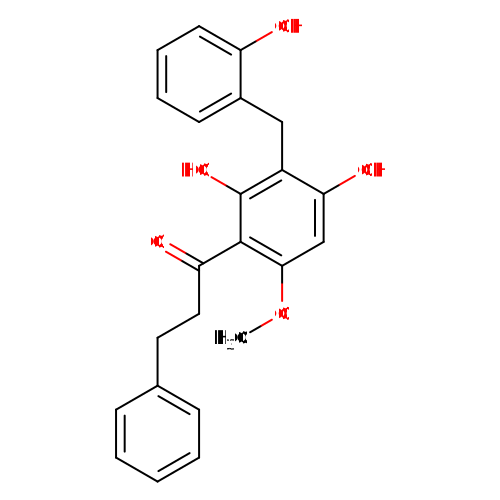
| Description | Uvaretin belongs to the class of organic compounds known as linear diarylheptanoids. These are diarylheptanoids with an open heptane chain. The two aromatic rings are linked only by the heptane chain. Thus, uvaretin is considered to be a flavonoid lipid molecule. Uvaretin is found in Desmos chinensis, Ulvaria chamae, Uvaria acuminata , Uvaria angolensis, Uvaria chamae , Uvaria kirkii, Uvaria leptocladon, Uvaria lucida, Uvaria spp. and Uvaria tanzaniae. Uvaretin was first documented in 1976 (PMID: 1255298). Uvaretin is a very hydrophobic molecule, practically insoluble (in water), and relatively neutral (PMID: 12168763) (PMID: 1262991) (PMID: 14709883) (PMID: 15635168). |
|---|
| Structure | COC1=CC(O)=C(CC2=CC=CC=C2O)C(O)=C1C(=O)CCC1=CC=CC=C1 InChI=1S/C23H22O5/c1-28-21-14-20(26)17(13-16-9-5-6-10-18(16)24)23(27)22(21)19(25)12-11-15-7-3-2-4-8-15/h2-10,14,24,26-27H,11-13H2,1H3 |
|---|
| Synonyms | | Value | Source |
|---|
| 1-(2,4-Dihydroxy-3-((2-hydroxyphenyl)methyl)-6-methoxyphenyl)-3-phenyl-1-propanone | ChEBI | | 2',4'-Dihydroxy-3'-[(2-hydroxyphenyl)methyl]6'-methoxy-7,8-dihydrochalcone | ChEBI | | 1-(2,4-Dihydroxy-3-(2-hydroxybenzyl)-6-methoxyphenyl)-3-phenyl-1-propanone | MeSH |
|
|---|
| Chemical Formula | C23H22O5 |
|---|
| Average Mass | 378.4240 Da |
|---|
| Monoisotopic Mass | 378.14672 Da |
|---|
| IUPAC Name | 1-{2,4-dihydroxy-3-[(2-hydroxyphenyl)methyl]-6-methoxyphenyl}-3-phenylpropan-1-one |
|---|
| Traditional Name | uvaretin |
|---|
| CAS Registry Number | Not Available |
|---|
| SMILES | COC1=CC(O)=C(CC2=CC=CC=C2O)C(O)=C1C(=O)CCC1=CC=CC=C1 |
|---|
| InChI Identifier | InChI=1S/C23H22O5/c1-28-21-14-20(26)17(13-16-9-5-6-10-18(16)24)23(27)22(21)19(25)12-11-15-7-3-2-4-8-15/h2-10,14,24,26-27H,11-13H2,1H3 |
|---|
| InChI Key | LQHGGFQNRNEFIG-UHFFFAOYSA-N |
|---|
| Experimental Spectra |
|---|
|
| Not Available | | Predicted Spectra |
|---|
|
| Not Available | | Chemical Shift Submissions |
|---|
|
| Not Available | | Species |
|---|
| Species of Origin | |
|---|
| Chemical Taxonomy |
|---|
| Description | Belongs to the class of organic compounds known as linear diarylheptanoids. These are diarylheptanoids with an open heptane chain. The two aromatic rings are linked only by the heptane chain. |
|---|
| Kingdom | Organic compounds |
|---|
| Super Class | Phenylpropanoids and polyketides |
|---|
| Class | Diarylheptanoids |
|---|
| Sub Class | Linear diarylheptanoids |
|---|
| Direct Parent | Linear diarylheptanoids |
|---|
| Alternative Parents | |
|---|
| Substituents | - Linear 1,7-diphenylheptane skeleton
- 2'-hydroxy-dihydrochalcone
- Linear 1,3-diarylpropanoid
- Cinnamylphenol
- Diphenylmethane
- Alkyl-phenylketone
- Butyrophenone
- Methoxyphenol
- Phenylketone
- Anisole
- Benzoyl
- Phenoxy compound
- Phenol ether
- Resorcinol
- Methoxybenzene
- Aryl ketone
- Aryl alkyl ketone
- Phenol
- 1-hydroxy-2-unsubstituted benzenoid
- Alkyl aryl ether
- 1-hydroxy-4-unsubstituted benzenoid
- Monocyclic benzene moiety
- Benzenoid
- Vinylogous acid
- Ketone
- Ether
- Organooxygen compound
- Organic oxygen compound
- Organic oxide
- Hydrocarbon derivative
- Aromatic homomonocyclic compound
|
|---|
| Molecular Framework | Aromatic homomonocyclic compounds |
|---|
| External Descriptors | |
|---|
| Physical Properties |
|---|
| State | Not Available |
|---|
| Experimental Properties | | Property | Value | Reference |
|---|
| Melting Point | Not Available | Not Available | | Boiling Point | Not Available | Not Available | | Water Solubility | Not Available | Not Available | | LogP | Not Available | Not Available |
|
|---|
| Predicted Properties | |
|---|
| General References | - Makangara JJ, Jonker SA, Nkunya MH: A novel phenanthrenolide and C-benzyl dihydrochalcones from Uvaria puguensis. Nat Prod Lett. 2002 Aug;16(4):267-72. doi: 10.1080/10575630290020604. [PubMed:12168763 ]
- Hufford CD, Lasswell WL Jr: Uvaretin and isouvaretin. Two novel cytotoxic c-benzylflavanones from uvaria chamae L. J Org Chem. 1976 Apr 2;41(7):1297-8. doi: 10.1021/jo00869a062. [PubMed:1255298 ]
- Cole JR, Torrance SJ, Wiedhopf RM, Arora SK, Bates RB: Uvaretin, a new antitumor agent from Uvaria acuminata (Annonaceae). J Org Chem. 1976 May 14;41(10):1852-5. doi: 10.1021/jo00872a037. [PubMed:1262991 ]
- Ichimaru M, Nakatani N, Takahashi T, Nishiyama Y, Moriyasu M, Kato A, Mathenge SG, Juma FD, Nganga JN: Cytotoxic C-benzylated dihydrochalcones from Uvaria acuminata. Chem Pharm Bull (Tokyo). 2004 Jan;52(1):138-41. doi: 10.1248/cpb.52.138. [PubMed:14709883 ]
- Nakatani N, Ichimaru M, Moriyasu M, Kato A: Induction of apoptosis in human promyelocytic leukemia cell line HL-60 by C-benzylated dihydrochalcones, uvaretin, isouvaretin and diuvaretin. Biol Pharm Bull. 2005 Jan;28(1):83-6. doi: 10.1248/bpb.28.83. [PubMed:15635168 ]
|
|---|