| Record Information |
|---|
| Version | 2.0 |
|---|
| Created at | 2022-04-27 21:58:43 UTC |
|---|
| Updated at | 2022-04-27 21:58:43 UTC |
|---|
| NP-MRD ID | NP0050602 |
|---|
| Secondary Accession Numbers | None |
|---|
| Natural Product Identification |
|---|
| Common Name | Strobopinin |
|---|
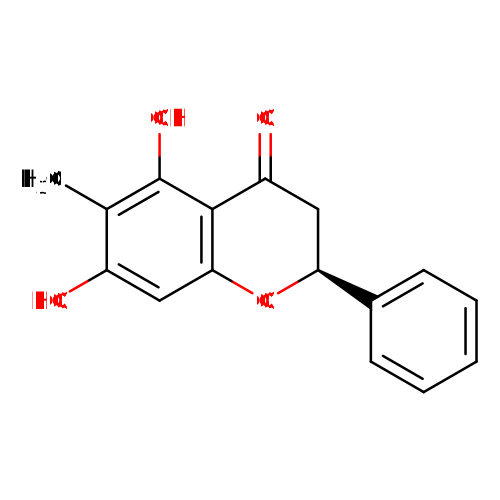
| Description | Strobopinin belongs to the class of organic compounds known as flavanones. Flavanones are compounds containing a flavan-3-one moiety, with a structure characterized by a 2-phenyl-3,4-dihydro-2H-1-benzopyran bearing a ketone at the carbon C3. Thus, strobopinin is considered to be a flavonoid. Strobopinin is a secondary metabolite. Secondary metabolites are metabolically or physiologically non-essential metabolites that may serve a role as defense or signalling molecules. In some cases they are simply molecules that arise from the incomplete metabolism of other secondary metabolites. Strobopinin is found in Alnus sieboldiana, Bauhinia purpurea, Leptospermum scoparium , Pentagramma pallida, Pinus bungeana, Pinus krempfii, Pinus monticola, Pinus parviflora, Pinus spp. , Pinus strobus, Piper hostmannianum, Piper hostmannianum var.berbicense, Pityrogramma pallida, Pseudotsuga wilsoniana, Syzygium samarangense and Thelypteris palustris. Strobopinin was first documented in 1957 (PMID: 13465274). Based on a literature review a small amount of articles have been published on strobopinin (PMID: 17397884) (PMID: 33026163) (PMID: 15643565). |
|---|
| Structure | CC1=C(O)C=C2O[C@@H](CC(=O)C2=C1O)C1=CC=CC=C1 InChI=1S/C16H14O4/c1-9-11(17)7-14-15(16(9)19)12(18)8-13(20-14)10-5-3-2-4-6-10/h2-7,13,17,19H,8H2,1H3/t13-/m0/s1 |
|---|
| Synonyms | Not Available |
|---|
| Chemical Formula | C16H14O4 |
|---|
| Average Mass | 270.2840 Da |
|---|
| Monoisotopic Mass | 270.08921 Da |
|---|
| IUPAC Name | (2S)-5,7-dihydroxy-6-methyl-2-phenyl-3,4-dihydro-2H-1-benzopyran-4-one |
|---|
| Traditional Name | strobopinin |
|---|
| CAS Registry Number | Not Available |
|---|
| SMILES | CC1=C(O)C=C2O[C@@H](CC(=O)C2=C1O)C1=CC=CC=C1 |
|---|
| InChI Identifier | InChI=1S/C16H14O4/c1-9-11(17)7-14-15(16(9)19)12(18)8-13(20-14)10-5-3-2-4-6-10/h2-7,13,17,19H,8H2,1H3/t13-/m0/s1 |
|---|
| InChI Key | INBPQAJYHSJVRY-ZDUSSCGKSA-N |
|---|
| Experimental Spectra |
|---|
|
| Not Available | | Predicted Spectra |
|---|
|
| Not Available | | Chemical Shift Submissions |
|---|
|
| Not Available | | Species |
|---|
| Species of Origin | |
|---|
| Chemical Taxonomy |
|---|
| Description | Belongs to the class of organic compounds known as flavanones. Flavanones are compounds containing a flavan-3-one moiety, with a structure characterized by a 2-phenyl-3,4-dihydro-2H-1-benzopyran bearing a ketone at the carbon C3. |
|---|
| Kingdom | Organic compounds |
|---|
| Super Class | Phenylpropanoids and polyketides |
|---|
| Class | Flavonoids |
|---|
| Sub Class | Flavans |
|---|
| Direct Parent | Flavanones |
|---|
| Alternative Parents | |
|---|
| Substituents | - Flavanone
- 5-hydroxyflavonoid
- 7-hydroxyflavonoid
- Hydroxyflavonoid
- Chromone
- Benzopyran
- Chromane
- 1-benzopyran
- Aryl ketone
- Aryl alkyl ketone
- Alkyl aryl ether
- 1-hydroxy-4-unsubstituted benzenoid
- 1-hydroxy-2-unsubstituted benzenoid
- Benzenoid
- Monocyclic benzene moiety
- Vinylogous acid
- Ketone
- Oxacycle
- Organoheterocyclic compound
- Ether
- Organic oxygen compound
- Organic oxide
- Organooxygen compound
- Hydrocarbon derivative
- Aromatic heteropolycyclic compound
|
|---|
| Molecular Framework | Aromatic heteropolycyclic compounds |
|---|
| External Descriptors | |
|---|
| Physical Properties |
|---|
| State | Not Available |
|---|
| Experimental Properties | | Property | Value | Reference |
|---|
| Melting Point | Not Available | Not Available | | Boiling Point | Not Available | Not Available | | Water Solubility | Not Available | Not Available | | LogP | Not Available | Not Available |
|
|---|
| Predicted Properties | |
|---|
| General References | - Portet B, Fabre N, Roumy V, Gornitzka H, Bourdy G, Chevalley S, Sauvain M, Valentin A, Moulis C: Activity-guided isolation of antiplasmodial dihydrochalcones and flavanones from Piper hostmannianum var. berbicense. Phytochemistry. 2007 May;68(9):1312-20. doi: 10.1016/j.phytochem.2007.02.006. Epub 2007 Mar 29. [PubMed:17397884 ]
- Xu WJ, Xie X, Wu L, Tian XM, Wang CC, Kong LY, Luo J: Cajuputones A-C, beta-Triketone Flavanone Hybrids from the Branches and Leaves of Melaleuca cajuputi. Chem Biodivers. 2020 Nov;17(11):e2000706. doi: 10.1002/cbdv.202000706. Epub 2020 Oct 27. [PubMed:33026163 ]
- Kuo YC, Yang LM, Lin LC: Isolation and immunomodulatory effect of flavonoids from Syzygium samarangense. Planta Med. 2004 Dec;70(12):1237-9. doi: 10.1055/s-2004-835859. [PubMed:15643565 ]
- MATSUURA S: The structure of cryptostrobin and strobopinin; the flavanones from the heartwood of Pinus strobus. Pharm Bull. 1957 Jun;5(3):195-8. doi: 10.1248/cpb1953.5.195. [PubMed:13465274 ]
|
|---|