| Record Information |
|---|
| Version | 2.0 |
|---|
| Created at | 2022-04-27 21:57:31 UTC |
|---|
| Updated at | 2022-04-27 21:57:31 UTC |
|---|
| NP-MRD ID | NP0050569 |
|---|
| Secondary Accession Numbers | None |
|---|
| Natural Product Identification |
|---|
| Common Name | Chloroxanthin |
|---|
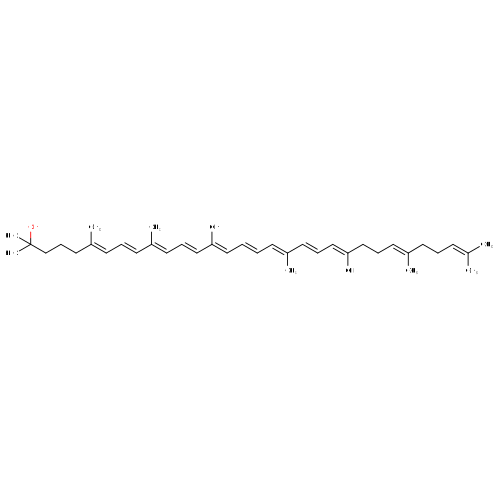
| Description | Chloroxanthin/ hydroxyneurosporene/ oh-neurosporene, also known as hydroxyneurosporene, belongs to the class of organic compounds known as xanthophylls. These are carotenoids containing an oxygenated carotene backbone. Carotenes are characterized by the presence of two end-groups (mostly cyclohexene rings, but also cyclopentene rings or acyclic groups) linked by a long branched alkyl chain. Carotenes belonging form a subgroup of the carotenoids family. Xanthophylls arise by oxygenation of the carotene backbone. Thus, chloroxanthin/ hydroxyneurosporene/ OH-neurosporene is considered to be an isoprenoid lipid molecule. Chloroxanthin is found in Myxococcus xanthus, Rhodobacter capsulatus, Rhodobacter sphaeroides, Rhodomicrobium vannielii and Rhodospirillum rubrum. Chloroxanthin/ hydroxyneurosporene/ oh-neurosporene is a very hydrophobic molecule, practically insoluble (in water), and relatively neutral. |
|---|
| Structure | CC(C)=CCC\C(C)=C\CC\C(C)=C\C=C\C(\C)=C\C=C\C=C(/C)\C=C\C=C(/C)\C=C\C=C(/C)CCCC(C)(C)O InChI=1S/C40H60O/c1-33(2)19-13-22-36(5)25-16-28-37(6)26-14-23-34(3)20-11-12-21-35(4)24-15-27-38(7)29-17-30-39(8)31-18-32-40(9,10)41/h11-12,14-15,17,19-21,23-27,29-30,41H,13,16,18,22,28,31-32H2,1-10H3/b12-11+,23-14+,24-15+,29-17+,34-20+,35-21+,36-25+,37-26+,38-27+,39-30+ |
|---|
| Synonyms | | Value | Source |
|---|
| Hydroxyneurosporene | Kegg |
|
|---|
| Chemical Formula | C40H60O |
|---|
| Average Mass | 556.9190 Da |
|---|
| Monoisotopic Mass | 556.46442 Da |
|---|
| IUPAC Name | (6E,8E,10E,12E,14E,16E,18E,20E,22E,26E)-2,6,10,14,19,23,27,31-octamethyldotriaconta-6,8,10,12,14,16,18,20,22,26,30-undecaen-2-ol |
|---|
| Traditional Name | hydroxyneurosporene |
|---|
| CAS Registry Number | Not Available |
|---|
| SMILES | CC(C)=CCC\C(C)=C\CC\C(C)=C\C=C\C(\C)=C\C=C\C=C(/C)\C=C\C=C(/C)\C=C\C=C(/C)CCCC(C)(C)O |
|---|
| InChI Identifier | InChI=1S/C40H60O/c1-33(2)19-13-22-36(5)25-16-28-37(6)26-14-23-34(3)20-11-12-21-35(4)24-15-27-38(7)29-17-30-39(8)31-18-32-40(9,10)41/h11-12,14-15,17,19-21,23-27,29-30,41H,13,16,18,22,28,31-32H2,1-10H3/b12-11+,23-14+,24-15+,29-17+,34-20+,35-21+,36-25+,37-26+,38-27+,39-30+ |
|---|
| InChI Key | IWZRTQIXVDXLNL-PZKADDIDSA-N |
|---|
| Experimental Spectra |
|---|
|
| Not Available | | Predicted Spectra |
|---|
|
| Not Available | | Chemical Shift Submissions |
|---|
|
| Not Available | | Species |
|---|
| Species of Origin | |
|---|
| Chemical Taxonomy |
|---|
| Description | Belongs to the class of organic compounds known as xanthophylls. These are carotenoids containing an oxygenated carotene backbone. Carotenes are characterized by the presence of two end-groups (mostly cyclohexene rings, but also cyclopentene rings or acyclic groups) linked by a long branched alkyl chain. Carotenes belonging form a subgroup of the carotenoids family. Xanthophylls arise by oxygenation of the carotene backbone. |
|---|
| Kingdom | Organic compounds |
|---|
| Super Class | Lipids and lipid-like molecules |
|---|
| Class | Prenol lipids |
|---|
| Sub Class | Tetraterpenoids |
|---|
| Direct Parent | Xanthophylls |
|---|
| Alternative Parents | |
|---|
| Substituents | - Xanthophyll
- Tertiary alcohol
- Organic oxygen compound
- Hydrocarbon derivative
- Organooxygen compound
- Alcohol
- Aliphatic acyclic compound
|
|---|
| Molecular Framework | Aliphatic acyclic compounds |
|---|
| External Descriptors | |
|---|
| Physical Properties |
|---|
| State | Not Available |
|---|
| Experimental Properties | | Property | Value | Reference |
|---|
| Melting Point | Not Available | Not Available | | Boiling Point | Not Available | Not Available | | Water Solubility | Not Available | Not Available | | LogP | Not Available | Not Available |
|
|---|
| Predicted Properties | |
|---|