| Record Information |
|---|
| Version | 2.0 |
|---|
| Created at | 2022-04-27 21:44:38 UTC |
|---|
| Updated at | 2022-04-27 21:44:38 UTC |
|---|
| NP-MRD ID | NP0050469 |
|---|
| Secondary Accession Numbers | None |
|---|
| Natural Product Identification |
|---|
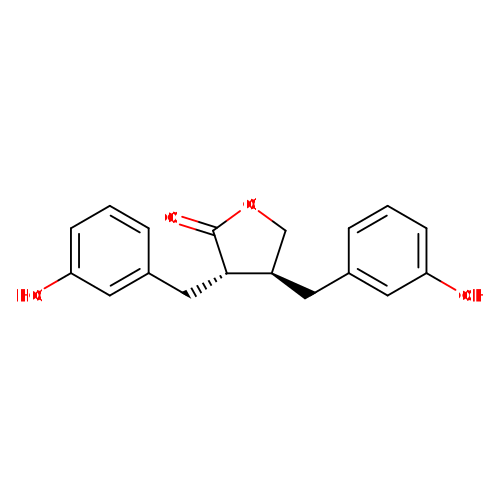
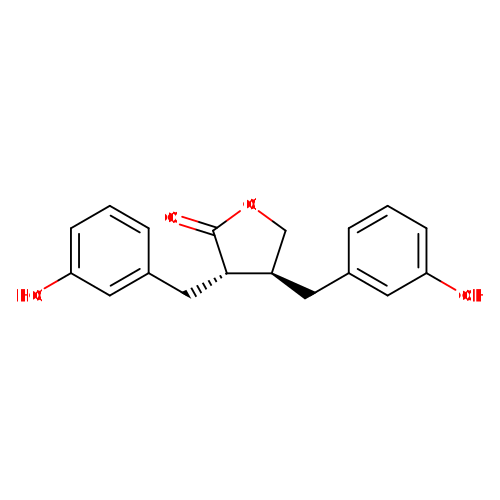
| Common Name | Enterolactone |
|---|
| Description | Enterolactone, also known as HPMF or BHMDF, belongs to the class of organic compounds known as dibenzylbutyrolactone lignans. These are lignan compounds containing a 3,4-dibenzyloxolan-2-one moiety. Enterolactone is an extremely weak basic (essentially neutral) compound (based on its pKa). Enterolactone and lignans may also be protective against cardiovascular disease. Antibiotic treatments can abolish the capacity to produce enterolactone. Enterolactone is a chemical compound formed by the action of intestinal bacteria on plant lignan precursors present in the diet. The richest known dietary sources of enterolactone precursors are flaxseed and sesame seed. In edible plants lignans are bound to the fiber fraction and therefore fiber-rich food products, such as cereals, vegetables, fruits and berries, are generally good sources of lignans and enterolactone. Many dietary plant lignan precursors, such as secoisolariciresinol, matairesinol, lariciresinol, pinoresinol, and sesamin, can be metabolized by gut microbes to enterolactone. Since enterolactone is produced by specific species of gut microbiota, the capacity to produce it varies between people. It may take up to a year before enterolactone production is restored. Enterolactone is suggested to possess beneficial health effects in humans. Enterolactone is found in Homo Sapiens, Mammalian lignana, Urtica dioica and Zingiber zerumbet. Enterolactone was first documented in 2002 (PMID: 12270221). In epidemiological studies lower concentrations of enterolactone have been observed in breast cancer patients compared to healthy controls, which may suggest that enterolactone is anti-carcinogenic (PMID: 16168401). |
|---|
| Structure | OC1=CC=CC(C[C@@H]2COC(=O)[C@H]2CC2=CC(O)=CC=C2)=C1 InChI=1S/C18H18O4/c19-15-5-1-3-12(8-15)7-14-11-22-18(21)17(14)10-13-4-2-6-16(20)9-13/h1-6,8-9,14,17,19-20H,7,10-11H2/t14-,17+/m1/s1 |
|---|
| Synonyms | | Value | Source |
|---|
| 2,3-Bis(3'-hydroxybenzyl)butyrolactone | HMDB | | 2,3-Bis(3'-hydroxybenzyl)butyrolactone, (trans)-isomer | HMDB | | HPMF | HMDB | | trans-2,3-Bis(3-hydroxybenzyl)-gamma-butyrolactone | HMDB | | BHMDF | HMDB | | 2,3-BHBB | HMDB | | 2,3-Bis(3'-hydroxybenzyl)butyrolactone, (trans)-(+-)-isomer | HMDB | | 3,4-Bis((3-hydroxyphenyl)methyl)dihydro-2-(3H)-furanone | HMDB | | (+)-Enterolactone | HMDB | | (3S)-trans-Enterolactone | HMDB | | (3S,4S)-Dihydro-3,4-bis[(3-hydroxyphenyl)methyl]-2(3H)-furanone | HMDB | | (3S,4S)-Enterolactone | HMDB | | (±)-enterolactone | HMDB | | 2,3-Bis(3’-hydroxybenzyl)butyrolactone | HMDB | | trans-2,3-Bis(3-hydroxybenzyl)-γ-butyrolactone | HMDB | | Enterolactone | HMDB |
|
|---|
| Chemical Formula | C18H18O4 |
|---|
| Average Mass | 298.3380 Da |
|---|
| Monoisotopic Mass | 298.12051 Da |
|---|
| IUPAC Name | (3S,4S)-3,4-bis[(3-hydroxyphenyl)methyl]oxolan-2-one |
|---|
| Traditional Name | enterolactone |
|---|
| CAS Registry Number | Not Available |
|---|
| SMILES | OC1=CC=CC(C[C@@H]2COC(=O)[C@H]2CC2=CC(O)=CC=C2)=C1 |
|---|
| InChI Identifier | InChI=1S/C18H18O4/c19-15-5-1-3-12(8-15)7-14-11-22-18(21)17(14)10-13-4-2-6-16(20)9-13/h1-6,8-9,14,17,19-20H,7,10-11H2/t14-,17+/m1/s1 |
|---|
| InChI Key | HVDGDHBAMCBBLR-PBHICJAKSA-N |
|---|
| Experimental Spectra |
|---|
|
| Not Available | | Predicted Spectra |
|---|
|
| Not Available | | Chemical Shift Submissions |
|---|
|
| Not Available | | Species |
|---|
| Species of Origin | |
|---|
| Chemical Taxonomy |
|---|
| Description | Belongs to the class of organic compounds known as dibenzylbutyrolactone lignans. These are lignan compounds containing a 3,4-dibenzyloxolan-2-one moiety. |
|---|
| Kingdom | Organic compounds |
|---|
| Super Class | Lignans, neolignans and related compounds |
|---|
| Class | Furanoid lignans |
|---|
| Sub Class | Tetrahydrofuran lignans |
|---|
| Direct Parent | Dibenzylbutyrolactone lignans |
|---|
| Alternative Parents | |
|---|
| Substituents | - Dibenzylbutyrolactone
- Lignan lactone
- 1-hydroxy-4-unsubstituted benzenoid
- 1-hydroxy-2-unsubstituted benzenoid
- Phenol
- Monocyclic benzene moiety
- Gamma butyrolactone
- Benzenoid
- Tetrahydrofuran
- Carboxylic acid ester
- Lactone
- Carboxylic acid derivative
- Oxacycle
- Organoheterocyclic compound
- Monocarboxylic acid or derivatives
- Hydrocarbon derivative
- Organic oxide
- Organic oxygen compound
- Carbonyl group
- Organooxygen compound
- Aromatic heteromonocyclic compound
|
|---|
| Molecular Framework | Aromatic heteromonocyclic compounds |
|---|
| External Descriptors | |
|---|
| Physical Properties |
|---|
| State | Not Available |
|---|
| Experimental Properties | | Property | Value | Reference |
|---|
| Melting Point | Not Available | Not Available | | Boiling Point | Not Available | Not Available | | Water Solubility | Not Available | Not Available | | LogP | Not Available | Not Available |
|
|---|
| Predicted Properties | |
|---|