| Record Information |
|---|
| Version | 2.0 |
|---|
| Created at | 2022-04-27 21:39:55 UTC |
|---|
| Updated at | 2022-04-27 21:39:55 UTC |
|---|
| NP-MRD ID | NP0050451 |
|---|
| Secondary Accession Numbers | None |
|---|
| Natural Product Identification |
|---|
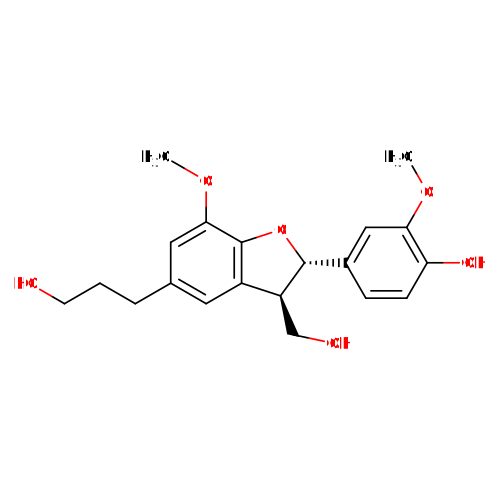
| Common Name | Dihydrodehydrodiconiferyl alcohol |
|---|
| Description | Dihydrodehydrodiconiferyl alcohol belongs to the class of organic compounds known as 2-arylbenzofuran flavonoids. These are phenylpropanoids containing the 2-phenylbenzofuran moiety. Dihydrodehydrodiconiferyl alcohol is found in Aconitum baicalense, Annona squamosa, Berberis koreana, Betula maximowicziana, Brosimum acutifolium, Bursera tonkinensis, Cleistopholis glauca, Cycas circinalis, Acanthopanax senticosus , Epimedium sagittatum, Eucommia ulmoides , Euonymus alatus, Helicteres angustifolia , Hibiscus taiwanensis, Juniperus chinensis, Magnolia coco, Mitragyna africanus, Picea glauca, Picea glehnii, Rosa canina, Santalum album L. , Sarcandra glabra , Streblus asper, Taraxacum alpinum, Vitex agnus-castus, Vitex negundo and Vitex rotundifolia. Dihydrodehydrodiconiferyl alcohol was first documented in 2018 (PMID: 30413192). Dihydrodehydrodiconiferyl alcohol is an extremely weak basic (essentially neutral) compound (based on its pKa) (PMID: 32962016) (PMID: 31948026) (PMID: 31857179) (PMID: 30693991). |
|---|
| Structure | COC1=CC(CCCO)=CC2=C1O[C@@H]([C@H]2CO)C1=CC(OC)=C(O)C=C1 InChI=1S/C20H24O6/c1-24-17-10-13(5-6-16(17)23)19-15(11-22)14-8-12(4-3-7-21)9-18(25-2)20(14)26-19/h5-6,8-10,15,19,21-23H,3-4,7,11H2,1-2H3/t15-,19+/m0/s1 |
|---|
| Synonyms | | Value | Source |
|---|
| (+)-Dihydrodehydrodiconiferyl alcohol | PhytoBank | | (2S,3R)-Dihydrodehydroconiferyl alcohol | PhytoBank | | (7S,8R)-Dihydrodehydrodiconiferyl alcohol | PhytoBank | | (7S,8R)-Lawsonicin | PhytoBank | | Dehydroconiferyl alcohol | PhytoBank |
|
|---|
| Chemical Formula | C20H24O6 |
|---|
| Average Mass | 360.4060 Da |
|---|
| Monoisotopic Mass | 360.15729 Da |
|---|
| IUPAC Name | 4-[(2S,3R)-3-(hydroxymethyl)-5-(3-hydroxypropyl)-7-methoxy-2,3-dihydro-1-benzofuran-2-yl]-2-methoxyphenol |
|---|
| Traditional Name | 4-[(2S,3R)-3-(hydroxymethyl)-5-(3-hydroxypropyl)-7-methoxy-2,3-dihydro-1-benzofuran-2-yl]-2-methoxyphenol |
|---|
| CAS Registry Number | Not Available |
|---|
| SMILES | COC1=CC(CCCO)=CC2=C1O[C@@H]([C@H]2CO)C1=CC(OC)=C(O)C=C1 |
|---|
| InChI Identifier | InChI=1S/C20H24O6/c1-24-17-10-13(5-6-16(17)23)19-15(11-22)14-8-12(4-3-7-21)9-18(25-2)20(14)26-19/h5-6,8-10,15,19,21-23H,3-4,7,11H2,1-2H3/t15-,19+/m0/s1 |
|---|
| InChI Key | SBLZVJIHPWRSQQ-HNAYVOBHSA-N |
|---|
| Experimental Spectra |
|---|
|
| Not Available | | Predicted Spectra |
|---|
|
| Not Available | | Chemical Shift Submissions |
|---|
|
| Not Available | | Species |
|---|
| Species of Origin | |
|---|
| Chemical Taxonomy |
|---|
| Description | Belongs to the class of organic compounds known as 2-arylbenzofuran flavonoids. These are phenylpropanoids containing the 2-phenylbenzofuran moiety. |
|---|
| Kingdom | Organic compounds |
|---|
| Super Class | Phenylpropanoids and polyketides |
|---|
| Class | 2-arylbenzofuran flavonoids |
|---|
| Sub Class | Not Available |
|---|
| Direct Parent | 2-arylbenzofuran flavonoids |
|---|
| Alternative Parents | |
|---|
| Substituents | - 2-arylbenzofuran flavonoid
- Norlignan skeleton
- Neolignan skeleton
- Methoxyphenol
- Coumaran
- Benzofuran
- Phenoxy compound
- Anisole
- Methoxybenzene
- Phenol ether
- 1-hydroxy-2-unsubstituted benzenoid
- Alkyl aryl ether
- Phenol
- Monocyclic benzene moiety
- Benzenoid
- Oxacycle
- Organoheterocyclic compound
- Ether
- Organic oxygen compound
- Alcohol
- Hydrocarbon derivative
- Primary alcohol
- Organooxygen compound
- Aromatic heteropolycyclic compound
|
|---|
| Molecular Framework | Aromatic heteropolycyclic compounds |
|---|
| External Descriptors | Not Available |
|---|
| Physical Properties |
|---|
| State | Not Available |
|---|
| Experimental Properties | | Property | Value | Reference |
|---|
| Melting Point | Not Available | Not Available | | Boiling Point | Not Available | Not Available | | Water Solubility | Not Available | Not Available | | LogP | Not Available | Not Available |
|
|---|
| Predicted Properties | |
|---|
| General References | - Qi Y, Choi SI, Son SR, Han HS, Ahn HS, Shin YK, Lee SH, Lee KT, Kwon HC, Jang DS: Chemical Constituents of the Leaves of Campanula takesimana (Korean Bellflower) and Their Inhibitory Effects on LPS-induced PGE2 Production. Plants (Basel). 2020 Sep 18;9(9). pii: plants9091232. doi: 10.3390/plants9091232. [PubMed:32962016 ]
- Li S, Zhao C, Yue F, Lu F: Revealing Structural Modifications of Lignin in Acidic gamma-Valerolactone-H(2)O Pretreatment. Polymers (Basel). 2020 Jan 5;12(1):116. doi: 10.3390/polym12010116. [PubMed:31948026 ]
- Chang CC, Tsai WT, Chen CK, Chen CH, Lee SS: Diastereomeric identification of neolignan rhamnosides from Trochodendron aralioides leaves by LC-SPE-NMR and circular dichroism. Fitoterapia. 2020 Jul;144:104455. doi: 10.1016/j.fitote.2019.104455. Epub 2019 Dec 17. [PubMed:31857179 ]
- Li M, Li B, Hou Y, Tian Y, Chen L, Liu S, Zhang N, Dong J: Anti-inflammatory effects of chemical components from Ginkgo biloba L. male flowers on lipopolysaccharide-stimulated RAW264.7 macrophages. Phytother Res. 2019 Apr;33(4):989-997. doi: 10.1002/ptr.6292. Epub 2019 Jan 29. [PubMed:30693991 ]
- Thabet AA, Youssef FS, Korinek M, Chang FR, Wu YC, Chen BH, El-Shazly M, Singab ANB, Hwang TL: Study of the anti-allergic and anti-inflammatory activity of Brachychiton rupestris and Brachychiton discolor leaves (Malvaceae) using in vitro models. BMC Complement Altern Med. 2018 Nov 9;18(1):299. doi: 10.1186/s12906-018-2359-6. [PubMed:30413192 ]
|
|---|