| Record Information |
|---|
| Version | 2.0 |
|---|
| Created at | 2022-04-27 20:52:32 UTC |
|---|
| Updated at | 2022-04-27 20:52:32 UTC |
|---|
| NP-MRD ID | NP0050315 |
|---|
| Secondary Accession Numbers | None |
|---|
| Natural Product Identification |
|---|
| Common Name | 13-Hydroxy-9Z,11E-octadecadienoic acid |
|---|
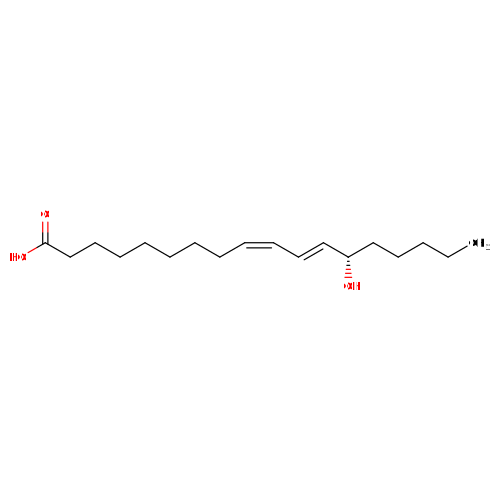
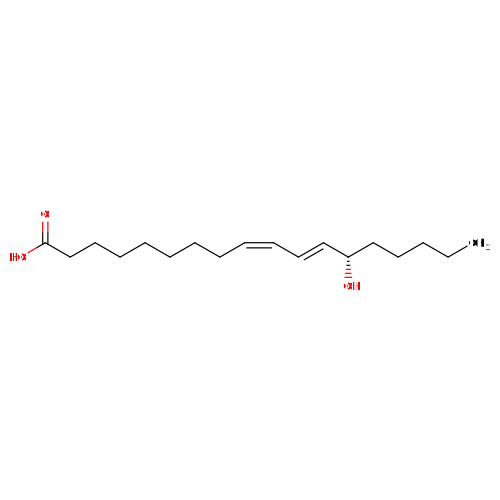
| Description | 13-HODE, also known as 13(S) hode or (S)-coriolic acid, belongs to the class of organic compounds known as lineolic acids and derivatives. These are derivatives of lineolic acid. Lineolic acid is a polyunsaturated omega-6 18 carbon long fatty acid, with two CC double bonds at the 9- and 12-positions. Thus, 13-HODE is considered to be an octadecanoid lipid molecule. 13-HODE is a very hydrophobic molecule, practically insoluble (in water), and relatively neutral. 13-HODE exists in all living organisms, ranging from bacteria to humans. 13-Hydroxy-9Z,11E-octadecadienoic acid is found in Chlorella pyrenoidosa, Deprea subtriflora, Hernandia ovigera, Lithothamnion corallioides, Mus musculus, Pleurotus pulmonarius and Semibalanus balanoides. 13-Hydroxy-9Z,11E-octadecadienoic acid was first documented in 1997 (PMID: 9561154). An HODE (hydroxyoctadecadienoic acid) in which the double bonds are at positions 9 and 11 (E and Z geometry, respectively) and the hydroxy group is at position 13 (with S-configuration) (PMID: 9367845). |
|---|
| Structure | CCCCC[C@H](O)\C=C\C=C/CCCCCCCC(O)=O InChI=1S/C18H32O3/c1-2-3-11-14-17(19)15-12-9-7-5-4-6-8-10-13-16-18(20)21/h7,9,12,15,17,19H,2-6,8,10-11,13-14,16H2,1H3,(H,20,21)/b9-7-,15-12+/t17-/m0/s1 |
|---|
| Synonyms | | Value | Source |
|---|
| (13S)-Hydroxyoctadecadienoic acid | ChEBI | | (9Z, 11E)-(13S)-13-Hydroxyoctadeca-9,11-dienoic acid | ChEBI | | (9Z,11E)-(13S)-13-Hydroxyoctadeca-9,11-dienoic acid | ChEBI | | (13S)-Hydroxyoctadecadienoate | Generator | | (9Z, 11E)-(13S)-13-Hydroxyoctadeca-9,11-dienoate | Generator | | (9Z,11E)-(13S)-13-Hydroxyoctadeca-9,11-dienoate | Generator | | 13S-Hydroxyoctadecadienoate | HMDB | | 13-Hydroxy-9,11-octadecadienoic acid | HMDB | | 13-Hydroxy-9,11-octadecadienoic acid, (S)-(e,Z)-isomer | HMDB | | 13-Hydroxy-9,11-octadecadienoic acid, (Z,e)-isomer | HMDB | | 13-Hydroxyoctadecadienoic acid | HMDB | | 13-Hydroxy-9,11-octadecadienoic acid, (e,Z)-isomer | HMDB | | 13(S) HODE | HMDB | | 13-Hydroxyoctadecadienoate | HMDB | | (+)-Coriolic acid | HMDB | | (13S,9Z,11E)-13-Hydroxy-9,11-octadecadienoic acid | HMDB | | (9Z,11E)-13-Hydroxy-9,11-octadecadienoic acid | HMDB | | (9Z,11E,13S)-13-Hydroxy-9,11-octadecadienoic acid | HMDB | | (9Z,11E,13S)-13-Hydroxyoctadecadienoic acid | HMDB | | (S)-Coriolic acid | HMDB | | (±)-coriolic acid | HMDB | | 13-Hydroxy-9(Z),11(e)-octadecadienoic acid | HMDB | | 13-Hydroxy-9,11-cis,trans-octadecadienoic acid | HMDB | | 13-Hydroxy-9-cis-11-trans-octadecadienoic acid | HMDB | | 13-Hydroxy-cis-9-trans-11-octadecadienoic acid | HMDB | | 13-Hydroxylinoleic acid | HMDB | | 13-Hydroxyoctadeca-9,11-dienoic acid | HMDB | | 13S-HODE | HMDB | | 13S-Hydroxy-9Z,11E-octadecadienoic acid | HMDB | | L-13-Hydroxy-cis-9,trans-11-octadecadienoic acid | HMDB | | alpha-Artemisolic acid | HMDB | | Α-artemisolic acid | HMDB | | (9Z,11E,13S)-13-Hydroxyoctadeca-9,11-dienoate | HMDB | | (9Z,11E)-13-HODE | HMDB | | (9Z,11E)-13-Hydroxyoctadecadienoic acid | HMDB | | FA(18:2(9Z,11E,13-OH)) | HMDB | | FA(18:2(9Z,11E,13S-OH)) | HMDB | | 13-HODE | HMDB, MeSH |
|
|---|
| Chemical Formula | C18H32O3 |
|---|
| Average Mass | 296.4449 Da |
|---|
| Monoisotopic Mass | 296.23514 Da |
|---|
| IUPAC Name | (9Z,11E,13S)-13-hydroxyoctadeca-9,11-dienoic acid |
|---|
| Traditional Name | 13-hydroxyoctadecadienoic acid |
|---|
| CAS Registry Number | Not Available |
|---|
| SMILES | CCCCC[C@H](O)\C=C\C=C/CCCCCCCC(O)=O |
|---|
| InChI Identifier | InChI=1S/C18H32O3/c1-2-3-11-14-17(19)15-12-9-7-5-4-6-8-10-13-16-18(20)21/h7,9,12,15,17,19H,2-6,8,10-11,13-14,16H2,1H3,(H,20,21)/b9-7-,15-12+/t17-/m0/s1 |
|---|
| InChI Key | HNICUWMFWZBIFP-IRQZEAMPSA-N |
|---|
| Experimental Spectra |
|---|
|
| Not Available | | Predicted Spectra |
|---|
|
| Not Available | | Chemical Shift Submissions |
|---|
|
| Not Available | | Species |
|---|
| Species of Origin | |
|---|
| Chemical Taxonomy |
|---|
| Description | Belongs to the class of organic compounds known as lineolic acids and derivatives. These are derivatives of lineolic acid. Lineolic acid is a polyunsaturated omega-6 18 carbon long fatty acid, with two CC double bonds at the 9- and 12-positions. |
|---|
| Kingdom | Organic compounds |
|---|
| Super Class | Lipids and lipid-like molecules |
|---|
| Class | Fatty Acyls |
|---|
| Sub Class | Lineolic acids and derivatives |
|---|
| Direct Parent | Lineolic acids and derivatives |
|---|
| Alternative Parents | |
|---|
| Substituents | - Octadecanoid
- Long-chain fatty acid
- Hydroxy fatty acid
- Fatty acid
- Unsaturated fatty acid
- Secondary alcohol
- Carboxylic acid derivative
- Carboxylic acid
- Monocarboxylic acid or derivatives
- Organic oxide
- Organic oxygen compound
- Alcohol
- Hydrocarbon derivative
- Carbonyl group
- Organooxygen compound
- Aliphatic acyclic compound
|
|---|
| Molecular Framework | Aliphatic acyclic compounds |
|---|
| External Descriptors | |
|---|
| Physical Properties |
|---|
| State | Not Available |
|---|
| Experimental Properties | | Property | Value | Reference |
|---|
| Melting Point | Not Available | Not Available | | Boiling Point | Not Available | Not Available | | Water Solubility | Not Available | Not Available | | LogP | Not Available | Not Available |
|
|---|
| Predicted Properties | |
|---|