| Record Information |
|---|
| Version | 2.0 |
|---|
| Created at | 2022-04-27 20:49:38 UTC |
|---|
| Updated at | 2022-04-27 20:49:38 UTC |
|---|
| NP-MRD ID | NP0050243 |
|---|
| Secondary Accession Numbers | None |
|---|
| Natural Product Identification |
|---|
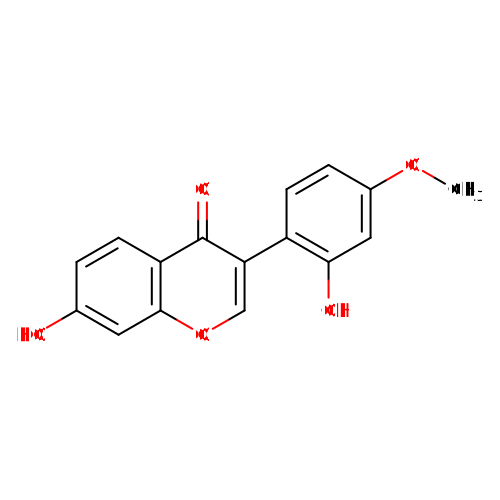
| Common Name | 2'-Hydroxyformononetin |
|---|
| Description | Xenognosin B belongs to the class of organic compounds known as 4'-o-methylisoflavones. These are isoflavones with methoxy groups attached to the C4' atom of the isoflavone backbone. Thus, xenognosin b is considered to be a flavonoid lipid molecule. Xenognosin B is a very hydrophobic molecule, practically insoluble (in water), and relatively neutral. Xenognosin B exists in all living organisms, ranging from bacteria to humans. Outside of the human body, Xenognosin B has been detected, but not quantified in, several different foods, such as chinese chives, chanterelles, rapes, chicory leaves, and sweet marjorams. 2'-Hydroxyformononetin is found in Agalinis purpurea, Dalbergia odorifera , Dalbergia sissoo, Euchresta formosana, Glycyrrhiza pallidiflora, Millettia brandisiana, Pycnanthus angolensis , Trifolium repens , Virola cadudifolia and Virola multinervia. 2'-Hydroxyformononetin was first documented in 1990 (PMID: 2306102). This could make xenognosin b a potential biomarker for the consumption of these foods (PMID: 9790908) (PMID: 1912490) (PMID: 1915347) (PMID: 9525107). |
|---|
| Structure | COC1=CC(O)=C(C=C1)C1=COC2=C(C=CC(O)=C2)C1=O InChI=1S/C16H12O5/c1-20-10-3-5-11(14(18)7-10)13-8-21-15-6-9(17)2-4-12(15)16(13)19/h2-8,17-18H,1H3 |
|---|
| Synonyms | | Value | Source |
|---|
| 2'-Hydroformononetin | ChEBI | | 2',7-Dihydroxy-4'-methoxyisoflavone | HMDB | | 2-HYDROXYFORMONONETIN | HMDB | | 7,2'-Dihydroxy-4'-methoxyisoflavone | HMDB | | 7-Hydroxy-3-(2-hydroxy-4-methoxyphenyl)-4H-chromen-4-one | HMDB | | Xenognosin b | ChEBI |
|
|---|
| Chemical Formula | C16H12O5 |
|---|
| Average Mass | 284.2635 Da |
|---|
| Monoisotopic Mass | 284.06847 Da |
|---|
| IUPAC Name | 7-hydroxy-3-(2-hydroxy-4-methoxyphenyl)-4H-chromen-4-one |
|---|
| Traditional Name | 2'-hydroxyformononetin |
|---|
| CAS Registry Number | Not Available |
|---|
| SMILES | COC1=CC(O)=C(C=C1)C1=COC2=C(C=CC(O)=C2)C1=O |
|---|
| InChI Identifier | InChI=1S/C16H12O5/c1-20-10-3-5-11(14(18)7-10)13-8-21-15-6-9(17)2-4-12(15)16(13)19/h2-8,17-18H,1H3 |
|---|
| InChI Key | XKHHKXCBFHUOHM-UHFFFAOYSA-N |
|---|
| Experimental Spectra |
|---|
|
| Not Available | | Predicted Spectra |
|---|
|
| Not Available | | Chemical Shift Submissions |
|---|
|
| Not Available | | Species |
|---|
| Species of Origin | |
|---|
| Chemical Taxonomy |
|---|
| Description | Belongs to the class of organic compounds known as 4'-o-methylisoflavones. These are isoflavones with methoxy groups attached to the C4' atom of the isoflavone backbone. |
|---|
| Kingdom | Organic compounds |
|---|
| Super Class | Phenylpropanoids and polyketides |
|---|
| Class | Isoflavonoids |
|---|
| Sub Class | O-methylated isoflavonoids |
|---|
| Direct Parent | 4'-O-methylisoflavones |
|---|
| Alternative Parents | |
|---|
| Substituents | - 4p-o-methylisoflavone
- Isoflavone
- Hydroxyisoflavonoid
- Chromone
- Methoxyphenol
- 1-benzopyran
- Benzopyran
- Phenoxy compound
- Anisole
- Phenol ether
- Methoxybenzene
- 1-hydroxy-4-unsubstituted benzenoid
- 1-hydroxy-2-unsubstituted benzenoid
- Alkyl aryl ether
- Phenol
- Pyranone
- Pyran
- Monocyclic benzene moiety
- Benzenoid
- Heteroaromatic compound
- Oxacycle
- Organoheterocyclic compound
- Ether
- Organic oxygen compound
- Organic oxide
- Organooxygen compound
- Hydrocarbon derivative
- Aromatic heteropolycyclic compound
|
|---|
| Molecular Framework | Aromatic heteropolycyclic compounds |
|---|
| External Descriptors | |
|---|
| Physical Properties |
|---|
| State | Not Available |
|---|
| Experimental Properties | | Property | Value | Reference |
|---|
| Melting Point | Not Available | Not Available | | Boiling Point | Not Available | Not Available | | Water Solubility | Not Available | Not Available | | LogP | Not Available | Not Available |
|
|---|
| Predicted Properties | |
|---|
| General References | - Fischer D, Ebenau-Jehle C, Grisebach H: Phytoalexin synthesis in soybean: purification and characterization of NADPH:2'-hydroxydaidzein oxidoreductase from elicitor-challenged soybean cell cultures. Arch Biochem Biophys. 1990 Feb 1;276(2):390-5. doi: 10.1016/0003-9861(90)90737-j. [PubMed:2306102 ]
- Akashi T, Aoki T, Ayabe S: CYP81E1, a cytochrome P450 cDNA of licorice (Glycyrrhiza echinata L.), encodes isoflavone 2'-hydroxylase. Biochem Biophys Res Commun. 1998 Oct 9;251(1):67-70. doi: 10.1006/bbrc.1998.9414. [PubMed:9790908 ]
- Paiva NL, Edwards R, Sun YJ, Hrazdina G, Dixon RA: Stress responses in alfalfa (Medicago sativa L.) 11. Molecular cloning and expression of alfalfa isoflavone reductase, a key enzyme of isoflavonoid phytoalexin biosynthesis. Plant Mol Biol. 1991 Oct;17(4):653-67. doi: 10.1007/BF00037051. [PubMed:1912490 ]
- Tiemann K, Inze D, Van Montagu M, Barz W: Pterocarpan phytoalexin biosynthesis in elicitor-challenged chickpea (Cicer arietinum L.) cell cultures. Purification, characterization and cDNA cloning of NADPH:isoflavone oxidoreductase. Eur J Biochem. 1991 Sep 15;200(3):751-7. doi: 10.1111/j.1432-1033.1991.tb16241.x. [PubMed:1915347 ]
- Chan SC, Chang YS, Wang JP, Chen SC, Kuo SC: Three new flavonoids and antiallergic, anti-inflammatory constituents from the heartwood of Dalbergia odorifera. Planta Med. 1998 Mar;64(2):153-8. doi: 10.1055/s-2006-957394. [PubMed:9525107 ]
|
|---|