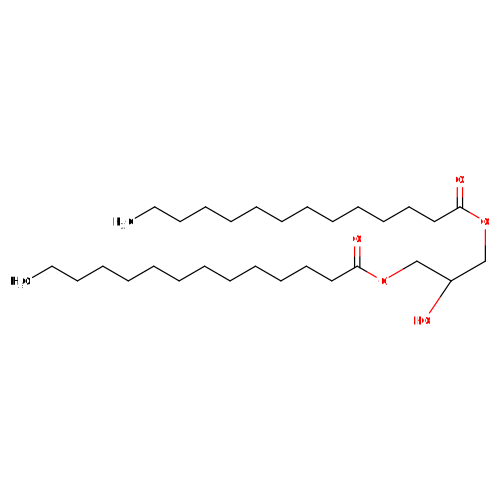
| Record Information |
|---|
| Version | 2.0 |
|---|
| Created at | 2022-03-17 21:24:25 UTC |
|---|
| Updated at | 2022-03-17 21:24:25 UTC |
|---|
| NP-MRD ID | NP0050170 |
|---|
| Secondary Accession Numbers | None |
|---|
| Natural Product Identification |
|---|
| Common Name | Zizyberenalic acid |
|---|
| Description | DG(14:0/0:0/14:0), Also known as diacylglycerol(28:0) Or diglyceride, belongs to the class of organic compounds known as 1,3-diacylglycerols. These are diacylglycerols containing a glycerol acylated at positions 1 and 3. Phosphatidic acid is then de-phosphorylated to form diacylglycerol. Since diacylglycerols are synthesized via phosphatidic acid, they will usually contain a saturated fatty acid at the C-1 position on the glycerol moiety and an unsaturated fatty acid at the C-3 position. DG(14:0/0:0/14:0) Is an extremely weak basic (essentially neutral) compound (based on its pKa). DG(14:0/0:0/14:0) Exists in all living organisms, ranging from bacteria to humans. Synthesis of DG(14:0/0:0/14:0) Begins with glycerol-3-phosphate, which is derived primarily from dihydroxyacetone phosphate, a product of glycolysis (usually in the cytoplasm of liver or adipose tissue cells). DG(14:0/0:0/14:0), In particular, consists of two chains of myristic acid at the C-1 and C-3 positions. Mono- and diacylglycerols are common food additives used to blend together certain ingredients, such as oil and water, which would not otherwise blend well. DG(14:0/0:0/14:0) Is a diglyceride, or a DG(14:0/0:0/14:0) (DAG). Glycerol-3-phosphate is first acylated with acyl-coenzyme A (acyl-CoA) to form lysophosphatidic acid, which is then acylated with another molecule of acyl-CoA to yield phosphatidic acid. It is a glyceride consisting of two fatty acid chains covalently bonded to a glycerol molecule through ester linkages. The myristic acid moieties are derived from nutmeg and butter. Diacylglycerols are precursors to triacylglycerols (triglyceride), which are formed by the addition of a third fatty acid to the DG(14:0/0:0/14:0) Under the catalysis of DG(14:0/0:0/14:0) Acyltransferase. Zizyberenalic acid was first documented in 1997 (PMID: 9034165). Diacylglycerols can have many different combinations of fatty acids attached at the C-1 C-2, or C-3 positions. |
|---|
| Structure | [H]C(O)(COC(=O)CCCCCCCCCCCCC)COC(=O)CCCCCCCCCCCCC InChI=1S/C31H60O5/c1-3-5-7-9-11-13-15-17-19-21-23-25-30(33)35-27-29(32)28-36-31(34)26-24-22-20-18-16-14-12-10-8-6-4-2/h29,32H,3-28H2,1-2H3 |
|---|
| Synonyms | | Value | Source |
|---|
| Diacylglycerol(28:0) | HMDB | | DAG(14:0/0:0/14:0) | HMDB | | 1-Myristoyl-3-myristoyl-sn-glycerol | HMDB | | Diglyceride | HMDB | | Diacylglycerol(14:0/0:0/14:0) | HMDB | | DAG(28:0) | HMDB | | Diacylglycerol | HMDB | | DG(28:0) | HMDB | | 1-Tetradecanoyl-3-tetradecanoyl-sn-glycerol | HMDB | | DG(14:0/0:0/14:0) | Lipid Annotator | | 2-Hydroxy-3-(tetradecanoyloxy)propyl tetradecanoic acid | Generator |
|
|---|
| Chemical Formula | C31H60O5 |
|---|
| Average Mass | 512.8051 Da |
|---|
| Monoisotopic Mass | 512.44408 Da |
|---|
| IUPAC Name | 2-hydroxy-3-(tetradecanoyloxy)propyl tetradecanoate |
|---|
| Traditional Name | 2-hydroxy-3-(tetradecanoyloxy)propyl tetradecanoate |
|---|
| CAS Registry Number | Not Available |
|---|
| SMILES | [H]C(O)(COC(=O)CCCCCCCCCCCCC)COC(=O)CCCCCCCCCCCCC |
|---|
| InChI Identifier | InChI=1S/C31H60O5/c1-3-5-7-9-11-13-15-17-19-21-23-25-30(33)35-27-29(32)28-36-31(34)26-24-22-20-18-16-14-12-10-8-6-4-2/h29,32H,3-28H2,1-2H3 |
|---|
| InChI Key | JADYBWICRJWGBW-UHFFFAOYSA-N |
|---|
| Experimental Spectra |
|---|
|
| Not Available | | Predicted Spectra |
|---|
|
| Not Available | | Chemical Shift Submissions |
|---|
|
| Not Available | | Species |
|---|
| Species of Origin | |
|---|
| Chemical Taxonomy |
|---|
| Description | Belongs to the class of organic compounds known as 1,3-diacylglycerols. These are diacylglycerols containing a glycerol acylated at positions 1 and 3. |
|---|
| Kingdom | Organic compounds |
|---|
| Super Class | Lipids and lipid-like molecules |
|---|
| Class | Glycerolipids |
|---|
| Sub Class | Diradylglycerols |
|---|
| Direct Parent | 1,3-diacylglycerols |
|---|
| Alternative Parents | |
|---|
| Substituents | - 1,3-acyl-sn-glycerol
- Fatty acid ester
- Fatty acyl
- Dicarboxylic acid or derivatives
- Secondary alcohol
- Carboxylic acid ester
- Carboxylic acid derivative
- Organic oxygen compound
- Organic oxide
- Hydrocarbon derivative
- Organooxygen compound
- Carbonyl group
- Alcohol
- Aliphatic acyclic compound
|
|---|
| Molecular Framework | Aliphatic acyclic compounds |
|---|
| External Descriptors | Not Available |
|---|
| Physical Properties |
|---|
| State | Not Available |
|---|
| Experimental Properties | | Property | Value | Reference |
|---|
| Melting Point | Not Available | Not Available | | Boiling Point | Not Available | Not Available | | Water Solubility | Not Available | Not Available | | LogP | Not Available | Not Available |
|
|---|
| Predicted Properties | |
|---|