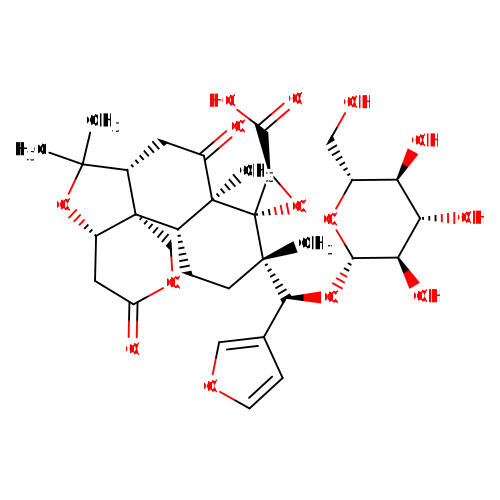
| Record Information |
|---|
| Version | 2.0 |
|---|
| Created at | 2022-03-17 21:23:44 UTC |
|---|
| Updated at | 2022-03-17 21:23:44 UTC |
|---|
| NP-MRD ID | NP0050129 |
|---|
| Secondary Accession Numbers | None |
|---|
| Natural Product Identification |
|---|
| Common Name | Linalool (8-hydroxydihydro-) |
|---|
| Description | Limonin 17-beta-D-glucoside, also known as beta-D-glucosyl-limonin, belongs to the class of organic compounds known as limonoids. These are highly oxygenated, modified terpenoids with a prototypical structure either containing or derived from a precursor with a 4,4,8-trimethyl-17-furanylsteroid skeleton. All naturally occurring citrus limonoids contain a furan ring attached to the D-ring, at C-17, as well as oxygen containing functional groups at C-3, C-4, C-7, C-16 and C-17. Linalool (8-hydroxydihydro-) is found in Citrus aurantium, Citrus iyo, Citrus junos, Citrus macrophylla, Citrus reticulata and Citrus sinensis. Limonin 17-beta-D-glucoside is an extremely weak basic (essentially neutral) compound (based on its pKa). |
|---|
| Structure | CC1(C)O[C@H]2CC(=O)OC[C@@]22[C@H]1CC(=O)[C@]1(C)[C@@H]2CC[C@@](C)([C@@H](O[C@@H]2O[C@H](CO)[C@@H](O)[C@H](O)[C@H]2O)C2=COC=C2)[C@@]11O[C@@H]1C(O)=O InChI=1S/C32H42O14/c1-28(2)17-9-18(34)30(4)16(31(17)13-42-20(35)10-19(31)45-28)5-7-29(3,32(30)25(46-32)26(39)40)24(14-6-8-41-12-14)44-27-23(38)22(37)21(36)15(11-33)43-27/h6,8,12,15-17,19,21-25,27,33,36-38H,5,7,9-11,13H2,1-4H3,(H,39,40)/t15-,16+,17+,19+,21-,22+,23-,24+,25-,27+,29+,30+,31-,32-/m1/s1 |
|---|
| Synonyms | | Value | Source |
|---|
| beta-D-Glucosyl-limonin | ChEBI | | Glucosyl-limonin | ChEBI | | Limonin 17-beta-D-glucopyranoside | ChEBI | | b-D-Glucosyl-limonin | Generator | | Β-D-glucosyl-limonin | Generator | | Limonin 17-b-D-glucopyranoside | Generator | | Limonin 17-β-D-glucopyranoside | Generator | | Limonin 17-b-D-glucoside | Generator | | Limonin 17-β-D-glucoside | Generator | | Limonin 17-beta-D-glucoside | KEGG |
|
|---|
| Chemical Formula | C32H42O14 |
|---|
| Average Mass | 650.6740 Da |
|---|
| Monoisotopic Mass | 650.25746 Da |
|---|
| IUPAC Name | (1'R,2R,2'R,3S,5'S,7'R,10'R,13'S)-5'-[(R)-(furan-3-yl)({[(2R,3R,4S,5S,6R)-3,4,5-trihydroxy-6-(hydroxymethyl)oxan-2-yl]oxy})methyl]-5',7',11',11'-tetramethyl-8',15'-dioxo-12',16'-dioxaspiro[oxirane-2,6'-tetracyclo[8.7.0.0^{1,13}.0^{2,7}]heptadecane]-3-carboxylic acid |
|---|
| Traditional Name | (1'R,2R,2'R,3S,5'S,7'R,10'R,13'S)-5'-[(R)-furan-3-yl({[(2R,3R,4S,5S,6R)-3,4,5-trihydroxy-6-(hydroxymethyl)oxan-2-yl]oxy})methyl]-5',7',11',11'-tetramethyl-8',15'-dioxo-12',16'-dioxaspiro[oxirane-2,6'-tetracyclo[8.7.0.0^{1,13}.0^{2,7}]heptadecane]-3-carboxylic acid |
|---|
| CAS Registry Number | Not Available |
|---|
| SMILES | CC1(C)O[C@H]2CC(=O)OC[C@@]22[C@H]1CC(=O)[C@]1(C)[C@@H]2CC[C@@](C)([C@@H](O[C@@H]2O[C@H](CO)[C@@H](O)[C@H](O)[C@H]2O)C2=COC=C2)[C@@]11O[C@@H]1C(O)=O |
|---|
| InChI Identifier | InChI=1S/C32H42O14/c1-28(2)17-9-18(34)30(4)16(31(17)13-42-20(35)10-19(31)45-28)5-7-29(3,32(30)25(46-32)26(39)40)24(14-6-8-41-12-14)44-27-23(38)22(37)21(36)15(11-33)43-27/h6,8,12,15-17,19,21-25,27,33,36-38H,5,7,9-11,13H2,1-4H3,(H,39,40)/t15-,16+,17+,19+,21-,22+,23-,24+,25-,27+,29+,30+,31-,32-/m1/s1 |
|---|
| InChI Key | FYIKIBQJAJRKQM-WNCNYDOCSA-N |
|---|
| Experimental Spectra |
|---|
|
| Not Available | | Predicted Spectra |
|---|
|
| Not Available | | Chemical Shift Submissions |
|---|
|
| Not Available | | Species |
|---|
| Species of Origin | |
|---|
| Chemical Taxonomy |
|---|
| Description | Belongs to the class of organic compounds known as limonoids. These are highly oxygenated, modified terpenoids with a prototypical structure either containing or derived from a precursor with a 4,4,8-trimethyl-17-furanylsteroid skeleton. All naturally occurring citrus limonoids contain a furan ring attached to the D-ring, at C-17, as well as oxygen containing functional groups at C-3, C-4, C-7, C-16 and C-17. |
|---|
| Kingdom | Organic compounds |
|---|
| Super Class | Lipids and lipid-like molecules |
|---|
| Class | Prenol lipids |
|---|
| Sub Class | Triterpenoids |
|---|
| Direct Parent | Limonoids |
|---|
| Alternative Parents | |
|---|
| Substituents | - Limonoid skeleton
- Hexose monosaccharide
- O-glycosyl compound
- Glycosyl compound
- Delta valerolactone
- Delta_valerolactone
- Dicarboxylic acid or derivatives
- Oxirane carboxylic acid or derivatives
- Oxirane carboxylic acid
- Oxane
- Monosaccharide
- Tetrahydrofuran
- Heteroaromatic compound
- Furan
- Secondary alcohol
- Ketone
- Carboxylic acid ester
- Lactone
- Acetal
- Carboxylic acid derivative
- Carboxylic acid
- Dialkyl ether
- Oxirane
- Ether
- Oxacycle
- Organoheterocyclic compound
- Polyol
- Hydrocarbon derivative
- Alcohol
- Organic oxygen compound
- Organic oxide
- Primary alcohol
- Carbonyl group
- Organooxygen compound
- Aromatic heteropolycyclic compound
|
|---|
| Molecular Framework | Aromatic heteropolycyclic compounds |
|---|
| External Descriptors | |
|---|
| Physical Properties |
|---|
| State | Not Available |
|---|
| Experimental Properties | | Property | Value | Reference |
|---|
| Melting Point | Not Available | Not Available | | Boiling Point | Not Available | Not Available | | Water Solubility | Not Available | Not Available | | LogP | Not Available | Not Available |
|
|---|
| Predicted Properties | |
|---|