| Record Information |
|---|
| Version | 2.0 |
|---|
| Created at | 2022-03-17 21:23:23 UTC |
|---|
| Updated at | 2022-03-17 21:23:23 UTC |
|---|
| NP-MRD ID | NP0050107 |
|---|
| Secondary Accession Numbers | None |
|---|
| Natural Product Identification |
|---|
| Common Name | Eriocitrin |
|---|
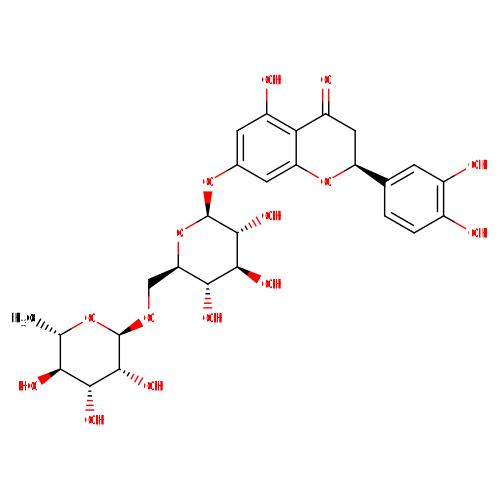
| Description | Eriocitrin, also known as eriodictioside, belongs to the class of organic compounds known as flavonoid-7-o-glycosides. These are phenolic compounds containing a flavonoid moiety which is O-glycosidically linked to carbohydrate moiety at the C7-position. Eriocitrin is an extremely weak basic (essentially neutral) compound (based on its pKa). Eriocitrin is found in Citrus latipes, Citrus maxima, Citrus paradisi, Citrus sinensis, Citrus spp., Citrus sudachi , Citrus unshiu, Citrus wilsonii, Cyclopia subternata, Lycopus europaeus, Mentha piperita, Mentha piperita , Myoporum tenuifolium and Satureja montana. Eriocitrin was first documented in 1998 (PMID: 9688172). A disaccharide derivative that consists of eriodictyol substituted by a 6-O-(alpha-L-rhamnopyranosyl)-beta-D-glucopyranosyl moiety at position 7 via a glycosidic linkage (PMID: 12551749) (PMID: 15315375) (PMID: 17690486). |
|---|
| Structure | C[C@@H]1O[C@@H](OC[C@H]2O[C@@H](OC3=CC(O)=C4C(=O)C[C@H](OC4=C3)C3=CC(O)=C(O)C=C3)[C@H](O)[C@@H](O)[C@@H]2O)[C@H](O)[C@H](O)[C@H]1O InChI=1S/C27H32O15/c1-9-20(32)22(34)24(36)26(39-9)38-8-18-21(33)23(35)25(37)27(42-18)40-11-5-14(30)19-15(31)7-16(41-17(19)6-11)10-2-3-12(28)13(29)4-10/h2-6,9,16,18,20-30,32-37H,7-8H2,1H3/t9-,16-,18+,20-,21+,22+,23-,24+,25+,26+,27+/m0/s1 |
|---|
| Synonyms | | Value | Source |
|---|
| Eriodictioside | ChEBI | | Eriodictyol 7-O-rutinoside | ChEBI | | Eriodictyol 7-O-beta-rutinoside | MeSH |
|
|---|
| Chemical Formula | C27H32O15 |
|---|
| Average Mass | 596.5340 Da |
|---|
| Monoisotopic Mass | 596.17412 Da |
|---|
| IUPAC Name | (2S)-2-(3,4-dihydroxyphenyl)-5-hydroxy-7-{[(2S,3R,4S,5S,6R)-3,4,5-trihydroxy-6-({[(2R,3R,4R,5R,6S)-3,4,5-trihydroxy-6-methyloxan-2-yl]oxy}methyl)oxan-2-yl]oxy}-3,4-dihydro-2H-1-benzopyran-4-one |
|---|
| Traditional Name | eriocitrin |
|---|
| CAS Registry Number | Not Available |
|---|
| SMILES | C[C@@H]1O[C@@H](OC[C@H]2O[C@@H](OC3=CC(O)=C4C(=O)C[C@H](OC4=C3)C3=CC(O)=C(O)C=C3)[C@H](O)[C@@H](O)[C@@H]2O)[C@H](O)[C@H](O)[C@H]1O |
|---|
| InChI Identifier | InChI=1S/C27H32O15/c1-9-20(32)22(34)24(36)26(39-9)38-8-18-21(33)23(35)25(37)27(42-18)40-11-5-14(30)19-15(31)7-16(41-17(19)6-11)10-2-3-12(28)13(29)4-10/h2-6,9,16,18,20-30,32-37H,7-8H2,1H3/t9-,16-,18+,20-,21+,22+,23-,24+,25+,26+,27+/m0/s1 |
|---|
| InChI Key | OMQADRGFMLGFJF-MNPJBKLOSA-N |
|---|
| Experimental Spectra |
|---|
|
| Not Available | | Predicted Spectra |
|---|
|
| Not Available | | Chemical Shift Submissions |
|---|
|
| Not Available | | Species |
|---|
| Species of Origin | |
|---|
| Chemical Taxonomy |
|---|
| Description | Belongs to the class of organic compounds known as flavonoid-7-o-glycosides. These are phenolic compounds containing a flavonoid moiety which is O-glycosidically linked to carbohydrate moiety at the C7-position. |
|---|
| Kingdom | Organic compounds |
|---|
| Super Class | Phenylpropanoids and polyketides |
|---|
| Class | Flavonoids |
|---|
| Sub Class | Flavonoid glycosides |
|---|
| Direct Parent | Flavonoid-7-O-glycosides |
|---|
| Alternative Parents | |
|---|
| Substituents | - Flavonoid-7-o-glycoside
- 3'-hydroxyflavonoid
- 4'-hydroxyflavonoid
- 5-hydroxyflavonoid
- Flavanone
- Hydroxyflavonoid
- Flavan
- Phenolic glycoside
- Chromone
- Disaccharide
- Glycosyl compound
- O-glycosyl compound
- Chromane
- Benzopyran
- 1-benzopyran
- Catechol
- Aryl alkyl ketone
- Aryl ketone
- 1-hydroxy-4-unsubstituted benzenoid
- Alkyl aryl ether
- 1-hydroxy-2-unsubstituted benzenoid
- Phenol
- Benzenoid
- Monocyclic benzene moiety
- Oxane
- Vinylogous acid
- Ketone
- Secondary alcohol
- Organoheterocyclic compound
- Oxacycle
- Ether
- Acetal
- Polyol
- Organooxygen compound
- Alcohol
- Organic oxide
- Hydrocarbon derivative
- Organic oxygen compound
- Aromatic heteropolycyclic compound
|
|---|
| Molecular Framework | Aromatic heteropolycyclic compounds |
|---|
| External Descriptors | |
|---|
| Physical Properties |
|---|
| State | Not Available |
|---|
| Experimental Properties | | Property | Value | Reference |
|---|
| Melting Point | Not Available | Not Available | | Boiling Point | Not Available | Not Available | | Water Solubility | Not Available | Not Available | | LogP | Not Available | Not Available |
|
|---|
| Predicted Properties | |
|---|
| General References | - Minato K, Miyake Y, Fukumoto S, Yamamoto K, Kato Y, Shimomura Y, Osawa T: Lemon flavonoid, eriocitrin, suppresses exercise-induced oxidative damage in rat liver. Life Sci. 2003 Feb 21;72(14):1609-16. doi: 10.1016/s0024-3205(02)02443-8. [PubMed:12551749 ]
- Kamara BI, Brand DJ, Brandt EV, Joubert E: Phenolic metabolites from honeybush tea (Cyclopia subternata). J Agric Food Chem. 2004 Aug 25;52(17):5391-5. doi: 10.1021/jf040097z. [PubMed:15315375 ]
- Miyake Y, Mochizuki M, Okada M, Hiramitsu M, Morimitsu Y, Osawa T: Isolation of antioxidative phenolic glucosides from lemon juice and their suppressive effect on the expression of blood adhesion molecules. Biosci Biotechnol Biochem. 2007 Aug;71(8):1911-9. doi: 10.1271/bbb.70115. Epub 2007 Aug 7. [PubMed:17690486 ]
- Miyake Y, Yamamoto K, Tsujihara N, Osawa T: Protective effects of lemon flavonoids on oxidative stress in diabetic rats. Lipids. 1998 Jul;33(7):689-95. doi: 10.1007/s11745-998-0258-y. [PubMed:9688172 ]
|
|---|