| Record Information |
|---|
| Version | 2.0 |
|---|
| Created at | 2022-03-17 21:14:42 UTC |
|---|
| Updated at | 2022-03-17 21:14:42 UTC |
|---|
| NP-MRD ID | NP0049576 |
|---|
| Secondary Accession Numbers | None |
|---|
| Natural Product Identification |
|---|
| Common Name | Decyl acetate |
|---|
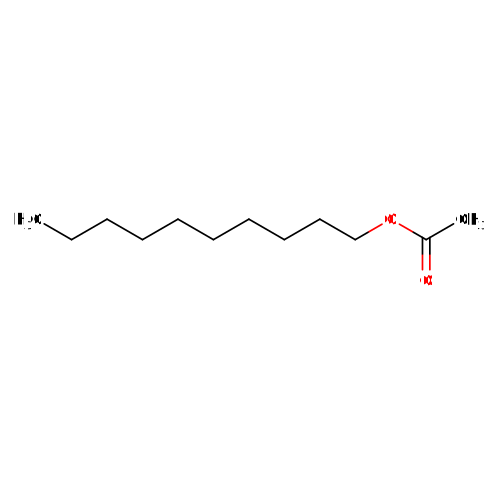
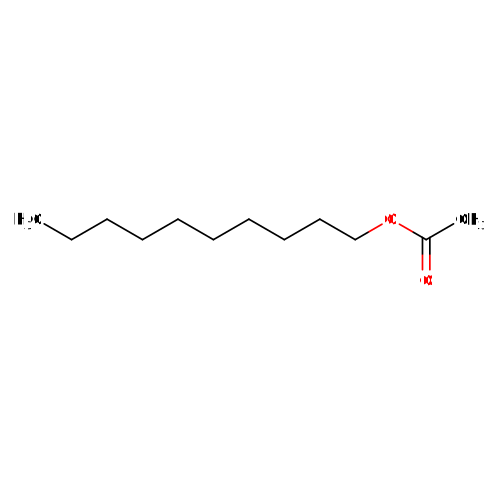
| Description | Decyl acetate, also known as 1-decanol acetate or decyl ethanoate, belongs to the class of organic compounds known as fatty alcohol esters. These are ester derivatives of a fatty alcohol. Decyl acetate is a very hydrophobic molecule, practically insoluble (in water), and relatively neutral. Decyl acetate is a citrus, clean, and fresh tasting compound. Outside of the human body, Decyl acetate is found, on average, in the highest concentration within a few different foods, such as limes, lemons, and mandarin orange (clementine, tangerine). Decyl acetate has also been detected, but not quantified in, several different foods, such as green vegetables, asian pears, celery stalks, fruits, and wild celeries. Decyl acetate is found in Abelmoschus moschatus, Boswellia sacra, Bupleurum fruticosum, Citrus iyo, Citrus maxima, Citrus medica, Etlingera elatior, Heracleum persicum, Mandragora autumnalis , Mandragora officinarum, Ophrys splendida, Osmorhiza aristata, Persea americana, Tagetes minuta and Trifolium pratense. This could make decyl acetate a potential biomarker for the consumption of these foods. |
|---|
| Structure | InChI=1S/C12H24O2/c1-3-4-5-6-7-8-9-10-11-14-12(2)13/h3-11H2,1-2H3 |
|---|
| Synonyms | | Value | Source |
|---|
| Decyl acetic acid | Generator | | 1-Decanol acetate | HMDB | | 1-Decyl acetate | HMDB | | Acetate C 10 | HMDB | | Acetate C-10 | HMDB | | Acetic acid, decyl ester | HMDB | | Decanol acetate | HMDB | | Decanyl acetate | HMDB | | Decyl alcohol, acetate | HMDB | | Decyl alcohol, acetate (6ci) | HMDB | | Decyl ester OF acetic acid | HMDB | | Decyl ethanoate | HMDB | | FEMA 2367 | HMDB | | N-Decyl acetate | HMDB | | N-Decyl ethanoate | HMDB |
|
|---|
| Chemical Formula | C12H24O2 |
|---|
| Average Mass | 200.3178 Da |
|---|
| Monoisotopic Mass | 200.17763 Da |
|---|
| IUPAC Name | decyl acetate |
|---|
| Traditional Name | decyl acetate |
|---|
| CAS Registry Number | 112-17-4 |
|---|
| SMILES | CCCCCCCCCCOC(C)=O |
|---|
| InChI Identifier | InChI=1S/C12H24O2/c1-3-4-5-6-7-8-9-10-11-14-12(2)13/h3-11H2,1-2H3 |
|---|
| InChI Key | NUPSHWCALHZGOV-UHFFFAOYSA-N |
|---|
| Experimental Spectra |
|---|
|
| Not Available | | Predicted Spectra |
|---|
|
| Not Available | | Chemical Shift Submissions |
|---|
|
| Not Available | | Species |
|---|
| Species of Origin | |
|---|
| Chemical Taxonomy |
|---|
| Description | Belongs to the class of organic compounds known as fatty alcohol esters. These are ester derivatives of a fatty alcohol. |
|---|
| Kingdom | Organic compounds |
|---|
| Super Class | Lipids and lipid-like molecules |
|---|
| Class | Fatty Acyls |
|---|
| Sub Class | Fatty alcohol esters |
|---|
| Direct Parent | Fatty alcohol esters |
|---|
| Alternative Parents | |
|---|
| Substituents | - Fatty alcohol ester
- Carboxylic acid ester
- Monocarboxylic acid or derivatives
- Carboxylic acid derivative
- Organic oxygen compound
- Organic oxide
- Hydrocarbon derivative
- Organooxygen compound
- Carbonyl group
- Aliphatic acyclic compound
|
|---|
| Molecular Framework | Aliphatic acyclic compounds |
|---|
| External Descriptors | |
|---|
| Physical Properties |
|---|
| State | Not Available |
|---|
| Experimental Properties | | Property | Value | Reference |
|---|
| Melting Point | Not Available | Not Available | | Boiling Point | Not Available | Not Available | | Water Solubility | Not Available | Not Available | | LogP | Not Available | Not Available |
|
|---|
| Predicted Properties | |
|---|